


Samuel McIlhagga is Arguably’s new assistant editor. He spent just under two years reporting on the economics and politics of the West Midlands for the Birmingham Dispatch.
Before that, he spent a decade working as a freelance feature writer and reporter for titles including UnHerd, Foreign Policy, the FT, the Independent and Jacobin. In 2024, he won the Rupert Cornwell Prize for foreign journalism.
You can pitch him at samuel@arguably.uk and follow him @McilhaggaSamuel.
George Eaton, Editor-in-Chief, Arguably
Back in July, as he accepted the Labour leadership, Andy Burnham declared that he would be a leader for “the north and the south, for Scotland, for Wales and for Northern Ireland”.
It may have been unintentional, but Burnham missed out a vast swathe of the country in his political promise: the Midlands. Much has been made of the Prime Minister’s northern-centric agenda and the potential fiscal consequences for the south-east. But in contrast to London, Birmingham is conspicuously absent from Burnhamite discourse.
And people have noticed. Burnham’s consistent failure to mention the Midlands, or cite Birmingham as a city in need of renewal, is frustrating given his rhetorical concern with “forgotten or written-off” places.
Burnham has made NEETs (Not in Education, Employment or Training) and chronic unemployment central to his messaging about the “left behind.” However, he has failed to note that the second-largest city in the UK now has the second-highest rate of working-age adults on out-of-work benefits (at 25%) of any conurbation — rivalling only Blackpool.
In many ways, Birmingham is in crisis: racked by a disputed ‘bankruptcy’, afflicted by a prolonged bin strike and governed by an unstable rainbow coalition of parties after the 2026 local election. Burnham and Labour’s politics cannot descend into tidy binaries about north and south if the city is to flourish and harness its unique advantages.
These include its geographic centrality and function as a major railway node, event-space infrastructure (the NEC, Utilita Arena and ICC), the city’s unusually young population (43.8% under 30, compared to 35.7% for England) and decades of accumulated industrial process knowledge through large manufacturers such as Jaguar Land Rover (JLR) and Aston Martin.
The last time Labour indulged in north-south thinking, under Clement Attlee and then Harold Wilson, a large part of Birmingham’s growth was limited by 1940s IDCs (Industrial Development Certificates) and 1960s ODCs (Office Development Certificates). These government vetoes sought to restrict development in the Midlands and redistribute it to places such as south Wales, the north-west and Scotland.
The result was catastrophic, transforming Birmingham and the West Midlands from the region with the highest household income, between 1961 and 1963, into an area defined by high unemployment and an undiversified economy — especially compared to London and Manchester. An odd inversion, considering Birmingham featured as a model of a diversified high-wage city in the urbanist Jane Jacobs’s The Economy of Cities.
The Prime Minister’s Birmingham blind spot hasn’t always been so pronounced. Back in the late 2010s, local media celebrated the “Two Andys” — Burnham and Andy Street, the then (wet) Tory mayor of the West Midlands — as an innovative cross-party collaboration in devolution, centred on HS2 and bottom-up regional growth. This was, in some respects, a forerunner of the political model Labour is now pursuing.
Since then, the current Labour mayor of the West Midlands, Richard Parker, seemingly hasn’t managed a one-to-one meeting with Burnham at Downing Street, and there has been no indication of a No 10 Midlands to accompany the current northern outpost. In 2026, the south has Westminster; the north has its new venture; Scotland has Holyrood; Northern Ireland has Stormont; Wales has Cardiff Bay — the Midlands has nothing.
This is an oversight on the Prime Minister’s part — Birmingham should be central to Labour’s vision, not marginal. Burnham has leading West Midlands MPs in his cabinet such as Shabana Mahmood and Pat McFadden to help craft a regional strategy. Mahmood holds Ladywood with a majority of 3,421, down from 28,582 in 2019 — largely due to the Gaza Independents (a pattern replicated across Labour seats in the area). As the next election approaches, there will be pressure on Burnham to pay more attention to the city.
In the early 1960s, Birmingham and the urban West Midlands had higher average family incomes than every other region of the UK, including London. The city’s weekly wages are now £299.90 below the capital’s and £15.90 below Manchester’s. Labour’s time in office will have been a failure if Birmingham does not begin to narrow this gap. But the city doesn’t necessarily need to follow Manchester’s path to recover.
Should Manchesterism really be Birminghamism?
Ironically, the Prime Minister’s ‘Manchesterism’ looks more like a set of policy proposals designed to address the needs of Birmingham than Manchester itself.
London and the home counties are the pole which Burnham negatively structures ‘Manchesterism’ against (despite protests to the contrary) — criticising the elevation of the knowledge economy over manufacturing, property speculation over productive investment and Treasury thinking over mayoral strategy.
This is strange because Burnham, alongside figures such as council chief executive Howard Bernstein, pioneered Manchester’s rise through very different means. Namely, growth was achieved via a dramatic increase in high-skilled service companies and an FDI (foreign direct investment)-led, partly Chinese and partly Emirati, property boom. In many ways, the tenures of Bernstein and Burnham made Manchester more like London, not less like it.

But these uncomfortable facts about Manchester’s rebirth are increasingly marginal to the main thrust of Labour’s regional devolution approach. At some point, Blairite notions about the knowledge economy, SME tech firms and university-led innovation were traded for industrial strategy, state-led development and reindustrialisation by Burnham.
Even the PM’s more populist offerings — tidying up high streets, cracking down on vape shops, helping pubs with rising costs, tackling anti-social behaviour — seem better suited to Birmingham than Manchester.
Spend any amount of time in both places, and you quickly realise it’s not Manchester city centre that is drowning under litter, full of empty shopping units and fenced-off derelict buildings. Compare Manchester’s Northern Quarter and Ancoats (buzzing with shops, bars and clubs) with Birmingham’s Digbeth and the Jewellery Quarter — often dead on the weekend and attacked by fly-tippers.
But these comparisons with Manchester do not mean that Birmingham needs to ‘catch up’ with its northern sibling. Instead, the city needs to play a different game — recognising a path-dependence that goes back to the 19th century.
Birmingham’s special path
Manchester has always been vanguardist, a city of capitalism at scale: Adam Tooze recently described it as the premier “shock city of the 19th century”. In contrast, Birmingham, up until the 20th century, was more artisan — full of small manufacturers and inventors producing patents and prototypes.
From the city’s awkward 18th-century development (it’s not on a port or large river) to its mid-20th-century obsession with car travel and motorways (it’s the least active city outside North America), Birmingham has been on a Sonderweg (or special path). This includes being less radically left-wing than Manchester or Glasgow (masters and artisans worked closely together) with large manufacturers only arriving in the early 20th century in the form of motorcycle and car plants.
The historian Asa Briggs wrote in Victorian Cities (1963) that “if Engels had lived not in Manchester but Birmingham… Marx might not have been a communist but a currency reformer.” Indeed, Burnham should think of our contemporary great industrial cities as each having a comparative advantage — Leeds dominating wool, Sheffield steel, Manchester textiles, Liverpool commerce and Birmingham light engineering in the 19th century.
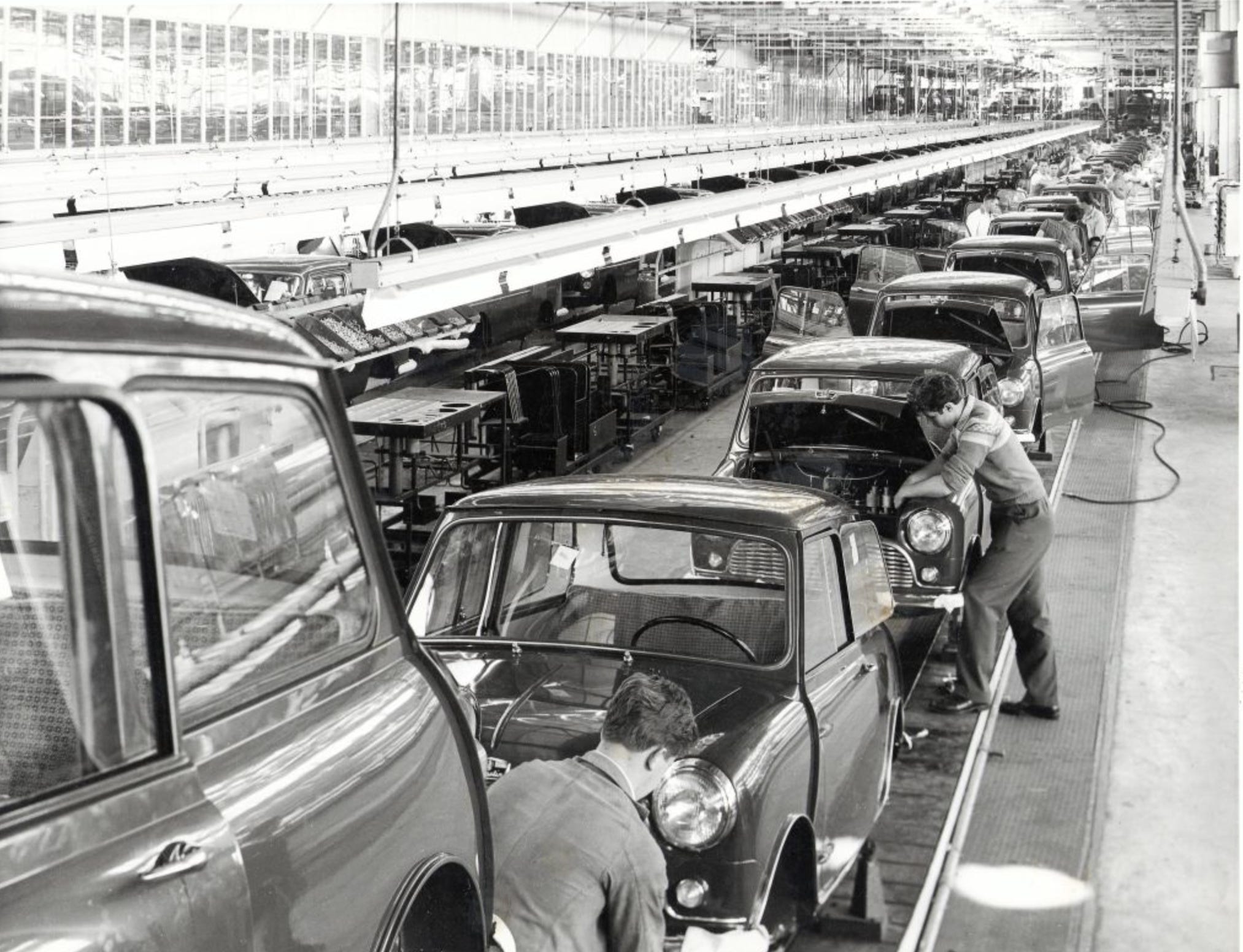
Birmingham was a town that radical Nonconformists and experimenters more interested in scientific innovation than Anglican orthodoxy went to in the 18th century, avoiding the stuffiness of the wealthy capital. Joseph Priestley, the discoverer of oxygen, pioneered a scientific renaissance and Boulton and Watt scaled up the production of steam engines into an industrial process. Birmingham’s leading political dynasty, the Chamberlains, who would go on to capture the Foreign Office, the Treasury and No 10, were Unitarians, not Anglicans.
In 2026, however, Birmingham lacks the skills to turn its outsider status back towards innovation — mostly because of the growth of huge manufacturing concerns in the early 20th century that, once deindustrialised in the 1970s and 1980s, left an economic and skills hole in Britain’s second city.
The skills gap
The Midlands’ capital has struggled to build a dense knowledge economy, and is currently characterised by economic inactivity and low-skilled service work. Consequently, the developmental and ‘productive state’, outlined by think tanks such as Common Wealth, is arguably a concept more suited to Birmingham than Manchester.
For instance, West Midlands-based firms such as JLR, Aston Martin and Collins Aerospace are disproportionately affected by global shocks and tariff wars, compared with Manchester’s knowledge-service firms, including multinationals like PwC and homegrown tech groups such as cloud-computing firm ANS.
In contrast to Birmingham’s short-term trade shock risk, Manchester may be affected in the medium term by AI eating into its intelligence premiums — the extra money that a scarcity of top-level human intelligence tends to generate for those with elite education in law, consulting, medicine, finance and academia. Instead of seeking to bring every British city to the same standard, Burnham should recognise the comparative advantages of each.
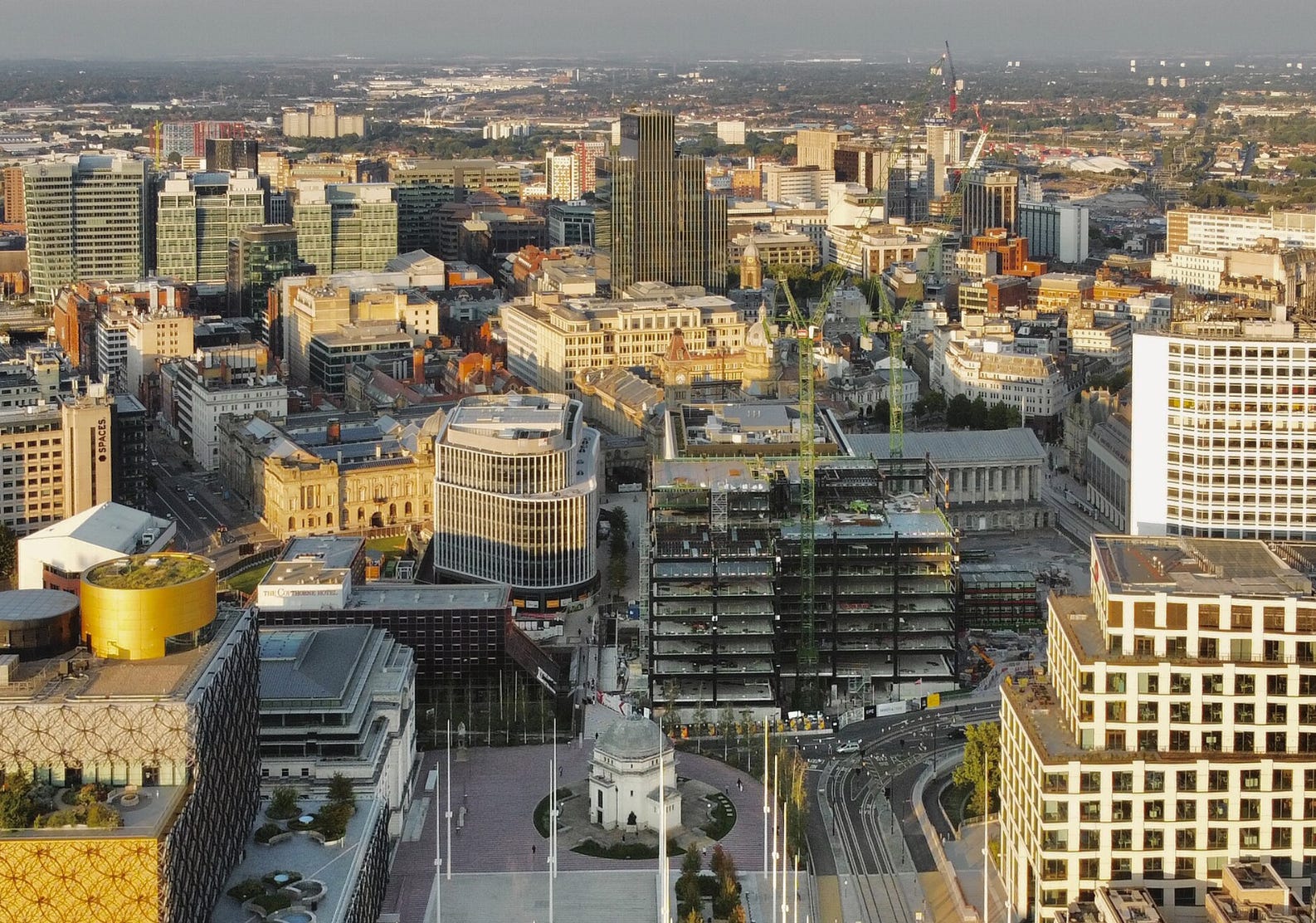
His “good growth in every postcode” has direct implications for Birmingham, a city that, unlike Manchester, attracts record FDI but struggles to distribute it beyond a narrow set of corporate offices. Despite the relocation of Goldman Sachs, PwC and HSBC offices to Centenary and Chamberlain Squares in Birmingham, the city historically has one of the lowest skills profiles in the country (defined as those with no GCSEs or vocational qualifications).
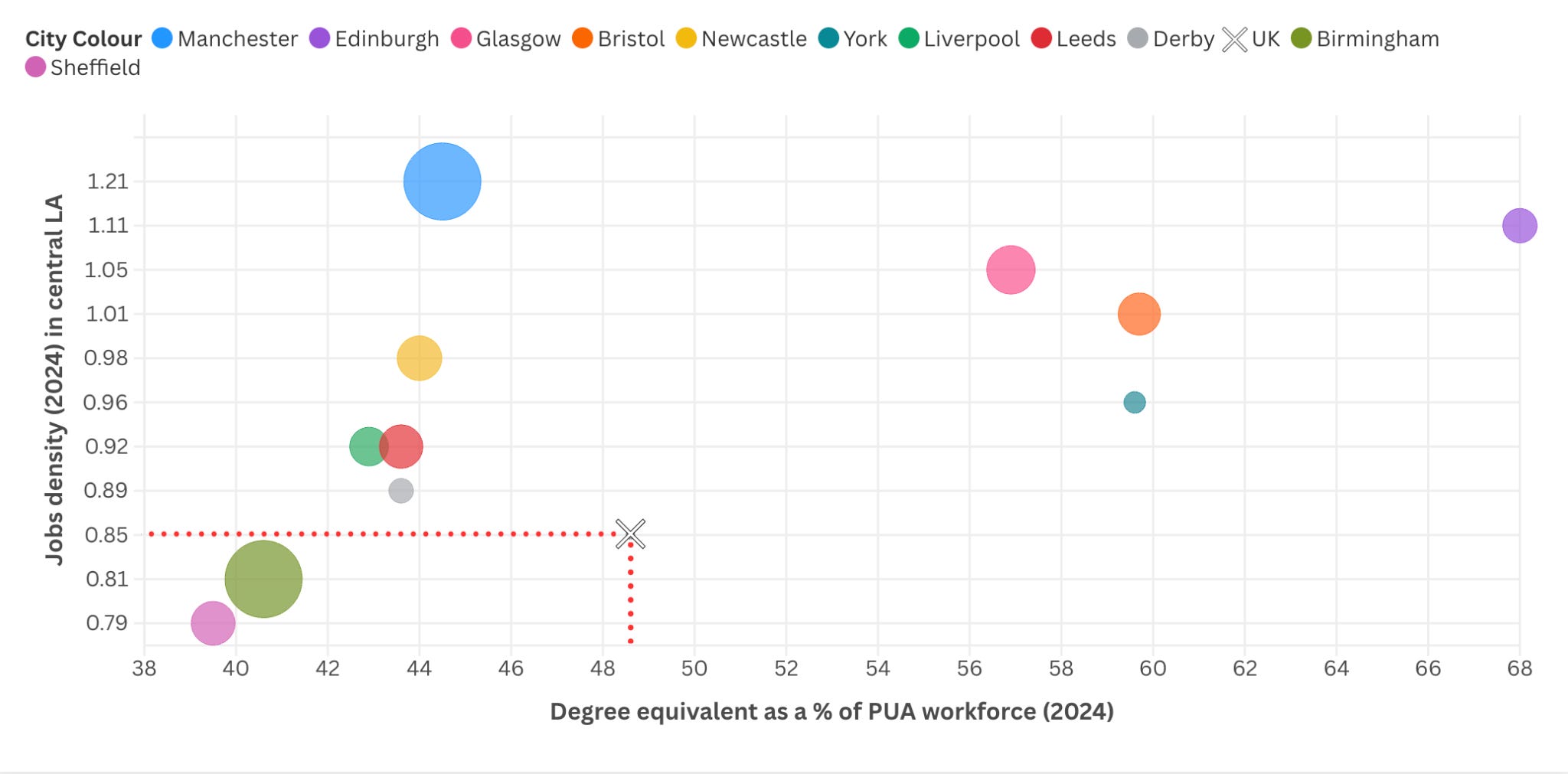
According to 2024-2025 Nomis ONS data, Birmingham’s graduate-equivalent workforce stands at 45.3% against a UK national average of 48.6% — almost every other large city sits above it (Manchester 58.5%, Glasgow 56.8%, Newcastle 50%, Liverpool 49.7%, Leeds 48.9%). Currently, there are few jobs for the population to go into — even if education rates improve. Birmingham’s job density measure is four points below the national average, while Manchester’s is 36 points above.
When you expand to PUAs (Primary Urban Areas), which take in older and less educated suburbs, Manchester, Newcastle, Leeds and Liverpool slip behind the national average graduate share. But, notably, Birmingham remains well behind its peers — in effect, the city has a very low share of graduates in both its urban core and peripheries.
Abundance with Brummie characteristics
But a comparative lack of graduates might not be a bad thing — Birmingham could act as a hedge against Manchester and London’s reliance on generating returns from scarce human intelligence in law, tech and consulting (all industries challenged by AI). Burnham’s focus on technical apprenticeships might equip Birmingham’s large non-graduate population with the tools to pioneer the green energy transition and extend high-speed rail.
In short, with the right strategy, Birmingham should be the British city occupying the top left-hand corner of the above scatter graph — dense with jobs, without relying on AI-threatened graduate knowledge-work. These roles would need to be in engineering, manufacturing and construction, rather than sectors such as customer service support, IT support and administration, to act as a proper hedge. Birmingham could look to its East Midlands neighbour Derby as a start — it has around the same graduate workforce percentage as Birmingham but much higher job density and skilled work rates, despite being a fifth of the size.
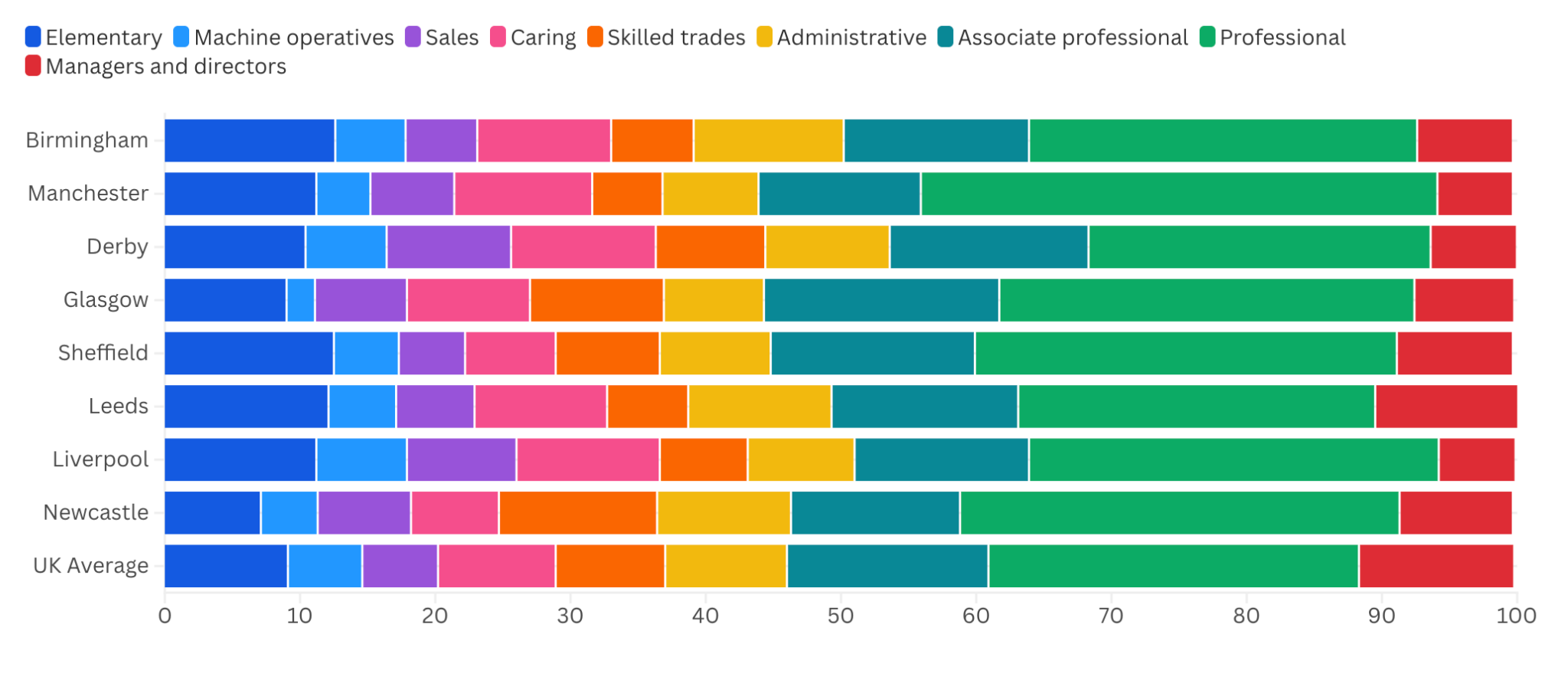
Meanwhile, Burnham’s prioritisation of NEETs should benefit what is a critically out-of-work metropolis. Where jobs do exist, Birmingham continues to be a city slanted towards low-wage elementary occupations (12.6% vs a 9.1% UK average), rather than higher-wage technical and vocational jobs. Birmingham has a low share of manufacturing and technical jobs for a below-average graduate workforce city — machine operators are 0.3% below the national average, while skilled trades are 2% below average.
To paraphrase the journalist David Goodhart, Burnham’s Manchesterism might transform Birmingham into the “hand” capital in modern Britain’s “head, hand, heart” division of labour between knowledge, manufacturing and care. If all three specialisms are brought into parity, Birmingham’s reliance on non-graduates need not be a problem. In fact, it could be an advantage.
As the Harvard political philosopher Michael Sandel argues in The Tyranny of Merit, places and people shouldn’t need to conform to the edicts of the global professional-managerial class to flourish. What Britain lacks, and what Birmingham could provide, is a large technical Mittelstand of industrial and R&D companies registered and owned in the UK, backed by an energy policy which won’t cripple innovation through inflated costs (something Germany currently struggles to mitigate).
In recent decades, before the energy crisis caused by Russia’s 2022 invasion of Ukraine, and China’s expansion into the automobile market, German cities such as Stuttgart, Wolfsburg and Ingolstadt sat in a top-left position — a spot Birmingham could occupy at a much larger scale. These German cities are dense with high-value non-graduate technical jobs created through the duale Ausbildung apprenticeship system. Birmingham should copy them — without replicating the Mittelstand’s vulnerabilities to Chinese exports.
Policies for Birmingham
Birmingham’s revival as a city of a thousand trades is almost entirely dependent on two things — Labour reducing sky-high commercial energy prices and overly restrictive planning regulations. Once these constraints have been addressed, because a focus on skills is useless without jobs, Burnham should do four things.
One, revive Vince Cable’s National College Scheme and make Birmingham and the West Midlands their home. Only two out of the seven National Colleges made it to 2026 without being cut or effectively going bankrupt. The High Speed Rail College in Aston, Birmingham, closed after only six years with fewer than 30 students.
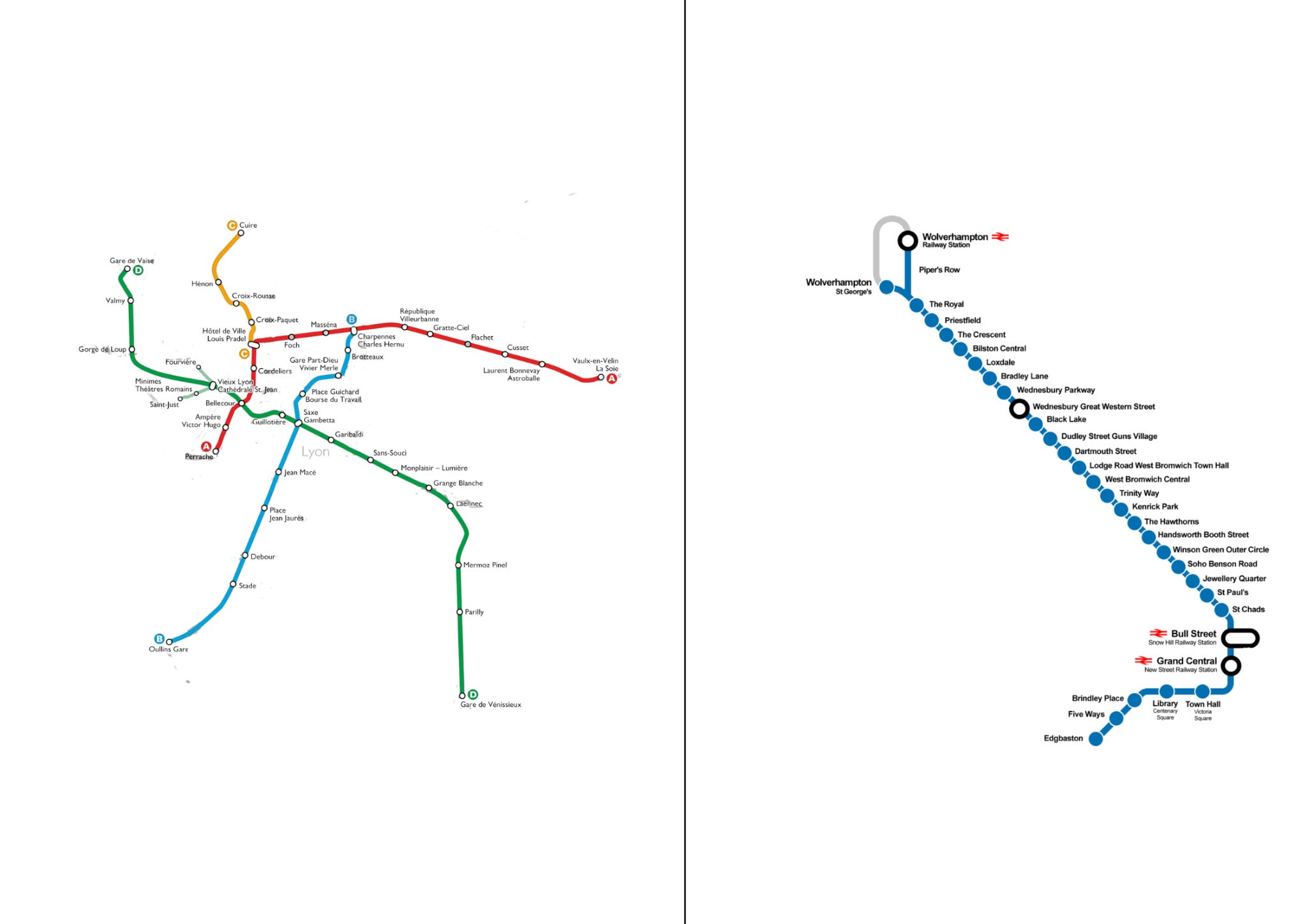
Two, massively expand the city’s tram system. Lyon, one of France’s second-tier cities, has 13 metro and tram lines (including funiculars), while Birmingham has one. As data analyst Tom Forth has pointed out, Birmingham effectively shrinks in size at rush hour because of its overreliance on buses, limiting people’s ability to commute to the city centre for higher-skilled and more productive work.
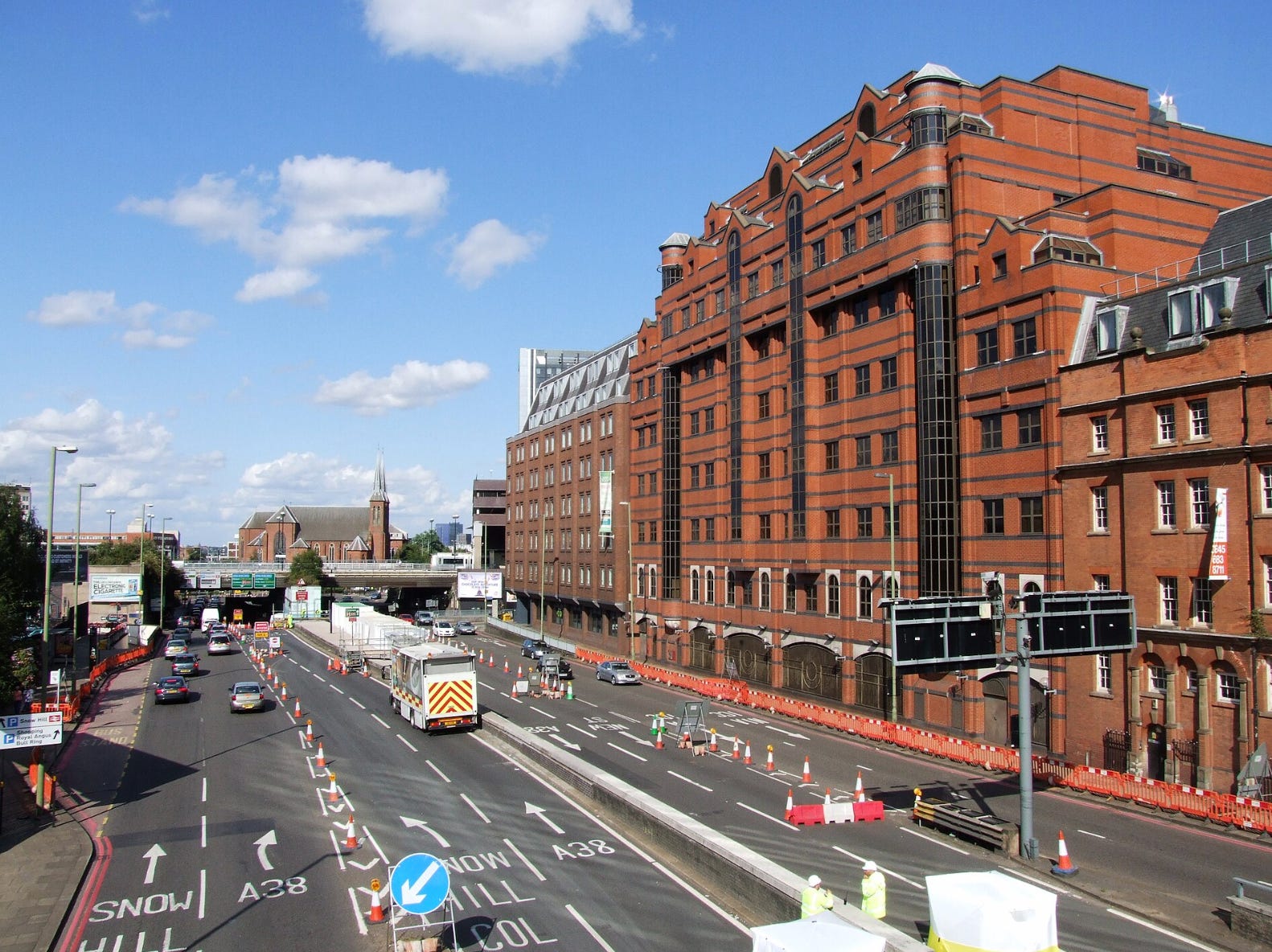
Three, abolish Birmingham’s central Queensway (A4400) and Middleway (A4540) ring roads. The ‘concrete collar’ strangles movement and development within the city. The West Midlands Combined Authority should replace them with a Viennese-style Ringstrasse — complete with a circular tram system, dense housing, a circular park and commercial space for start-ups.
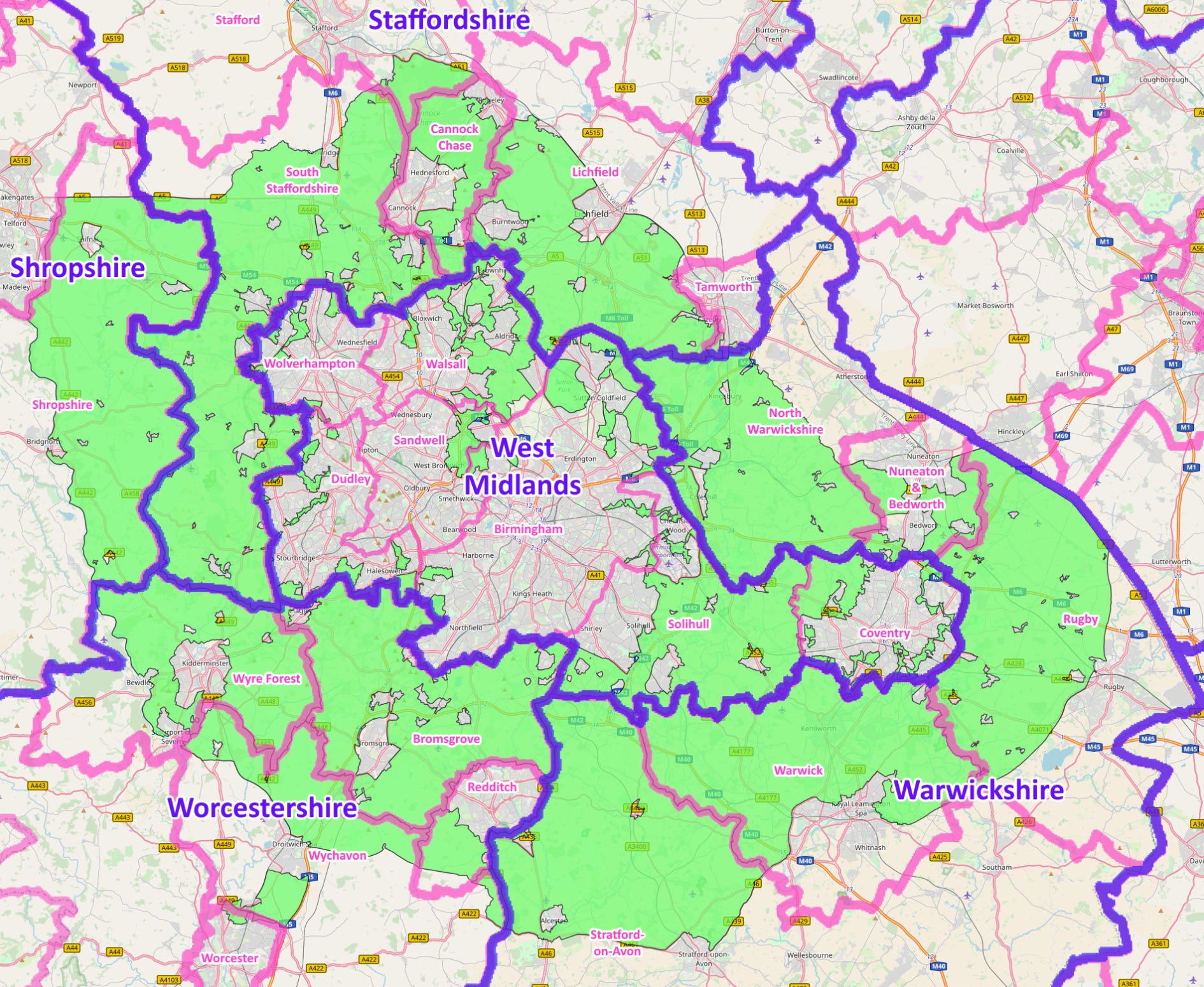
Four, urbanise the gap between Birmingham and Coventry. There is currently 9km of poor-quality green belt between them (known as the Meriden Gap) — the two places are effectively part of the same conurbation but are arbitrarily separated by planning restrictions. Closing the Meriden Gap by clustering housing development around the pre-existing Birmingham-Coventry rail line, the planned HS2 interchange station and a planned tramline, would create strong economic agglomeration effects for the region.
The lack of highly productive firms in Britain’s second city can be seen in the data. Birmingham has become one of the largest cities by population in Western Europe, surpassing Marseille, Lyon, Cologne, and Brussels — while having a GVA (gross value added) score 16 points below them on average. To be frank, this isn’t just a Birmingham problem: almost all large provincial ex-industrial English cities are outcompeted by their continental peers.
However, the city could pioneer a separate trajectory out of this very English abyss: pushing for the fruits of Labour’s newfound enthusiasm for industrial policy and national manufacturing champions. If anything, Burnham needs to look 90 miles down the M6 for what should be the main beneficiary of his politics.
A superb analysis.
Really excellent portrait of a city (England's second city, still?) that is sorely lacking leadership and vision. Even the mayoralty's 'West Midlands' name suggests an absence of the city as a central idea.