


Today on Arguably, James O’Malley, the author of the Odds and Ends of History and the co-host of YIMBY Pod, explains why delivering HS2 in full is so essential to Britain’s infrastructure needs.
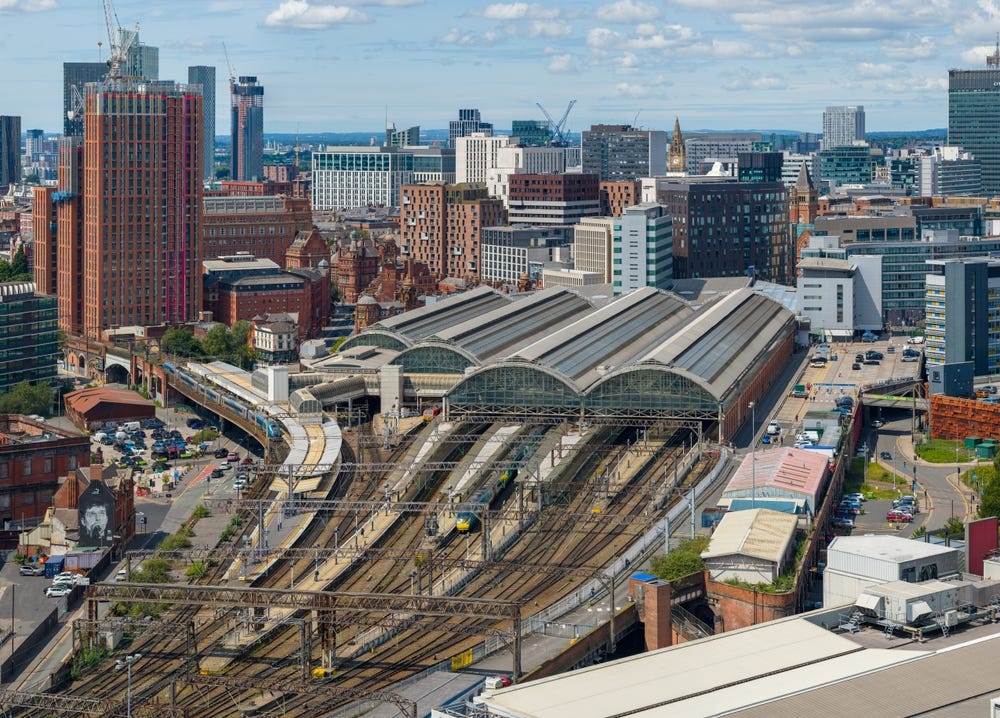
Manchester Piccadilly station (Bardhok Ndoji/Shutterstock)
A week might be a long time in politics, but a decade is nothing for Britain’s infrastructure. Decisions being made today about the fate of HS2 will reverberate potentially for the next century, outlasting the political careers and possibly even the lives of the people making them. If we make poor decisions, we could end up wrapping a noose around rail capacity in the 2040s and 2050s – but if we make the right ones, we can help ensure that Britain’s future is one of growth and prosperity.
That is why we need to make a controversial decision with just one credible answer. And it’s one that Andy Burnham has indicated he knows. We need to recommit to building HS2 – or something that looks a lot like it – to Manchester.
The case for HS2
Don’t get me wrong – HS2 has long been a deeply troubled project. Cost estimates have soared to an expected £100bn, and construction timelines have proven wildly optimistic. In 2009, when Gordon Brown’s government first proposed the new railway, the hope was that services could be up and running as early as 2026. But today, much of the route is still being carved out by diggers and cranes, and the new stations at Old Oak Common and Birmingham Curzon Street are still holes in the ground (don’t ask about Euston).
However, if you add up Britain’s most pressing rail needs, such as the need for more capacity between our largest cities, and more commuter services serving the towns around them, as well as the need to move a significant amount of freight to rail to meet our net zero goals, then what is needed looks like HS2 as originally envisaged. Despite the name, the railway was never really about speed – it was about adding capacity to the rail network. So HS2 remains an essential, strategic necessity for our country.
And this necessity is why the most catastrophic decision that Rishi Sunak made was when he announced the cancellation of the leg of the line linking Birmingham and Manchester (while, ironically, in the latter for the 2023 Conservative Party conference). What makes it truly terrible, though, isn’t just that it snuffed out the opportunity for future growth – it’s that it also breaks the rest of the planned HS2 operating model, to the point where unless something changes, the railway currently under construction will not work as intended.
Broken rails
From its conception, HS2 was always conceived as a separate railway to the rest of the network. HS2 trains would run from HS2 platforms, along HS2 tracks, independent of the existing West Coast Main Line (WCML), that currently runs from London Euston to Manchester Piccadilly. But when Sunak made the decision to cut the railway short, it meant accepting a radically different model from the one that had been planned.
He announced that HS2 trains would travel along new HS2 tracks from London to Handsacre, just north of Birmingham, at which point they would cross on to the WCML and head to Manchester on existing tracks. Which might sound workable in a meeting of political advisers in Downing Street – but once you dig into the technical details, it basically makes no sense, and breaks the entire purpose of the railway.
Take capacity, for example. The plan for HS2 all along has been to run 200m trains across the whole network, with Manchester trains coupled together to form 400m-long trains, with 1,008 seats each. But following the cancellation of the northern leg, Manchester Piccadilly station will no longer be upgraded to accommodate them, meaning only 200m trains, with 504 seats each, will fit. The new trains will be shorter than the 265m Pendolinos that are currently used on the route, which have around 607 seats each, meaning that after HS2 services begin we might have a rail network with fewer seats every hour to Manchester than we do now.
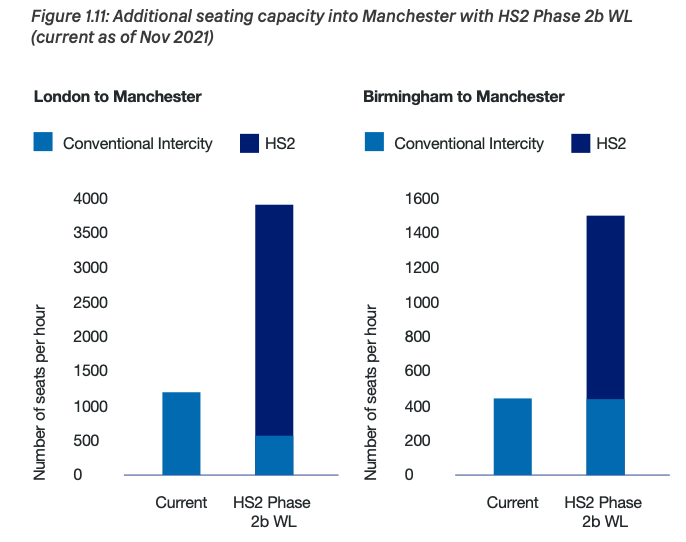
A Department for Transport illustration of the capacity boost the HS2 Manchester link would have provided
Similarly, sharing the WCML tracks north of Birmingham will eliminate much of the promised speed increase heading north because, though trains may be faster heading from London to Birmingham, once they transfer to the old tracks they will not be able to tilt around the tighter curves as the existing Pendolinos can, limiting them to 110mph on these sections, rather than 125mph at present. This means that trains from London to Glasgow may only be 12 minutes faster than they are now, and that journeys that head north of Handsacre and spend most of their time on old WCML track (e.g. Birmingham to Glasgow) could conceivably turn out slower.
That’s why, in my view, the government will have no choice but to fix this. Because the current status quo is madness.
But let me be clear. This is very much not an argument for further cancellations in the HS2 programme – we need more rail capacity between London and Manchester, whatever happens. This is an argument for fixing a looming disaster that is easily predictable, and that if we let it happen, will only serve to undermine every other planned infrastructure project in the future.
And don’t take my word for it. Chris Gibb, a veteran railwayman and former chief operating officer for Virgin West Coast, has been trying to sound the alarm about this. He’s proposed a smart compromise that takes advantage of a lucky coincidence and an order for some custom trains. But when he shared his professional opinion with the All-Party Parliamentary Rail Group in April, he was promptly sacked by the Department for Transport from his position as a non-executive director of DfT Operator Ltd, the government body that manages the newly nationalised rail companies. I asked DfT if it had considered his plan, and the department sadly did not get back to me.
Signalling problems
I think, deep down, many people already know we need to fix this. In fact, the current government has already made tentative moves in the right direction. In January, Transport Secretary Heidi Alexander told parliament that it is the long-term aim to build a “full new north-south line from Birmingham to Manchester”.
But she also said that construction would only begin in the 2040s, after the completion of both the London to Birmingham leg of HS2, and the Northern Powerhouse Rail improvements around Manchester, which will share some tracks and tunnels with whatever we call the revived line. (Whatever we call it, I strongly suspect it won’t be called ‘HS2’, nor will it be delivered by the much-beleaguered HS2 Ltd.)
So on the one hand, this is encouraging – politicians clearly know this is a problem. But my view is that this missing link should be treated with the urgency it deserves. Just look at the timeline: if construction only begins in the 2040s, how long will it take for services to actually start running? Don’t try to think about how old you might be based on this schedule, as it’ll only make you sad.
In effect, then, unless the project is recommitted to now, we will be wasting HS2’s potential for at least the first decade or two that it is in service. Without new tracks to Manchester, we won’t be able to move as much freight from roads on to the West Coast Main Line, we won’t be able to run more commuter trains into high-growth areas such as Milton Keynes, and trains between our great cities might even be running with fewer seats than they are now.
But the politicians of 2026 have the opportunity to stop this madness – by showing some political courage and fixing Rishi Sunak’s worst mistake now.
