



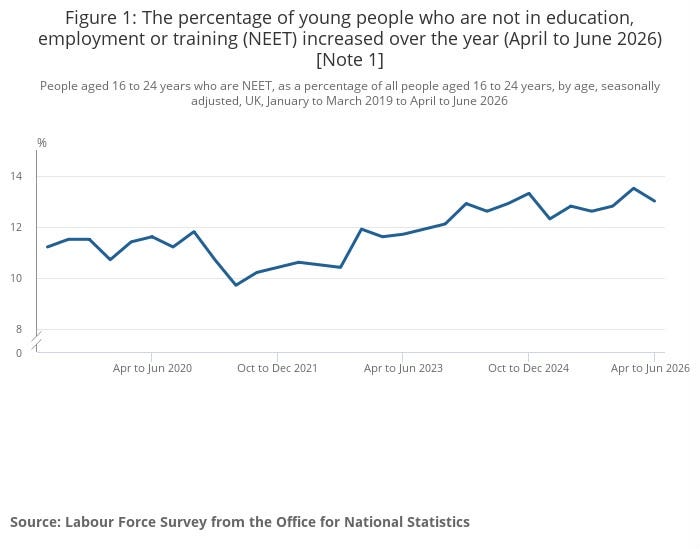
After a friend graduated with a first-class degree in Chinese, it took them several months and multiple interview stages to get a part-time job at a local supermarket. At the time I thought that this situation was atypical. Now, the above pattern is playing out across the UK. In 2022, NEET (not in education, employment or training) numbers among 16-to-24-year-olds started ticking up. By 2026, 13%, or nearly one million people, were in this category – leaving the UK with the worst rate of any European country other than Romania.
A good deal of current youth inactivity can be put down to historical macroeconomic factors. Deindustrialisation stripped the labour market of plentiful jobs that a 16 or 18-year-old could walk into out of school. Globalisation then exported many remaining entry-level manufacturing roles to cheaper labour markets. At the same time, rapidly increasing housing costs prevent young people from moving cities for opportunities, especially low-paid vacancies that don’t justify the rise in rent that comes with leaving home.
There is now an expectation that AI will quickly eliminate low-level knowledge work in sectors such as law, finance, consulting and software – resulting in a shrinking of the bottom half of the professional pipeline. Add the UK’s mediocre economic growth rates since 2008, which prevent jobs being created, and you get a perfect storm of NEETdom.
But these global headwinds shouldn’t let the Labour government off the hook. There are dozens of interventions that the Burnham government and businesses could pursue to mitigate the NEET problem.
Employers: the missing piece?
The recent Milburn report argued that we fail young people somewhere in the transition between school and work. But there’s a large omission here: it is taken for granted that employers do not want to, or cannot, carry out the same on-the-job training they provided for school leavers only a few decades ago.
Employers’ retreat from training has created a new burden – shifting costly training overheads from the private to the public sector. Some of this cost now rests on state schools, which are already overstretched by academic demands and behaviour management. Another portion has been outsourced to job centres, which can retrain the unemployed but cannot conjure the vacancies for them to fill.
Lower expectations of in-house training are a boon for big business – companies looking for cheap, disposable workers are now scraping the bottom of the barrel, investing little while claiming to be socially responsible. Nando’s has been offering a GCSE-equivalent “Level 2 Apprenticeship” in hospitality, with school leavers getting the chance to “experience life in [their] restaurants”. The benefit here is that the chain can offer an ‘apprentice wage’ which can be as low as £8.20 an hour.
Apprenticeship providers are usually expected to compensate for this lower pay by offering a chance to learn specialist technical skills, which come with a higher asking price down the line. This isn’t the case here. Few people used to “apprentice” for jobs waiting tables or working a till – until very recently, such jobs were a rite of passage, with a relatively low bar to entry.
Nando’s apprenticeships are at least paid. From October, up to 10,000 NEETs will receive the honour of limited work experience slots at Sainsbury’s stores. It’s no surprise that Labour has hailed this scheme, providing plenty of PR placements for the supermarket in the process. Indeed, the Milburn report doesn’t make much of a distinction between paid and unpaid experience.
There are already far too many stories about vulnerable young people being exploited by the same schemes that are supposed to help them. In 2025, Waitrose generated controversy for denying paid work to a young autistic man in Cheadle Hulme, near Manchester, after he’d already spent 600 hours on placement without pay. Another disabled man completed a nine-month unpaid placement as a binman with Southampton City Council before being rejected for paid versions of the same job.
So far, Labour has been too wary of confronting the big structural issues behind youth inactivity. Milburn has said we’d see a “profound… system reset” with “new approaches” laid out in a final report by the end of this autumn. While we await this, there are a number of smaller policy proposals the government and businesses could look at to improve the situation.
Poor public transport
In many areas of the country, Conservative-era austerity and privatisation policies have eroded people’s ability to get around via public transport. Labour has restored the £2 price cap on bus fares. But shortened timetables and unreliable services often make early-morning or late-night shift work difficult for those in remote or rural areas.
Those seeking to escape their reliance on public transport then encounter a Catch-22 – the prices of driving lessons and learner insurance have surged: the former by 37% since 2020 (from £28.47 to £39 an hour in 2026) and the latter by 27.8% since 2020. NEETs need a car to get to work, but need work to afford lessons and insurance. We’ve had a driving test backlog for six years now, resulting in an average learner needing to book a test five months ahead to get a slot, with no signs of a return to the pre-Covid era. Government agencies could highlight this issue and target investment effectively by devising a British Opportunity Index, tracking job and apprenticeship availability against public transport coverage by postcode.
Labour could also launch an initiative to train more driving instructors and examiners – perhaps even offering an extension of the Advanced Learner Loan to cover the costs of learning to drive in Britain’s most rural and disconnected areas.
Ghost jobs
Almost anyone who has been in the labour market as an active applicant can attest that there are not enough jobs to go around. Even employers with genuine vacancies ghost qualified candidates. No amount of CV-tailoring, work experience, or in-school support will protect NEETs from a basic lack of opportunity generated by an economy that has been in decline, or in stasis, since 2008.
Job boards have a structural problem: aggregators’ profit motives are usually at odds with the common good. The near-absence of regulation on job sites means employers can easily post jobs that don’t exist. The recruitment software company Greenhouse’s ‘2024 State of Job Hunting’ report, based on a survey of applicants across the UK, Germany and the US, estimated that between 18% and 22% of jobs posted on its own job aggregation sites were non-existent when audited.
Jobseeker’s Allowance and Universal Credit claimants are wasting time applying for non-existent vacancies when they could be retraining; government agencies are at risk of misjudging the number of vacancies and distributing investment and training to the wrong sectors that falsely appear to be growing.
We know that at least some ‘ghost jobs’ are ruses to harvest and sell data. We could try to make this impossible: there’s no real need for an employer to collect your telephone number, address and email if they haven’t committed to interviewing you. The data-collection incentive would go away if we introduced a single-point jobs board within the gov.uk ecosystem; employers could send messages to applicants through a secondary interface, with details withheld for privacy and released once a contract is signed.
What can Labour do?
It’s also worth asking whether Labour could divert some of the existing education budget into lower-responsibility, entry-level part-time roles for NEETs. As it stands, the thousands of free workers at Sainsbury’s would still need to rely on government benefits during their time on the scheme.
As a ‘two birds with one stone’ measure, a subset of this group could instead receive a slightly lower benefits entitlement in return for a few hours of paid work a week as teaching assistants, in council offices, in care homes, or in low-risk NHS roles. There are social-democratic precedents for these ideas. During the Great Depression, Franklin D. Roosevelt’s Works Progress Administration hired millions of unemployed workers to build up America’s infrastructure. These efforts stretched into ‘knowledge work’ and the performing arts, with out-of-work writers, actors and musicians contributing to paid public art and preservation projects.
We also need a serious re-evaluation of the economic policies that have worsened the NEETs crisis. One answer would be to reverse Labour’s employers’ NI rise (for those over 21), perhaps removing the ‘triple lock’ on the state pension to pay for it.
At the time of writing, Burnham is mulling over a youth minimum wage climbdown and PIP (Personal Independent Payment) cuts for under-25s – both of which will expend a good deal of political capital. The Conservative Party, under Kemi Badenoch, is suggesting going one step further – proposing a ban on school leavers claiming Universal Credit at all while halving National Insurance contributions for those aged between 21 and 24.

A safer option for Burnham might be to incentivise on-the-job training. We already have an apprenticeship levy system. But it could be improved. Employers should receive tax breaks for every employee hired on an apprenticeship or graduate scheme – on the condition that companies provide a regulated baseline of training and move trainees onto above-average graduate pay within a set timeframe.
If these transport, advertising and barriers to training disappear, there’s no guarantee we’ll bounce back to a pre-Covid market. We should be asking more of Britain’s employers. Instead, we’re working around demands firms wouldn’t have made a few decades ago. Businesses now feel empowered to put entry-level applicants through multiple rounds of interviews and cognitive tests, to demand experience in roles that are easily taught, and to ask for 24/7 availability, even for part-time shift work.
The Milburn report is a good start, but Labour needs to reckon with generational structural shifts in the employment market. Burnham can, and should, start with the smaller stuff: ghost jobs, poor public transport, employers’ NI – but at some point the party needs a fuller response to the forces reshaping the economy: globalisation, deindustrialisation, automation.
But it’s not all on the government – the market plays as important a part as the state in generating NEETdom. Perhaps retail and hospitality businesses should reflect. Their line of work has always involved a high turnover of inexperienced young people, who won’t have round-the-clock availability and might need to learn on the job.
Must the burden sit entirely with applicants, careers advisers and the government – or is anyone brave enough to tell these employers that they’re asking too much for too little pay?
