


I spent a chunk of my summer sitting in my London flat. This is a building designed to trap heat in a city never designed to have any. At some point, I caught myself actively fantasising about a cold summer. Think grey Bergen drizzle, a lake in southern Sweden, somewhere with a temperate climate that would require a jumper.
Seemingly, I’m not the only one. The word ‘coolcation’ has been gaining traction lately. What, exactly, does this portmanteau mean? According to many, the implication is that while Southern Europe bakes (with Spain and France pushing past 45°C this summer), northern Europeans looked at the forecast and turned the car around – trading beaches for fjords and Benidorm for Bergen. This seems like a plausible story to me: does the data agree?
What do the numbers say?
People are, without question, searching for holidays differently. On the French version of Hotels.com, searches for Copenhagen jumped 246% after the first May heatwave and Dublin rose 151%, while cooler holiday searches were up 74% year-on-year. The trouble is what this search data can and cannot do. A growing literature, from Choi and Varian to Havranek and Zeynalov, has shown that search interest is a good nowcast: it estimates what is happening right now, before the official statistics land, which in our case means the next few booking weeks. What it does not do is forecast the season.
I built a comparison, using multiple indicators, myself. For each set of destinations, I put the demand signal (search interest, forward bookings, stated intent) next to the realised outcome (actual overnight stays and arrivals, from national statistics offices and Eurostat). The result? What I like to call: ‘the coolcation gap’.
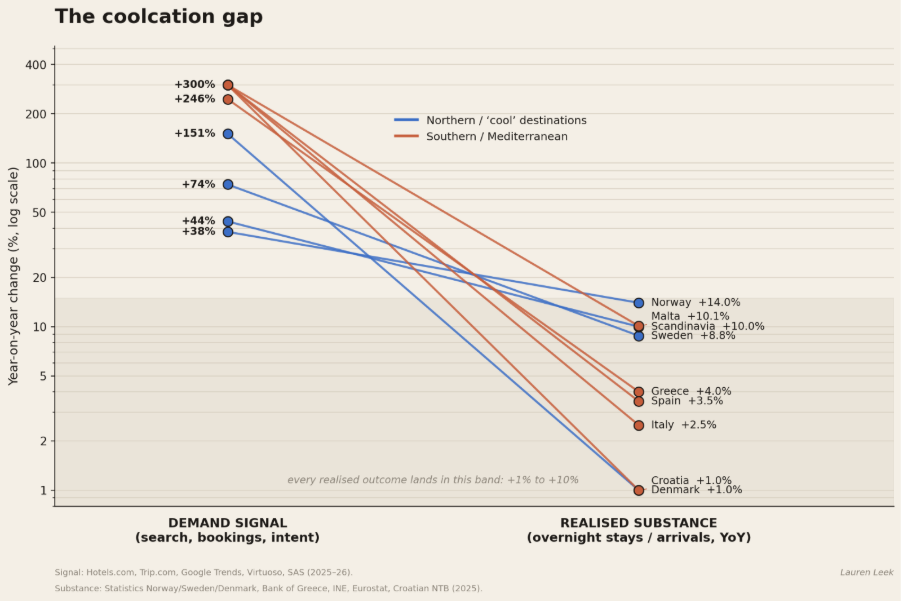
Across these destinations the demand signal averages nearly 200% growth year-on-year while the realised outcome averages about 6% growth, a divergence of roughly thirty to one. If the coolcation were a real migration, the northern ‘cool’ destinations should be climbing while the southern ones fall. Instead, every destination that was supposed to be losing tourists is still growing: Norway’s foreign guest nights are up 14%, but so is Malta at 10%, Greece at 4%, Spain at 3.5%, Croatia at 1%. So, the north did go up somewhat but the south did not go down.
Greece shows why. At first glance it had a record 2025, but when I looked closer, it turned out to be a pricing story. In July, revenue per available room rose 15.4%, but almost all of that came from a 20.7% jump in the average daily rate, while occupancy actually softened.
A genuine coolcation shows up as empty rooms and falling rates. Instead, the rooms are nearly as full and the prices are higher, which is a sign demand is holding.
So if tourists are still, hesitantly, arriving and spending in the Mediterranean, what’s changed? To identify a change we have to look at when people are travelling. Southern Mediterranean tourism is still 59% concentrated in the prime summer months, but most of the growth is ‘in the shoulders’, with May and June bookings up 13% and September and October up 20%, and airlines scheduling 4.6% more seats into the region this coming winter.
Why is this a problem?
To identify the problem, we have to look further into the future. The European Commission’s Joint Research Centre (JRC) 2023 modelled 269 regions against a Tourism Climate Index, finding that a 1% rise in climatic comfort buys about a 0.57% rise in bed-nights. Meanwhile, when the same model is projected forward to a world 3 to 4°C warmer, it gives a headline number of roughly 10% of summer demand lost in the south.
I assumed a 10% demand reduction would not be problematic per se – until I placed the projected summer warming next to how much each economy leans on tourism.
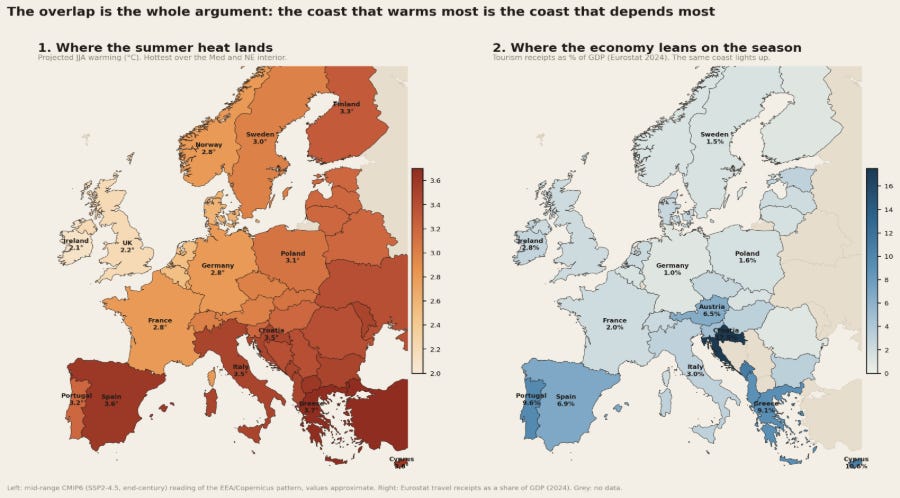
The coasts that are projected to warm the most, the Iberian, Italian, Adriatic and Aegean rim, almost entirely overlap with the coasts that lean hardest on tourism as a share of the economy. In contrast, the Atlantic northwest – Ireland, the UK, western France – barely shows up on the tourism dependence map.
Looking at the data systematically, we can see which countries are most exposed – the ones where the heat and the economic dependence coincide, hot and reliant on the summer season.
So I turned that overlap into an exposure map. The horizontal axis is how dependent each economy is on tourism, measured as travel receipts as a share of GDP (Eurostat, 2024) – that is, the actual money foreign visitors spend, rather than the flatteringly large ‘total contribution’ figures the World Travel and Tourism Council (WTTC) publishes, which fold in supply-chain, investment and knock-on spending and so inflate the headline two- or threefold. The vertical axis is my own costing of what a JRC-style 10% summer drop would take off the table, in euros. The arithmetic is deliberately back-of-napkin: inbound revenue × summer share × 10%.
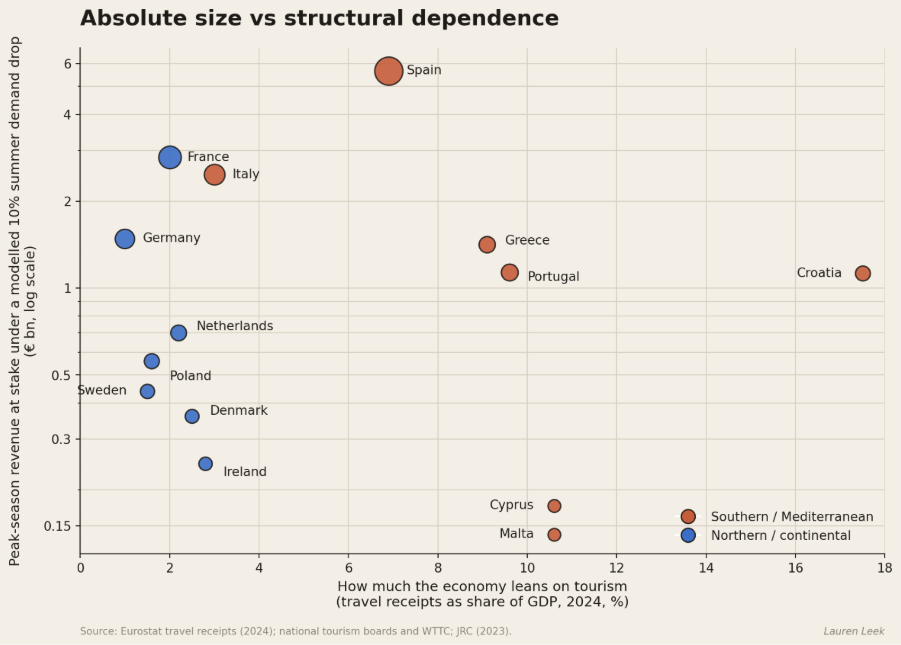
The map splits two dynamics apart. We can see absolute exposure in the top half and structural exposure in the bottom and top right corners. Structural exposure is defined by how much the whole economy depends on tourism. Croatia sits at 17.5% of GDP, three-quarters of it earned in summer, in a country of under four million, with Cyprus and Malta beside it, small and hot and almost entirely a summer proposition, with no autumn demand to fall back on.
This is where political economy becomes a useful lens. There is a critical tradition in tourism studies that refuses to treat tourism as mere leisure and reads it instead as a relationship of power, asking who owns and profits from it. Growing out of dependency theory in the late 1970s, it defined itself against the sunny modernisation view that tourism was a straightforward development ladder for poorer countries, arguing the reverse: that heavy specialisation results in dependency rather than an opportunity.
Turner and Ash had already named the ‘pleasure periphery’ in 1975, the poorer sunlit regions reorganised to serve the leisure of wealthy northern populations; Raoul Bianchi’s more recent political economy of tourism has carried it forward. The thesis is consistent across all of them: the core exports comfort; the periphery imports price-taking seasonal demand and rebuilds itself around serving it.
Climate adds a physical squeeze on top of the structural one, turning the periphery’s one asset, pleasant rather than dangerous summer sun, into a liability in its peak weeks. While a diversified economy loses a product line, a dependency loses its reason for being. That is why the same 10% is a rounding error for Germany and an existential question for Malta. This is why ‘just pivot to the shoulder season’ costs a city that is still charming when it rains very little, and a sun-and-sand monoculture almost everything.
Somebody must be gaining from climate change. The JRC pencils in Germany, Denmark and the Netherlands for demand gains above 5%. Notably, West Wales, of all places, is the single biggest projected winner. But the gains are diffuse, spread thin across temperate places and hard to pin specifically on climate rather than price or fashion. The losses, meanwhile, when they concentrate, land hard and narrowly on a few summer-only economies. Diffuse gains and concentrated losses: that asymmetry is the real policy problem.
The implications
If the threat is timing rather than migration, the policy response is not to chase the ‘coolcation’ crowd north but to make the months around the current peak work. It’s encouraging that the levers are known and some are already being pulled.
The most concrete are the dull, structural levers. Staggering school holidays across the continent is the single high-leverage move available, and the one policy governments are slowest to coordinate. Yet, flight capacity is following market demand: seat numbers into Italy, Spain, Greece, Croatia and Portugal for the final quarter of 2026 are up 4.6% year-on-year, with Greece adding 10.7%. This is precisely the off-peak connectivity a longer season needs. And winter hotel rates across those five markets are now markedly below summer, which is the price signal doing its job, pulling cost-sensitive travellers into April and October.
But connectivity and price discounting only smooth the curve; they do not cure the dependency – the harder and more important half of the equation. The exposed economies in the top-right of my map cannot price their way out of being a single-season monoculture, and the good news is that the most serious of them have stopped pretending otherwise.
Greece, which is overheating both literally and figuratively, is now building the machinery to break that single-season dependence. It includes a Special Spatial Framework that grades each region by carrying capacity – how many visitors a place can take before its infrastructure and environment start to buckle – rather than letting the islands absorb unlimited numbers. National and regional tourism observatories now track visitor pressure across regions and seasons, while the state actively pushes tourism inland and into the mountains, through the Peloponnese and Epirus, places that work in November.
The OECD’s 2026 tourism review mirrors current Greek dynamics, albeit in convoluted policy language, arguing that dependent nations need to reduce seasonality and diversify their tourism products, or watch competitiveness erode. Around Greece, the rest of the Mediterranean is diversifying into gastronomy, wellness, rural stays and archaeology, and the European Commission is nudging the whole bloc toward ‘climate-resilient tourism strategies’.
Happily, for once, the climate-conscious choice and the pleasant option point the same way. A Mediterranean holiday in May or late September is cooler, quieter, cheaper, and kinder to the place, since your money arrives in the months it is needed most – rather than in the months when the town is already drowning in demand.
You do not have to discover Bergen to escape the crush. Instead, simply keep your original plans and move your trip five weeks back. That is the whole coolcation, really: it was never about going somewhere colder, only about going at a colder time.
I started this summer sweating in a London flat and fantasising about a lake in Sweden. It turns out the lake could also just be in a more affordable country but at another time of the year.
