


Today on Arguably, Martha explains why welfare reform must once again become a progressive priority. This piece is free to read but become a paid subscriber for just £6 a month to ensure you never miss any of our essays, columns and interviews.

William Beveridge in his study at University College, Oxford (Wikimedia Commons)
What is the welfare state for? Why do we tax ourselves at ever greater levels to sustain this fiscal Leviathan? It’s a question that – despite the hours devoted to welfare across the media – we often forget to think about deeply.
But it demands an answer now. Welfare reform was perhaps the most notable absence from this week’s King’s Speech, a silence shaped by the trauma of last summer’s Labour revolt. Yet there is no case for inaction – if the government fails to reform the welfare state, this work risks being left to those who care little for its survival (Nigel Farage has pledged to impose “the biggest benefit cuts you’ve probably ever heard any government do”).
The enduring argument for the welfare state is clear: it is a form of collective insurance against life’s hazards: ill-health, unemployment and disability. It supports individuals in their hour of need and gives them agency to rebuild themselves. But to do this, it must sustain consent.
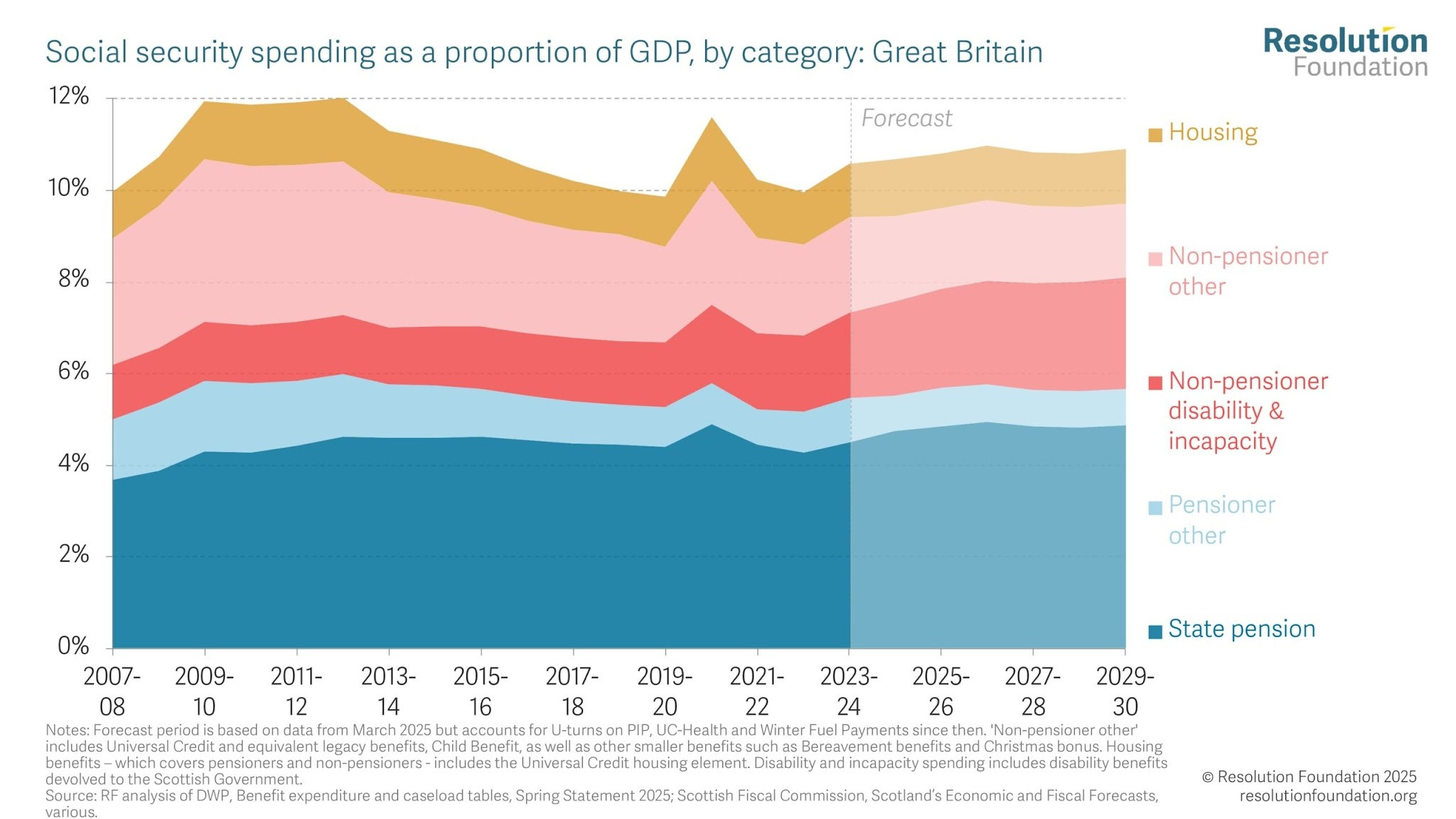
Today, this compact is under threat from two directions. First, inflated by the anachronistic “triple lock”, spending on pensioners is projected to reach £196.2bn by 2030-31 (accounting for almost half of all welfare spending). Second, spending on health and disability benefits, now claimed by one in 10 working-age people, or more than four million, is forecast to reach £109.8bn, up more than £30bn since 2020.
There are legitimate reasons for this, such as an increase in mental health conditions, driven by economic insecurity, the after-effects of the Covid-19 pandemic and greater social isolation. But there are also perverse incentives at play. Unemployment benefits in Britain are so low – just 12 per cent of previous earnings – that the rational response for too many is to seek to claim sickness and disability benefits, which are paid at a far more generous rate. The Universal Credit health element comes without the punitive work search requirements and the constant threat of sanctions.
While young people have become sicker, many other European countries do not allow such large numbers to receive support unconditionally and without time limits. The application process, often conducted over the phone and through forms, can be gamed by using new technologies, reducing the frictions that previously controlled demand. Large Language Models, for instance, can explain to a person how to fill out forms for Personal Independence Payments (PIP), ensuring they have the correct language to access support. Search TikTok for #ADHDhacks, and you will be stunned by the cultural shift among many young Britons toward claiming as much as they can. This isn’t Beveridge’s dream – it’s his nightmare.
All this contributes to a dangerous divergence. Some workers are now taxed at Nordic-style levels – a 51 per cent marginal rate for graduates earning £50,270 – to fund one of western Europe’s most dysfunctional states. Too many see their taxes slide away into a system from which they receive little in return: no affordable housing, barely functioning public services and, critically, no sense of shared institutions or ownership.
Karl Polanyi called it the double movement: when the market disembeds social life to a sufficient degree, society pushes back. Indeed, the welfare state itself was the product of such a movement. But if the contributory principle is further hollowed out, a pushback from the opposite direction will follow (49 per cent of Labour supporters now believe the system is “too open to abuse and fraud”).
The 1942 Beveridge Report offered a clue as to how we can escape our current plight. The welfare state was never supposed to be the whole answer; it was one part of a universal model of social policy. If the modern system is to regain consent, it must recover that breadth of ambition.
This will mean rebuilding the institutional fabric that once gave the social contract substance: public, affordable housing that young people can actually access, a health service that functions as a shared experience rather than a rationed emergency response, and employment support that treats people as citizens with agency rather than infantilising them.
The government’s attempt at welfare reform in 2025 failed to articulate a wider moral ambition for a new social contract; instead it became a counting exercise for the Treasury (which planned cuts of £5bn to meet its fiscal rules). There was no explanation of what the system was for or how it would benefit society, only an argument about its cost.
Since then there has not been a serious attempt by critics to propose ways to rebuild the trust which underpins the welfare state. Too often, these voices adopt a purely defensive posture based on existing claimants rather than the system as a whole.
Take PIP as a welfare instrument that ought to be reformed. It compensates people for what disability prevents them from doing – a benevolent intention with a perverse logic. The benefit pays out for the continued performance of incapacity rather than for the development of capability. It monetises exclusion instead of investing in inclusion. Indeed, by tying support to demonstrated inability, it creates a powerful incentive to inhabit, rather than escape, a medicalised identity. The system is, in this sense, unprogressive: it asks disabled people to perform their disadvantage in order to be supported, and then withdraws support at the first sign that the disadvantage might be overcome.
A genuinely pro-disability reform of PIP would invert this logic. It would seek to enable participation by redirecting spending towards workplace adaptation, assistive technology, and the preventative mental healthcare whose absence is now driving so many young people towards benefits.
This is not a cut; rather, it is a refusal to accept that compensating people for non-participation is the highest aspiration the welfare state can offer them. This case is one that neither Labour, nor its critics – focused on defending the current settlement – have made. But until someone does, the political ground will be ceded to those for whom “reform” is simply a byword for punitive cuts.
Critically, to rebuild the social contract, we must also scrap the triple lock, acknowledging that untargeted generosity to all pensioners, including the asset-rich, funded by higher taxes on the young, is an act of generational warfare that will reap a politics of grievance best harnessed by populist forces.
And we must design a benefits system that does not financially penalise people for being honest about their capacity to work. We should not accept thousands of young people signing on to health benefits or PIP for years on end without question: this is an unprogressive settlement.
The postwar welfare state was built on a bargain: contribute, and you will be protected. That bargain has been allowed to decay until what remains is a hollowed-out transfer system that commands diminishing loyalty from the people it was built to serve. Renewing it is not merely a fiscal challenge; it is one of moral ambition.
If Labour does not reform welfare in this parliament – and reform it in a recognisably Labour way, anchored in dignity, participation and the contributory principle – the alternative is not the current settlement. It is a Reform government inheriting a system that has already lost the consent of those who fund it, with a free hand to dismantle what remains.
As early as 1942 it was recognised that the budding of an idea, 'The Welfare State, ' was not the whole answer. I'd encourage anyone and everyone to read Stuart Maconie's book, 'The Nanny State Made Me.' Those who are so opposed to the welfare state, the Nanny State as they disparagingly call it, are themselves beneficiaries of 'The Nannied Classes.' One of the most objectionable of the this questionable clique as MP even had his own 'nanny' delivering leaflets for him.
Meanwhile, Gaby Hinsliff thinks she has written a clever column. The reality is she 'is' part of the problem; merely looking for clickbait all the while contributing to the extreme right diatribe that has led to a government leadership challenge that was not needed. 14 years of total and abject tory mismanagement and corruption along with Reform grifting and 'cryptocorruption.' Pay attention not to the extreme right wing press, nor to the likes of BadEnoch or Nigel Fraudage... but look to see how policy by Starmer and his Cabinet has been bedding in and taking effect... which it indeed has been... much of which is geared to social reform.
https://www.theguardian.com/commentisfree/2026/may/15/labour-wes-streeting-angela-rayner-andy-burnham-leader