


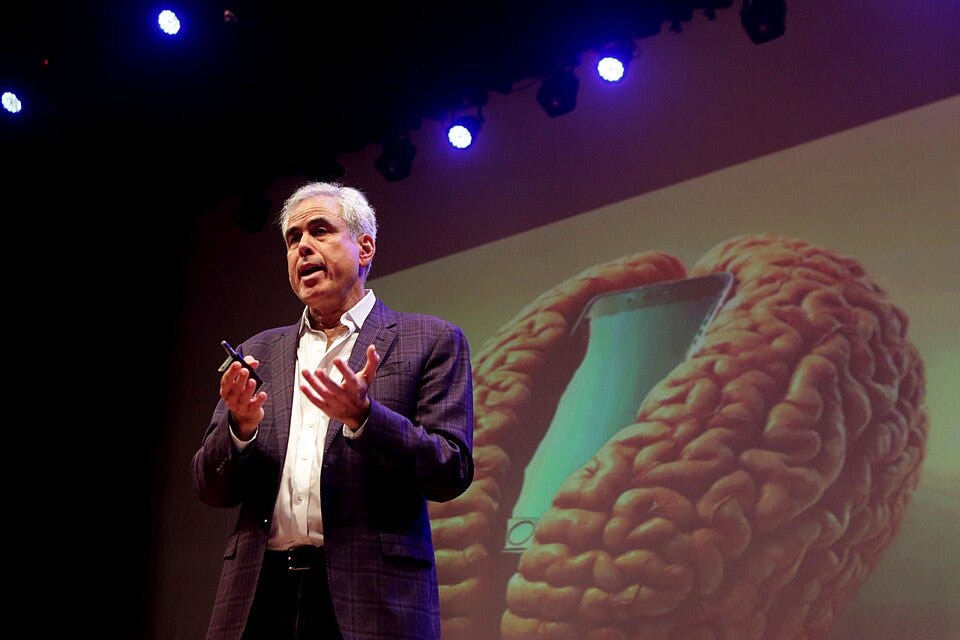
Author Jonathan Haidt speaks in São Paulo (Fronteiras do Pensamento/Wikimedia Commons)
In the last three years there has been a transformation in how we describe and then legislate on digital harm to children. Rather than viewing platforms as the hosts of sometimes harmful content, politicians and parents alike now treat them as inherently exploitative. A global movement, given intellectual ballast by social psychologists such as Jonathan Haidt, has gained momentum, winning social media bans for children in Australia, Spain, France and the UK. But what is curious is that there is now no obvious stopping point for regulation.
Consider the pre-2023 digital settlement. Concern centred around online versions of offline crimes – stalking, harassment, sexual threats, blackmail, the sale of goods and services on the dark web. This culminated in the introduction of the Online Safety Act, which, while introducing landmark age restrictions on porn and other material, had clear limits. But the conversation has since accelerated faster than anyone could have anticipated.
This reflects the reality that, in the aftermath of Covid, the internet feels different. Multiple lockdowns spent with little else to do but stare at phones led to a whole new era of content consumption, and spurred on a far more powerful set of features – critically, short-form video running on personalised algorithms. The feed, particularly capturing the attention of children for hours on end, was the principal problem. As a result, the focus has shifted from content to the fundamental architecture and design of the platforms themselves. Harm is now defined by the length of time spent online, with loneliness, isolation and days not spent with friends the abiding concerns.
This has led to a new frontier in the digital legislative landscape. The UK plans to block infinite scroll and autoplay and impose a social media curfew for 16-to-17-year-olds. Gaming and AI chatbots are emerging as the next targets, with concern over how the latter mimic human relationships with children, both in friendly or more sinister ways.
This shift is far from merely a British phenomenon. Emmanuel Macron stated earlier this year that “the emotions of our children and teenagers are not for sale or to be manipulated, neither by American platforms nor by Chinese algorithms”. EU Commission President Ursula von der Leyen has proposed a ban on “social media plus” for children under 13, a deliberately vague description which aims to capture video games, app stores and AI companions.
Britain is set to become the first country in the world to ban sexualised AI chatbots for under-18s, but beyond this there is likely to be a drive to limit how children can access chatbots at all, to curb the “emotional dependency” they may develop, alongside caps on how long they can use them for. What is being regulated now is not the output, but the duration and rhythm of digital interaction. The back-and-forth itself is the harm, but there is no version of a chatbot that does not do this. The harm and the technology have become the same object, which is why the regulatory net will only widen.
Legislating around AI chatbots is complex. Children should obviously be barred from having sexualised conversations but they should not be blocked from chatting to a chatbot for hours about history or using them to develop their own creative projects. Trying to legislate around this nuance will not be easy.
And most of the low-hanging fruit has been taken. We have entered a far more challenging phase in which interventions will reshape digital products themselves rather than simply police them. Platforms do not have “adult” and “child” versions built into their code for policy to switch between. As a consequence, the load-bearing wall of this entire legislative approach is age assurance. Every measure described above will only be as good as the ability to know who is on the other side of the screen, which means infrastructure and friction that adults will have to navigate too. Politicians must lead a far more honest conversation on where parental responsibility lies in controlling their children’s access to technologies and social media.
The complexities of implementation are catching up with countries such as Australia. Three months after the social media ban was imposed, the regulator eSafety found that usage among under-16s had only fallen from 86% to 81%, prompting the government to double the maximum penalty for firms to $99m. More contentious is the prospect, still under debate in several countries, of banning VPNs – a threat to the civil liberties of law-abiding adults – to close the workarounds used by digitally savvy children.
A social media ban for under-16s is a defensible, even welcome, piece of policy; we should aspire to shield children from this all-consuming world. But this is not where most campaigners want to stop. The current theory of harm is one without barriers or boundaries; it is aimed at design choices that are inseparable from the products themselves. The likely result is badly-designed legislation, in which intention outruns outcome and being seen to act matters more than what is achieved.
I think this captures a really important point, but one that leads me to totally the opposite conclusion. I agree that there is a fragility in basing tech regulation on a sharp distinction between adults and children. We in the liberal West find it much easier to wield state power in protection of our children than ourselves. We usually think of this phenomenon as an exception to, or a failing of, our broader libertarian sensibilities. The article does this when it warns against impinging on adults' civil liberties by banning VPNs.
I would argue that this framing, in the modern day, is backwards. The logic behind impeding choice to protect children is that - unlike adults - they are unable to protect themselves. But none of us are able to protect ourselves from modern digital technologies. Phone addiction has, over the course of a few years, become comfortably the most widespread addiction in history. Democracy has decayed, loneliness and misery have spread not just among children but among adults, unable to regain control of their lives from their phones.
In this landscape, individual freedom to decide cannot survive. The knot the article describes is the question of where the line can be drawn between protecting children and oppressing adults. The answer is not on the left of that line, but the right. Legislating to keep social media - as it currently exists - away from children is the expression of a truth that we all know deep down. That this technology is poison, for children and adults alike.
We should not be wasting our energy trying to figure out where to stop, but working out how to harness the energy of this moment to go further and provide democratic protection from digital overreach to everybody. A truly bold politics would be one that says not just "children shouldn't have to live like this", but "no-one should have to live like this".