


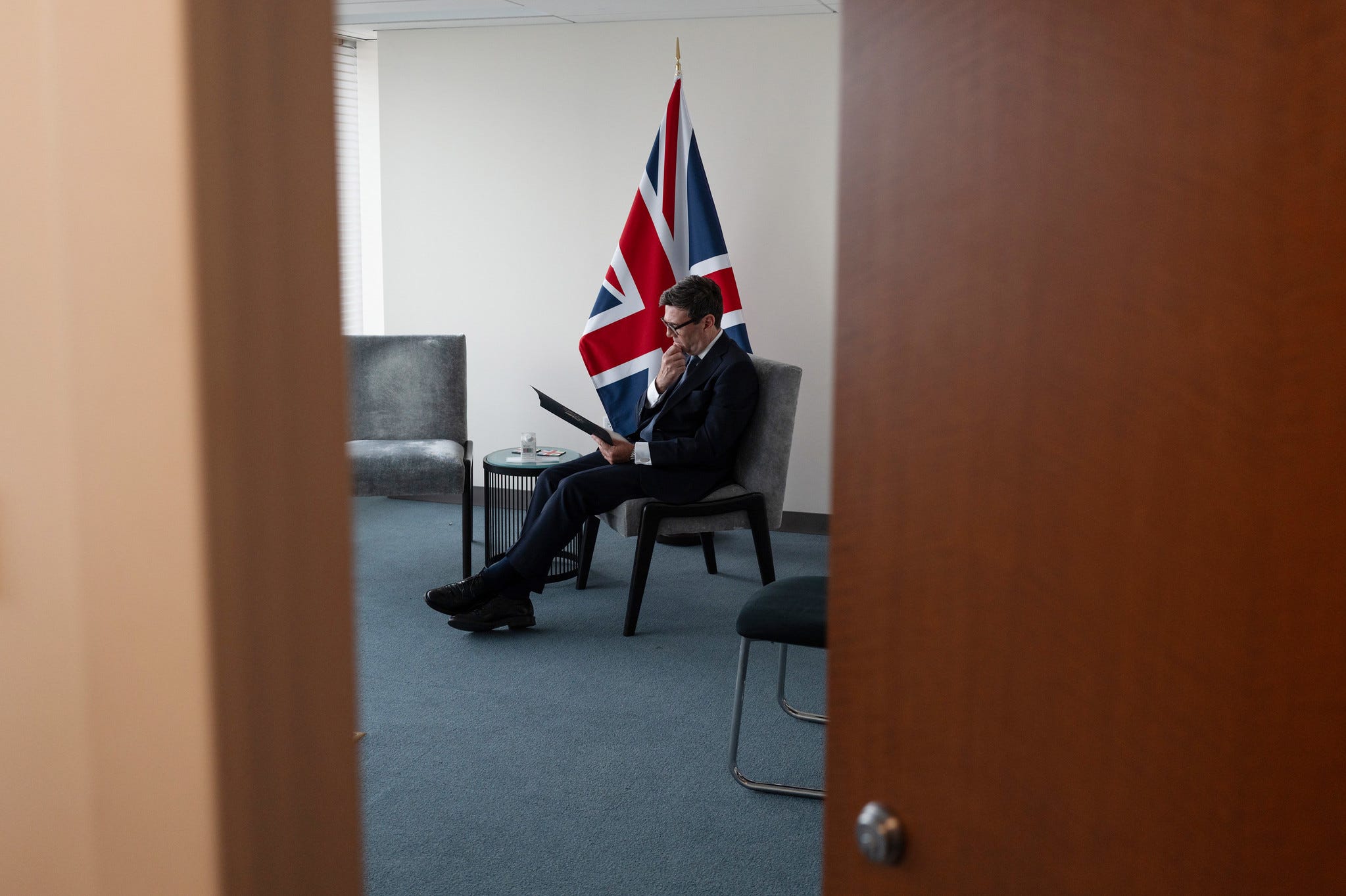
This will be the first Labour Party conference in five years where I do not have a degree of agency over what the leader will say. To which I can only say: good! In fact, to paraphrase Sir Steve Redgrave, anyone who sees me skulking around a Liverpool rehearsal suite now has permission to shoot me.
Still, like any Labour member, there are things I want to see on Tuesday. And chief among them is the hope that Andy Burnham chooses the right cause. By now, he will know that the leader’s speech is quite unlike any other. Defined by its unusual length – around an hour – it is simply impossible to restrain it to one topic. It becomes more like a play, with subplots and a denouement. Or like a body of water, where tributary arguments must cascade into a central river. Crucially, this river cannot be stagnant. It must move and flow, carry people with it, and give the speech its urgency and impetus. And its destination must be the first glimpse of the Britain our prime minister wants to build, illuminated in its most politically attractive and salient light. With the stakes this high, an ordinary argument will not suffice. It must be a great cause.
In 2022 – my first leader’s speech with Keir – that cause was climate change. The £28bn Green Prosperity Plan captured Labour’s determination to harness state intervention in pursuit of progressive ambition. Meanwhile, last year’s speech was dominated by the fight for Britain’s soul and the confrontation with ethno-nationalist racism. This year, Burnham arrives in Liverpool with no shortage of options, many of them personal. There is his vow to end rough sleeping, his first promise in his first speech as prime minister. There is devolution, the policy ballast which undergirds his narrative of economic rebalancing. Then, perhaps most enduringly of all, there is his long-standing commitment to transform the shameful state of social care in this country.
Such is the time to fill on Tuesday, all three could feature. But if I were him, I would not elevate any of those beyond mere River Gowy status. Because as with so many aspects of being prime minister, the blank page of a conference draft can encourage delusions of untrammelled agency. The truth is this: your causes chose you, far more than you chose your causes. And this year, the cause that has chosen Burnham is the crisis of opportunity for our young people.
The moral imperative is clear. It is utterly intolerable to allow nearly a million young people to languish out of work, education or training when we know how scarring that is for their long-term life chances. But allowing dementia patients to languish in inadequate care homes is also intolerable. Homelessness is intolerable. Britain’s regional inequalities are intolerable. The difference is the politics.
After all, Kemi Badenoch, perhaps now Labour’s main opponent, has made her strategic intentions crystal clear. She will seize on the moral urgency of Chancellor John Healey’s previous calls for higher defence spending. And she will ask again and again why the Labour Party cannot cut welfare spending even when our national security is at stake. I am more than ready to believe there is a compassionate Labour approach that cuts worklessness, not welfare. But we are long past the time when it should have been clearly spelt out. And this is a task only a prime minister can now perform.
Then there is the fiscal arithmetic. We all know the funding settlement is tight in the later years of this parliament. And we all know that yet more tax rises will be an extremely difficult sell to the British people. A significant change in the labour market for young people is, therefore, one of the few ways the government might improve the OBR’s fiscal forecasts. It is vital, not just on its own terms, but for maintaining national renewal rather than decline.
The electoral strategy also stacks up. As many have noted, Labour’s voter coalition is sociologically strained, an uneasy cultural mix of middle-class progressives and more conservative working-class voters. What brings them together is a sentimental connection to advancing working-class opportunity. They either need it in their town now. Or their family history is bound up with its benefits. It is the emotional glue of the party. Nothing moves the conference hall quite like it.
Finally, and most importantly for Tuesday, there is the storytelling. Opportunity issues may score low in salience polling. But as a canvas for talking about the nation’s future, nothing else comes close. Not only that, our young people have been at the sharp end of Britain’s biggest challenges for almost two decades.
The years of Tory austerity redistributed the public realm away from their material interests. Brexit narrowed their horizons. They carried the social contract on their shoulders throughout the Covid-19 lockdowns. They are patient zero for having their childhood contorted by social media. Artificial intelligence and climate change are their problems, far more than ours. And their reward for all this is to become a generation that sees the basic security of a good life – fair pay, a secure job and a good home – move further and further from their grasp.
After all that, can Labour’s offer to the most disadvantaged of these young people really just be welfare? Of course not. And on Tuesday, Andy Burnham should make opportunity his cause.
