


In 1972, one of Michael Heseltine’s first tasks at the Department of the Environment was to help create England’s new metropolitan counties. Six were created in 1974, including Greater Manchester, Merseyside and Tyne and Wear. How did Heseltine decide where to draw the boundaries of these new local authorities? By his own account, he hired a plane, took a map with him and sketched the lines from the air. Heseltine concedes that his approach would today have been “judicially reviewed to oblivion” and a decade after the new counties were established, Margaret Thatcher would abolish them in an attempt to strip left-wing Labour council leaders of power, including her bête noire Ken Livingstone in London.
Andy Burnham, like Heseltine, has a longstanding belief in devolution, and is now following in his footsteps by embarking on an ambitious reorganisation of public services and their boundaries. Last week, he pledged to create new local policing units aligned with local authority boundaries and wider regional forces aligned with strategic authorities, such as the one he ran in Greater Manchester. Fire and rescue services and integrated care boards will also align with strategic authorities’ boundaries.
This is no small undertaking, but Burnham has set a deadline of the end of this parliament. It will be politically contentious, operationally complex and painstaking to deliver. Successive governments have grappled with the boundaries of local institutions, and the Starmer administration was no exception.
For two years, it was immersed in negotiations – often with Labour councillors – about local government reorganisation. On the final day that parliament sat under Starmer’s leadership, his government announced the new boundaries for councils across England: 134 authorities will be replaced with 38 and the number of councillors will be reduced by 51%. These reforms have proved contentious, with a growing number of Conservative and Reform-led councils mounting legal challenges against the government to stop their fiefdoms being scrapped, something consuming valuable ministerial time, attention and political capital. Like vultures circling a carcass, councils saw their role as simply waiting for the Starmer administration to fail. Now that it has, they are betting that their strategy of brinkmanship will encourage the Burnham administration to give up the fight and change course.
The benefits of institution-breaking and reconfiguring are not always obvious, and successive governments have a long history of redrawing boundaries with little discernible return. There are a dizzying array of public services, each with their own different geographies, that prevent them from working together. I call this the Incoherent State.
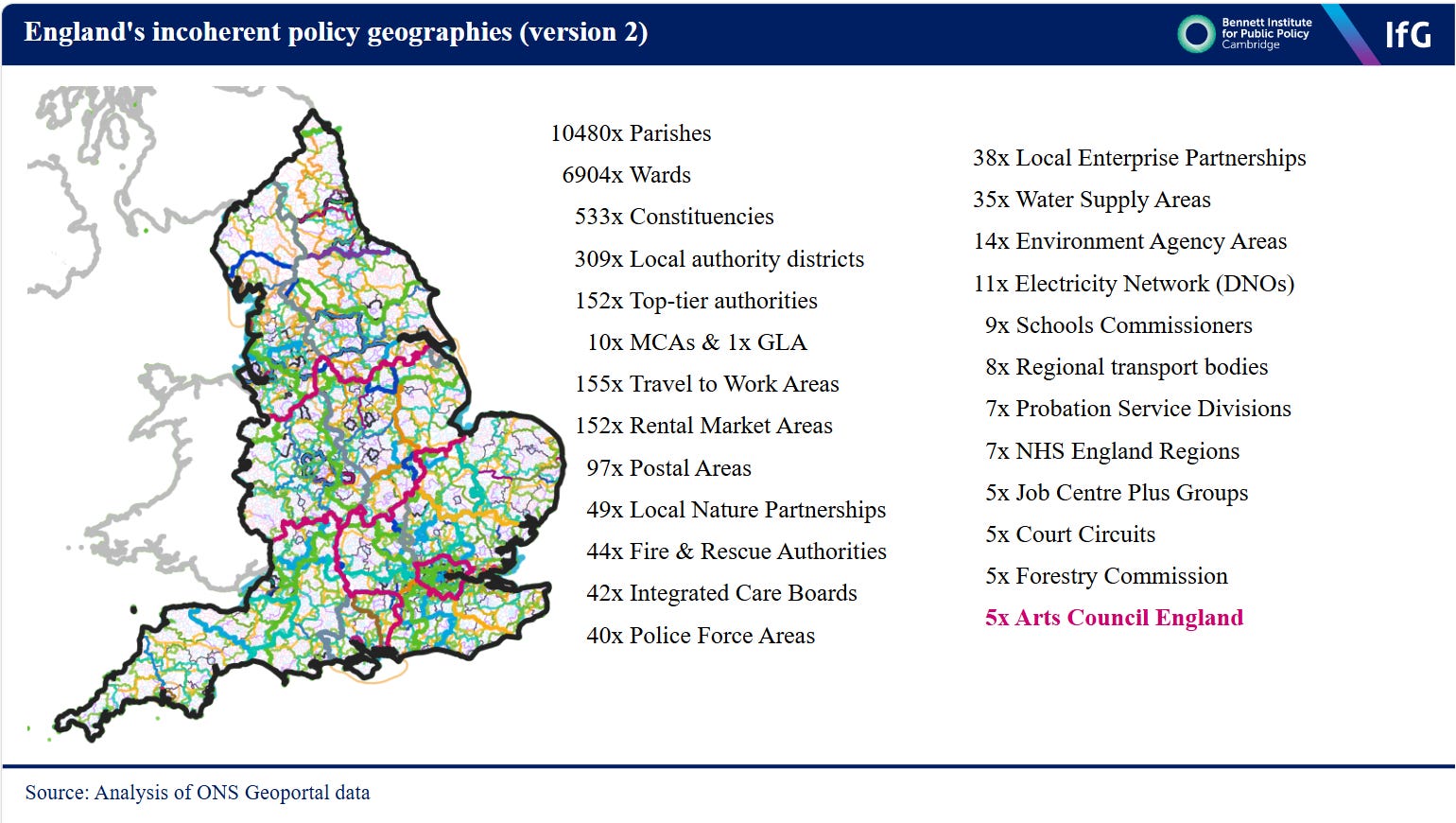
Yet fixing our messy boundaries could produce real benefits for the Burnham administration if it can get it right – though there is further still to go. Let’s start with Greater Manchester. It benefits from a partnership with the Ministry of Justice’s Prison and Probation Service. Together, the MoJ and Greater Manchester commission services jointly to reduce female reoffending, providing women with accommodation, education, training, and employment. This partnership is performing well and Greater Manchester has the highest Probation Scorecard in England.
It is also the only place outside of London where the operational boundaries of the Prison and Probation Service are the same as the boundaries of Greater Manchester. In other words, West Yorkshire or Cornwall cannot benefit from a similar collaboration, because the boundaries are different.
The NHS English Regions, the Probation Service Divisions, the Environment Agency areas, the Water Supply Areas and the Integrated Care Boards, similarly, do not match the geographies of strategic authorities. This is understandable given that this phase of devolution is only a decade-old, but the government is failing to grasp the scale of change required. If the Burnham administration envisages a role for mayors in holding water and energy providers to account as part of a move towards public ownership, then reform is imperative.
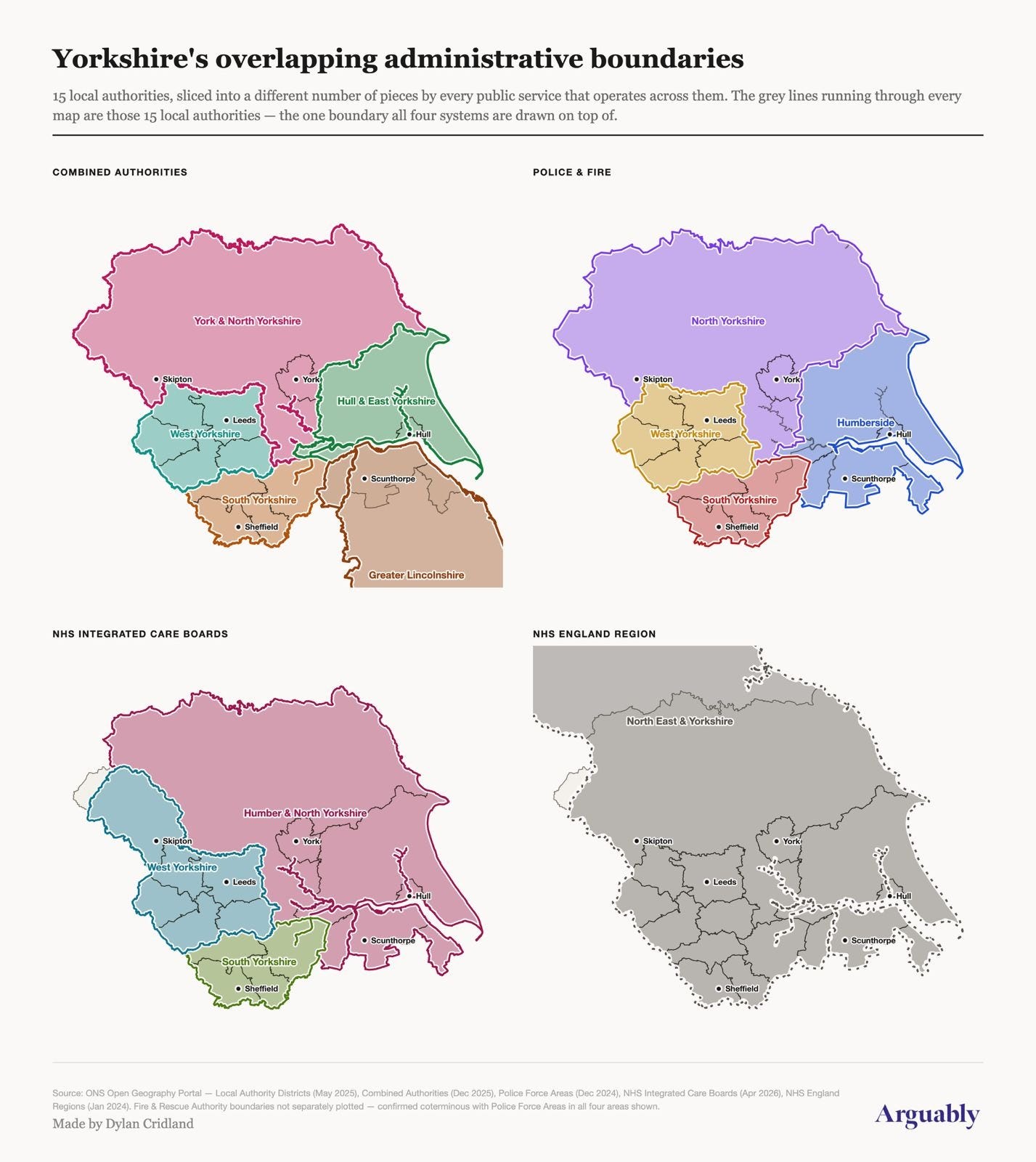
So, what should the government do? It will need to add coherence to this disorganised devolution. It must first establish mayors across all of England. No longer can England tolerate spatial inequalities of its own creation, with a small number of strategic authorities benefiting from devolution and swathes of areas, including much of the South, without it. Burnham has been clear that he wants to see change in “every postcode”. A necessary precondition is allowing public services to coalesce around one institution. The Starmer administration failed to establish more mayors owing to a combination of departmental budget constraints and a fear of creating powerful political opponents who would end the near-hegemony of Labour mayors. The Burnham administration will need to demonstrate that it is committed to devolution as a principle rather than merely when it is politically convenient.
With mayors across England, the government can begin to reconfigure institutional boundaries around them, starting with those Burnham has already outlined. The police forces undergoing change are low-hanging fruit, but so too are School Commissioners based in the Department for Education. Ofsted monitors school performance and local authorities work with council-owned schools, but there is no whole-system democratic oversight. To address that deficit, Burnham is reportedly considering ‘Health and Education Commissioners’ to oversee GPs, schools and childcare providers.
Given the prospect of public control over water and energy, the Water Supply Areas, controlled by regional water companies, are another candidate for alignment. With oversight over water, mayors could return to an approach practised in Victorian England, with ‘Water Commissioners’ or ‘Commissioners of Sewers’ responsible for managing water shortages and poor sanitary conditions. Align the geographies of utilities with strategic authorities and, much like the Victorians, mayors could have real oversight over their performance.
This is no big bang. In fact, restructuring these institutions is likely to take time – and while the ambition is welcome, the timeframe the Burnham administration has set is, at best, demanding and, at worst, undeliverable. The Starmer administration was afflicted by state reform fatigue as it sought to reorganise local authorities at the same time as pursuing devolution. Burnham will need to avoid making the same mistake.
The ability of mayors to act as convenors and market-shapers, to hold the police and water industry to account, and to work with prisons to give people a better chance at life, as Burnham did in Greater Manchester, requires a sensible administrative geography. Fixing the Incoherent State is critical to making the most of devolution and public service reform. The Burnham administration must grasp the nettle with both hands; now is not the time for half-measures.
