


Today on Arguably, Daisy Christodoulou, the author of Seven Myths about Education, writes on the lessons Labour should draw from England’s recent school success.

Every three years, the OECD publishes the results of its PISA assessments – a worldwide study of how well 15-year-olds do in reading, maths and science. Last week, the results of PISA 2025 were published and were among the most dramatic on record. The average test scores across dozens of countries have fallen precipitously since the last assessment in 2022 – and those scores were themselves down on the 2018 round.
What is going on? Two global trends are likely to be part of the explanation. First, Covid and the pandemic-era school closures may well have had a bigger, and longer-term, impact than we thought. Second, the rising use of technology and social media may be sapping students’ capacity to concentrate.
But England has avoided the downward trend: it is in the global top ten for reading, maths and science, and the second highest-performing country outside of East Asia.
Comparing England with the devolved nations is instructive. In 2012, England and Scotland scored around the same, but by 2025, Scottish students had fallen about a year behind in maths and science, and a smaller amount in reading. The scores of students in Northern Ireland, with its selective grammar school system, are around the same as in Scotland, while the scores of students in Wales are even lower.
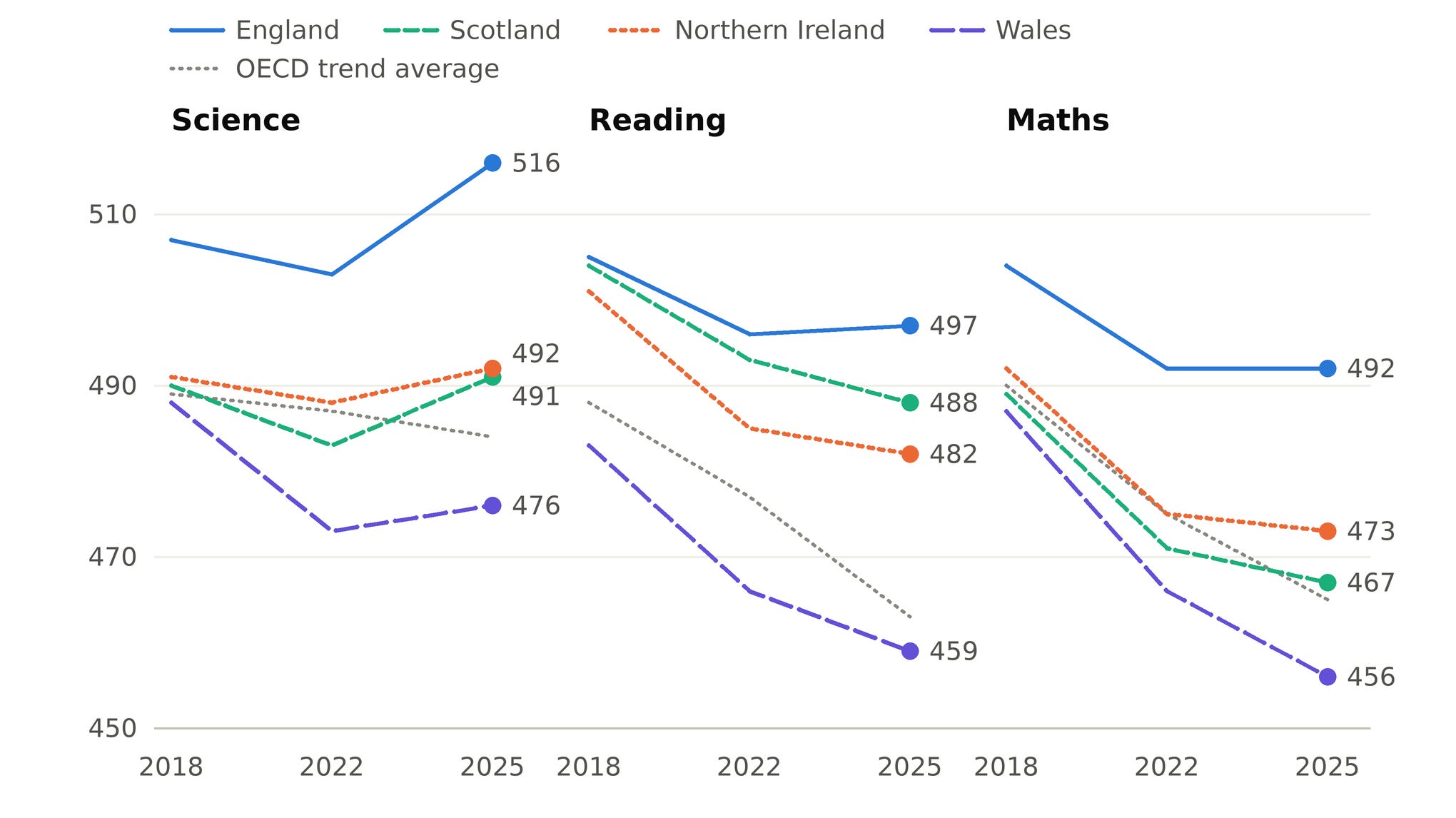
Chart: Arguably. UK devolved national educational authorities PISA scores: science, reading and maths, 2018-2025.
Comparing policy approaches is also instructive. From 2010, England pursued a different education policy to Wales and Scotland – and, it has to be said, to many other parts of the world. As education secretary from 2010-14, Michael Gove introduced a knowledge-rich curriculum, removed coursework and teacher assessment from the exam system and reformed school league tables to focus on qualifications in traditional subject areas: English, maths, the sciences, history or geography and foreign languages (the English Baccalaureate).
The schools minister, Nick Gibb, oversaw a programme of phonics teaching and assessment in primary schools. There were structural changes too: it was made easier for state schools to opt out of local authority control and become academies and new ‘free schools’ were established, many of which were deeply committed to Gove and Gibb’s principles of explicit teaching, direct instruction and high expectations for all students.
By contrast, Wales and Scotland embraced almost diametrically opposed policies. Scotland started developing its Curriculum for Excellence in the late 2000s, and one of its main architects moved to Wales to advise on the curriculum. These curricula rejected the importance of traditional knowledge and assessment in favour of concepts such as 21st-century skills, teacher assessment and project-based learning.
This type of policy experiment is one of the benefits of devolution: culturally similar regions can pursue different policies, and we can all learn from the findings. And in this case, the findings are clear. It’s not just PISA 2025: English students are doing well in other international tests too, while some of the new free schools championed by Gove are delivering remarkable results and attracting visitors from around the world.
Michaela Community School in Brent, with its controversial head teacher Katharine Birbalsingh, gets a lot of headlines, but there are other highly successful new schools too: Mercia School in Sheffield, Dixons Trinity in Bradford and Ark Soane in London have all posted exceptionally impressive results with non-selective intakes.
Are there downsides to English academic success? A common refrain is that English schools might be doing well at exams, but the students who leave them struggle in the job market, with 839,000 young people in England not in employment, education or training. However, the UK’s natural experiment can help us. Wales has a higher NEET rate than England, and one that has risen faster. So clearly education policy cannot solely be to blame here: it is likely that other economic factors matter more.
Another possible downside is mental health. Perhaps English students are uniquely depressed and miserable as a result of hot-housing in exam-factory-style schools. Again, this is difficult to sustain: the World Health Organisation does a frequent survey of adolescent health and while it finds that English students do dislike school and feel pressured by schoolwork, it also identifies something very similar in Wales and Scotland. As with NEETs, these are complex areas with complex causes which are not totally within the gift of schools to change.
What should Labour’s – and more broadly, the centre left’s – response to all this be? At present the signs are that the government would like to tear up many aspects of the Gove settlement. Education Secretary Lucy Powell and her predecessor Bridget Phillipson have been sceptical of school freedoms, academic accountability metrics, such as the EBacc, and the focus on terminal exams. But unpicking Gove’s reforms would be a mistake. On a purely political level, it is problematic for Labour to seem ambivalent about a success story which is attracting so much positive international attention.
But, more importantly, it would also be a mistaken policy turn. Gove’s measures delivered benefits for individuals and for the country at large, and it would be better to extend their reach than cancel them outright.
Two specific reforms, currently under discussion, represent a retrograde step. First, Powell has suggested that she would like to bring back coursework for national exams. This is a bad idea: even in 2010 it was obvious that coursework was being gamed and becoming a workload-heavy time sink for teachers and students. Now, with the advent of generative AI, the potential for coursework to lead to plagiarism is greater than ever.
Second, Andy Burnham has suggested that we need new qualifications such as GCSEs in AI, manufacturing and plumbing. These might sound relevant and good for the job market, but history shows that it is very hard for 11-16 schools to deliver high-quality vocational courses for large numbers of students.
A student who wants a career in AI is probably better served by doing well in their GCSE maths and physics courses than by taking a new GCSE in AI. A student who wants to be a plumber will be better served by enrolling on an existing plumbing NVQ at a further education college, which can provide specialist equipment and teaching, and manage links with local employers.
What should a reforming Labour government do instead? Powell has said that she wants an education system that “spreads excellence” rather than hoards it. One possible policy would be to identify around a hundred outstanding middle and senior leaders who have worked at some of the most successful schools in England, and create a training programme focused on preparing them for headship in struggling schools outside the big cities. If the government wants to focus on vocational education, it might be better to concentrate on FE colleges rather than schools, as they have greater specialist vocational expertise.
If Labour is serious about spreading rather than hoarding excellence, this would be far more powerful than dismantling a curriculum, assessment and accountability system that is rapidly becoming the envy of the world.
