


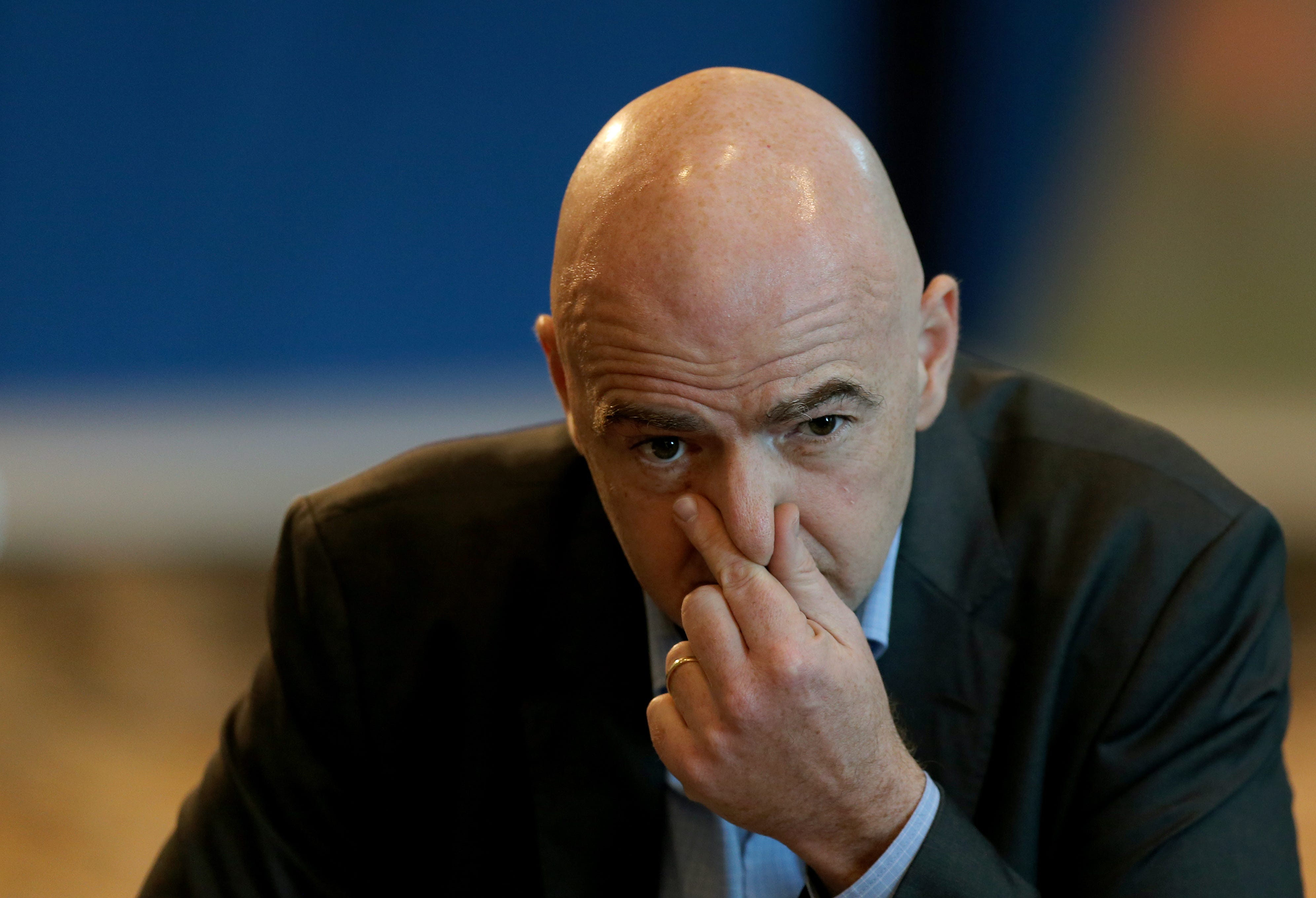
FIFA president, Gianni Infantino (Wikimedia Commons)
“Show me the incentive and I’ll show you the outcome.” – Charlie Munger
Donald Trump had barely been ushered away from the middle of Spain’s World Cup celebrations before reports emerged that FIFA president Gianni Infantino wanted to sell a stake in the future of the tournament. This plan has thankfully now been abandoned after a response that was about as positive as Barcelona fans were when Luis Figo signed for Real Madrid. UEFA’s members threw the metaphorical pig’s head by unanimously threatening to boycott FIFA competitions, while the Asian and North American confederations also signalled their strong disapproval.
The proposal is now dead, but it was only the latest symptom of a deeper problem. Schemes such as this will keep returning in different forms as long as FIFA is structured to profit from the decisions it makes as football’s governing body. Only institutional reform can break that cycle.
What has gone wrong
This is hardly the first time FIFA has been accused of putting money ahead of the good of the game. In 2015, US prosecutors charged senior officials over a 24-year scheme involving more than $150m in alleged bribes and kickbacks. Sepp Blatter resigned days after being re-elected, while much of FIFA’s leadership was arrested or removed.
Infantino was elected in 2016 promising to “implement good governance and transparency” which he said would “help to restore trust in our organisation and deter future wrongdoing.” Two years later, he was promoting a secretive $25bn deal with outside investors to create new and expanded competitions.
The proposal that has just been scrapped, FIFA Forward Enterprise (FFE), would have been a new subsidiary valued at around $20bn. It would have placed the commercial operations of future World Cups and other FIFA competitions into a separate company, then sold investors a minority stake in the revenues generated by those tournaments, with FIFA retaining overall control.
The temptation is to denounce FIFA greed and demand that it govern purely in the interests of football. It is a noble sentiment, but if proper governance of the game requires every FIFA bigwig to acquire the moral fibre of a Boy Scout, we will probably be waiting a very long time.
Human beings are good at rationalising whatever decision materially benefits them into the morally virtuous choice. What psychologists call “moral wiggle room” means that people interpret the facts and consequences in ways that serve their own interests while preserving their belief that they are decent people. This means that good intentions can resist a badly designed system for a while, but the quality of an institution cannot depend on the virtue of whoever happens to run it forever.
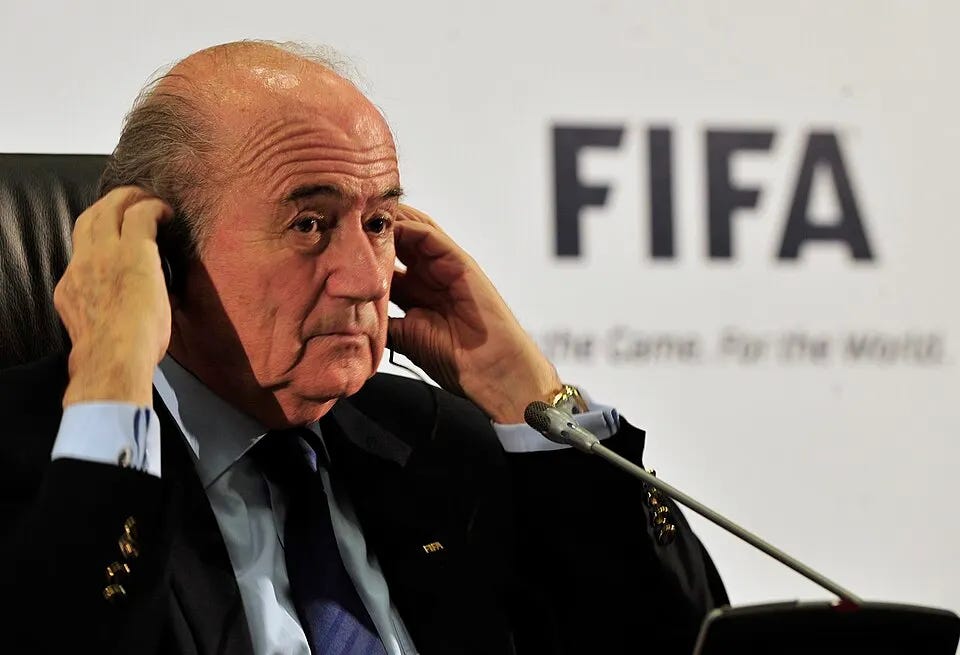
Former FIFA president Sepp Blatter, who was suspended following the 2015 investigation. (Marcello Casal Jr./ABr Wikimedia Commons)
FIFA’s recurring problems stem from its structural setup. It governs world football while also staging the competitions that generate most of its income. One responsibility is to protect and develop the game, but the other is to maximise FIFA’s bottom line.
Those interests can sometimes overlap, especially when a successful World Cup generates funding for countries with fewer resources. If that investment ever finally reaches the right people, standards rise and international football becomes more competitive. This can create a virtuous cycle where more money produces stronger tournaments, and those stronger tournaments generate more money to reinvest in the game. The problems come when FIFA’s commercial interests conflict with the interests of the game.
Every additional match produces more broadcast money, ticket sales and sponsorships, so FIFA has a powerful financial incentive to make its competitions as large and as frequent as possible. Recently, it’s been doing this very successfully, and the Club World Cup and men’s World Cup expansion coincided with spectacular financial results. Just before the final, Infantino said FIFA expected revenue to exceed $15bn across the 2023-2026 cycle and promised to “unleash” its remaining commercial potential.
This has not had a positive effect on the players’ bodies. FIFPRO’s workload study tracked 1,500 male players and compared their schedules with recommendations from medical experts. Those experts called for 28 days of off-season rest followed by another 28 days of pre-season preparation. However, Chelsea received only 13 days of pre-season after winning the 2025 Club World Cup, while Paris Saint-Germain had seven.
Kevin De Bruyne summed up the problem in 2024: “It seems that money speaks louder than the players’ voices.” Multimillionaire footballers may not be the most instinctively sympathetic group of workers, but a sport in which its biggest attractions are all lying on a surgeon’s slab is worse for everyone watching it.
Supporters’ bank accounts have been on the receiving end of FIFA’s incentives too. Before the 2026 tournament, the cheapest final ticket offered through national association allocations cost £3,129. Following a team from its first match to the final through those allocations would cost around five times the equivalent price in Qatar.
Selling a stake in FFE would have made FIFA’s decision-making even more lopsided in favour of money-making. The investors were not willingly handing over billions of dollars because they felt strongly about improving grassroots coaching in Suriname. At the same time, the proposal would have protected FIFA’s leadership from opposition, given it would double the amount of money each association would receive – sums which are literally game-changing for smaller nations.
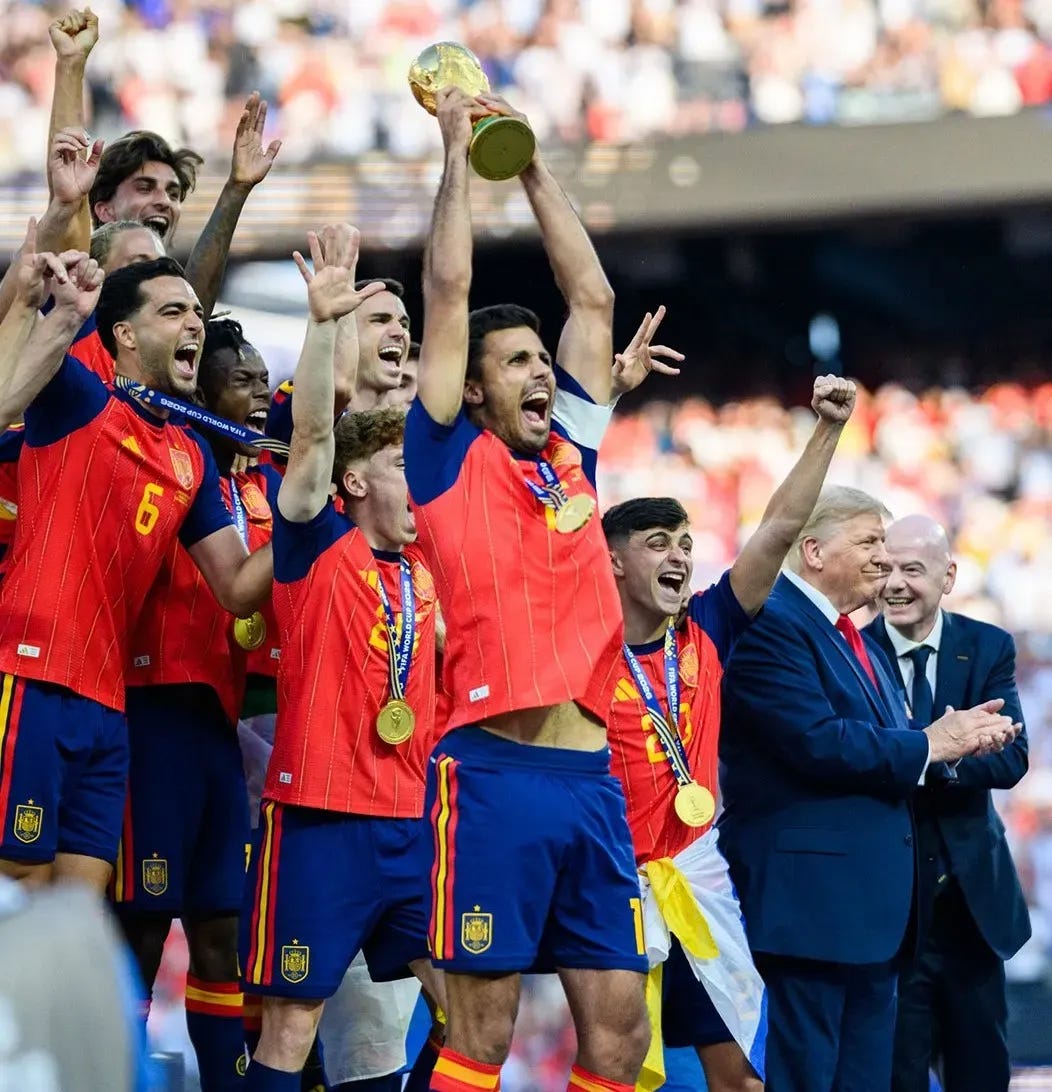
Spain celebrating winning the 2026 World Cup alongside Donald Trump and Gianni Infantini (Wikimedia Commons)
What is to be done
To fix this, we need to separate FIFA’s commercial and governance functions. This would mean creating a new commercial company that would sell media rights, sell sponsorships and generally seek outside investment. At the same time, though, a separate governing body would be established to control the international calendar, competition formats, player workloads, issues around supporter access, and, God knows, maybe even minimum human rights violation standards for proposed World Cup host countries.
For that separation to work in practice, nobody would be able to hold a position in both organisations. Most importantly, pay and bonuses in the governing body would have to be unrelated to commercial income, rather than increasing each time it approved another tournament or added more matches.
Imagine that the commercial arm proposes another expansion of the World Cup to 64 teams. That would be well within its transparent remit of maximising revenue. The key, though, would be that the governing body would have no financial incentive to agree. Because of this, it would be able to judge the proposal against metrics it thought good for the game’s long-term viability. The final decision taken would come from a, hopefully creative, tension between commercial ambition and football’s wider interests.
Under FFE, there still wouldn’t have been that separation between functions. FIFA would own the company, control its board, and decide the calendar and tournament formats. The commercial arm may technically have sat in a different legal entity, but the same people would still make the rules and benefit from the money those rules generate.
Even if that plan is not to be, how likely is FIFA to impose restraints on itself going forward? Today, I feel sceptical. Today, I feel cynical. Today, I feel unconvinced.
Any serious separation would threaten the financial interests of FIFA’s leadership. The people required to approve reform are the same people who benefit from the present system.
Meaningful change would require governments to challenge FIFA’s position. The US is powerful enough to do this, but the Trump-Infantino bromance, coupled with the fact that one of FFE’s proposed lead investors was Trump’s son-in-law’s brother, Joshua Kushner, means it won’t happen anytime soon. The EU might be able to have some influence, but they move slower than Teddy Sheringham at the best of times (although, maybe the first yard is in Ursula von der Leyen’s head too).
UEFA’s threat may have worked to defeat this particular proposal, and they may even get Infantino to resign. But stopping one ill-judged scheme would not correct the structure that produced it. Until that structure changes, FIFA’s behaviour will stay the same.
