


Today on Arguably, I assess the lessons of the most significant local elections for a generation and propose a way forward for Labour. This article is free to read but become a paid subscriber for just £6 a month to ensure you receive all of our post-election coverage.

Image: FotoField/Shutterstock
Banish all talk of “midterm blues”. That was the comforting line that the Conservatives used as they shedded votes to left and right before the great humbling of 2024. Labour now risks a version of the same fate – not political death, but irrelevance, reduced to a rump akin to the French Socialists, Forza Italia or Kemi Badenoch’s Tories.
At every turn, these results undercut the party’s self-image. The “Red Wall”, “Labour London”, “Labour Scotland”, “Labour Wales” – these fortresses are now either crumbling or demolished. With just 17 per cent of the vote, behind Reform on 26 per cent and the Greens on 18 per cent, Labour’s projected national share stands at a record low. To the recurrent question of which voters it is prepared to alienate, the government answered: everyone.
Some still ask with bewilderment how Labour went from a landslide victory two years ago to this. But in truth, the warning signs were always there. The party’s support was broad but shallow, a “sandcastle majority” in the words of pollster James Kanagasooriam. I remember first warning Labour strategists of the threat posed by the Greens after witnessing the party’s Bristol insurgency before the 2024 general election, but the response was too often one of complacency. Little thought was given to the prospect that Labour might one day face a substantial challenge to its left as well its as right, both fuelled by economic insecurity.
The government’s parlous state reflects failures of both personnel and policy. No serious analysis can ignore Keir Starmer’s record unpopularity (a net favourability rating of -45) and the historic unlikelihood that he can win a second general election from this position. A Labour leadership contest is now a matter of when, not if, as some of those MPs publicly maintaining faith in Starmer know.
Both he and Labour have suffered from overwhelmingly negative definition, with all too little positive to compensate. The below chart from More in Common illustrates the problem better than any other.
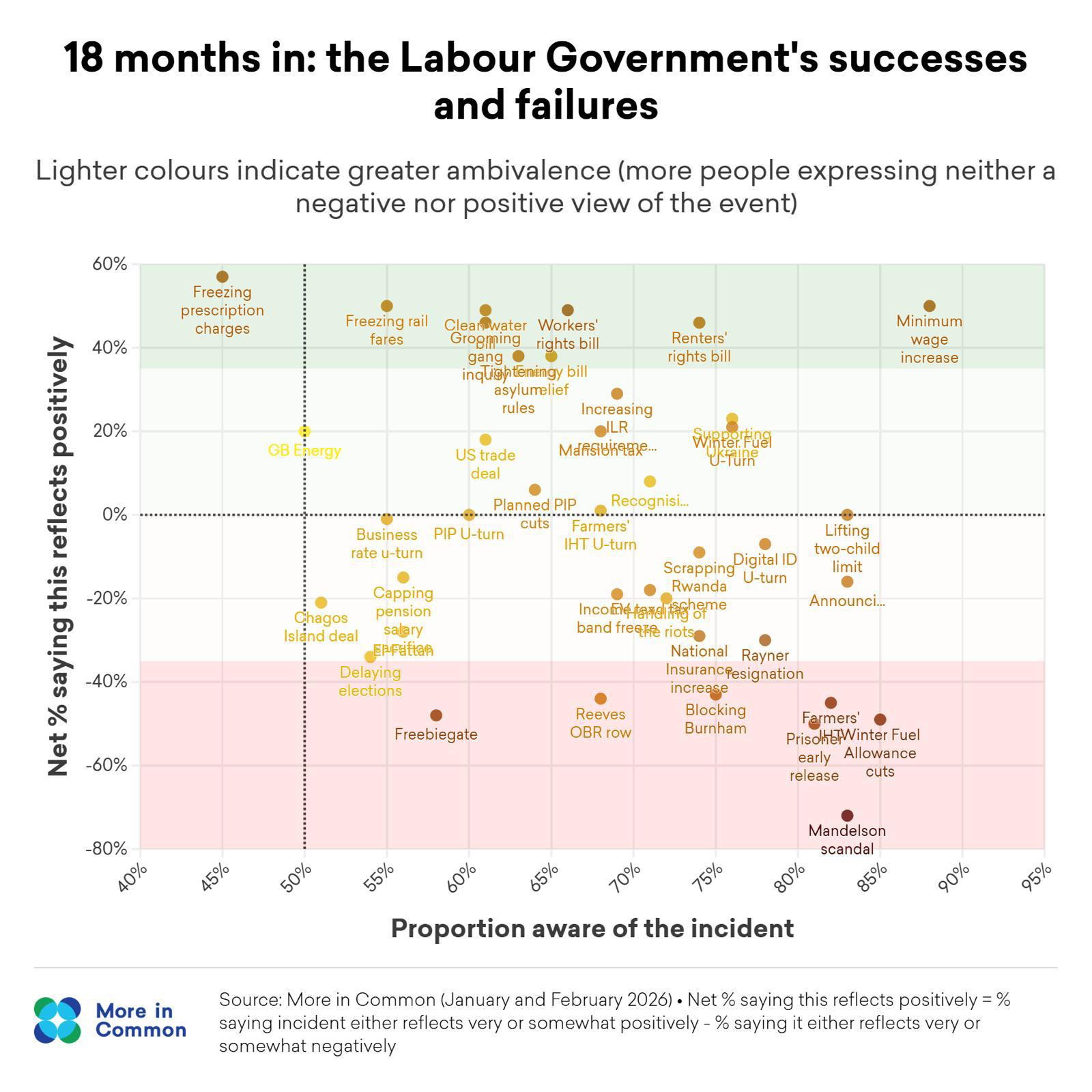
Labour has had no shortage of unpopular and high-salience decision – the winter fuel cuts, the appointment of Peter Mandelson as US ambassador, the farmers’ tax – but the minimum wage rise is the only popular policy that has enjoyed similar cut-through.
A false debate has now begun over whether Labour should prioritise winning back “progressive” voters from the Greens or defectors from Reform. In reality, it needs to do both. For every 10 voters Labour is losing to Reform or the Conservatives, it is losing 16 to the Greens, the Liberal Democrats, Plaid Cymru and the SNP. But rather than making a crude choice between either side, the party must forge what Liam Byrne in his recent book on populism calls a “heroic coalition” – uniting left-bloc voters with Reform’s more pragmatic and persuadable supporters (those focused on living standards and public services).
It would be a fundamental error for Labour to conclude that salvation lies in mimicking its rivals. Green policies such as rent controls and an annual wealth tax only offer false hope – international evidence shows they would not deliver the promised outcomes. Meanwhile, withdrawing from the European Convention on Human Rights at the behest of Reform would leave the UK isolated internationally, undermine the Good Friday Agreement and do far less to tackle illegal immigration than usually assumed.
Rather than chasing its opponents’ tails, Labour must reclaim the radical centre, adopting a reformist cast of mind focused on policies that will actually improve people’s lives. There is, as Arguably columnist David Lawrence has noted, a progressive, pro-growth agenda that no party adequately represents: reforming the planning and building safety rules throttling housebuilding, allowing mayors to approve and fund local transport projects, replacing stamp duty with a proportional property tax, removing punitive marginal tax rates of up to 77 per cent, reforming the triple lock and expanding high-skilled migration routes.
But at this extraordinary hour, this is not enough. What Labour lacks is not merely a compelling programme but a national project: a cause that connects economic growth, geopolitical security, patriotic renewal and generational optimism. Perhaps the most plausible candidate is a pledge to seek to rejoin the EU (through a new referendum).
That might surprise you, but in recent years there has been a quiet transformation in public opinion as the cost of Brexit has become ever clearer. Sixty five per cent of Labour supporters and 79 per cent of Greens already favour Rejoin, according to a BMG Research poll this week, but, crucially, they are joined by 37 per cent of Tories (a forgotten tribe) and even 22 per cent of Reform voters. As Sam Freedman has written, a major offer on Europe is “one of the few topics that will be polarising enough to get media attention while unifying a potential coalition”.
In previous surveys support for Rejoin has endured even when the public is confronted by the return of free movement – a different proposition now that central and eastern European living standards have drawn closer to those of the west. A theoretical commitment to join the Euro would be another matter, but here realism is needed. A Europe that would, broadly, welcome the UK’s return as a prodigal son would likely accept constructive ambiguity on this question (Denmark, the Czech Republic, Hungary, Poland, Romania and Sweden all remain outside the single currency).
The EU is far from a perfect institution – it has often been too opaque in its decision-making, too wasteful in its spending and too remote from its citizens. But as the world fragments into rival blocs, it offers Britain and its European social model the best shelter from the geopolitical storm. Labour’s current “reset” is far too modest to mitigate the economic cost of Brexit – now estimated at up to 6-8 per cent of GDP – and risks falling into an electoral valley of death: too hard for Leavers, but too soft for Remainers. The prospect of “dynamic alignment” is, I’d wager, unlikely to excite many voters and Britain should aspire to shape Europe’s rules, not merely follow them.
The UK’s political future is not yet set. Reform is comfortably ahead but still short of the support required to be confident of winning a parliamentary majority. The Greens’ gains are, for now, too narrow for them to become the main left challenger. Their rise creates opportunities as well as risks for Labour – millions of floating voters are unattracted by either.
In the postwar era, the stakes have rarely been higher. The next election will not simply determine which party governs Britain but whether the country remains anchored in a liberal, social democratic tradition at all. This, then, is a moment for neither denialism nor fatalism, but for a progressive agenda finally equal to this moment of crisis.