


Today on Arguably, Aveek Bhattacharya, strategy fellow at Coefficient Giving and former chief economist of the Social Market Foundation, sets out how Andy Burnham can meet his pledge to end rough sleeping.
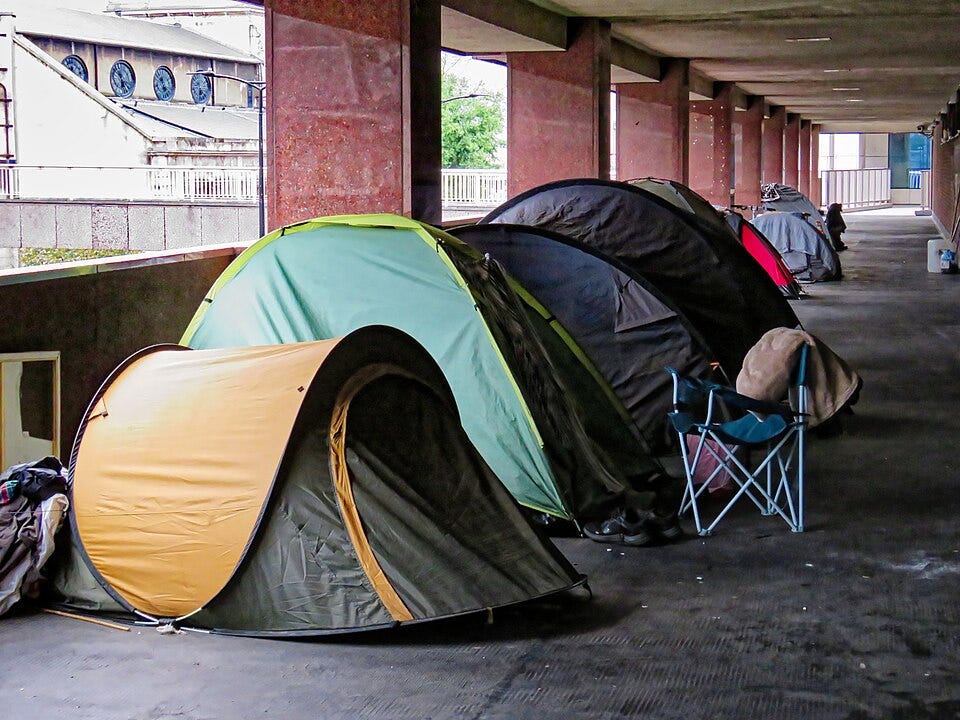
Rough sleepers in the City of London (Acabashi/Wikimedia Commons)
To be a successful Prime Minister, Andy Burnham needs to improve upon his predecessor in numerous ways, but two of the most pressing are delivering quick, tangible results and proving that he has authentic principles and values. That’s why making his first instruction an order to end rough sleeping is so powerful. It meets both of those objectives while tackling a moral outrage that scars our society.
Keir Starmer was hardly wrong when he said that the country needs a “decade of national renewal”. Investment and reform will take time to pay off and the economy, energy system and housing market cannot be turned around overnight. Burnham’s intention to develop a “10-year plan for Britain” recognises this reality. Yet voters are fast losing patience: 51% expect to see “real improvements in our country” within the next year compared to 62% who were willing to give Starmer more time than that when he entered office.
Street homelessness is one of the most visible indicators of societal failure but unlike other long-term challenges, it is possible to make rapid and evident progress. The last Labour government prioritised this issue, meeting its target of reducing rough sleeping by two-thirds between 1999 and 2001. It achieved this through assertive outreach, investment in prevention and funding for shelters, and built on these successes to reduce other forms of homelessness. Yet the Conservative-Liberal Democrat coalition halted this progress in 2010, cancelling national homelessness programmes and devolving all responsibility to local government. Rough sleeping duly surged again. A 43% fall during the Covid-19 pandemic, building on Theresa May’s nascent efforts to end rough sleeping by 2027, provided further evidence of what can be achieved. But these gains were again squandered and rough sleeping reached a record high in 2025, up 171% since 2010.
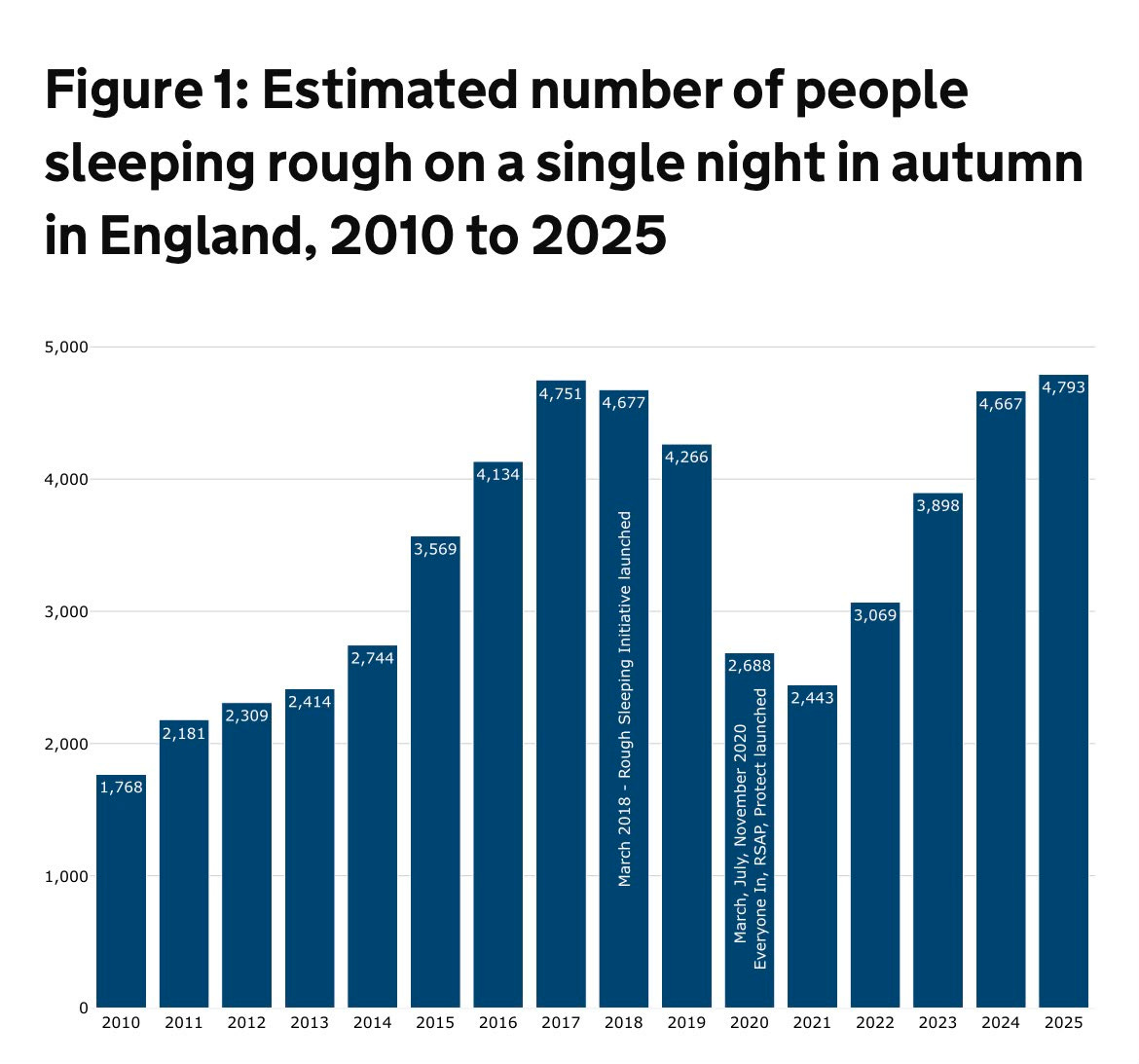
We await the detail of Burnham’s target, but it would make sense for him to try and match the scale of improvement achieved under New Labour, reducing rough sleeping by at least two-thirds by the end of the parliament. It won’t be easy, but it’s a promise history shows he can keep. And it is one that voters can hold him accountable for with the evidence of their own eyes.
This said, a signature promise on homelessness might prompt an unpleasant sense of déjà vu in Burnham. When he took office as mayor of Greater Manchester in 2017, he set himself the goal of ending rough sleeping across the city region by 2020 (donating 15% of his mayoral salary to the cause). Though he made impressive initial progress, reducing the number by two-thirds by 2021, the problem has returned. Reducing rough sleeping by a quarter, as Burnham did in Manchester, is not to be dismissed, but for the last four years the figures have gone in the wrong direction and the city region no longer outperforms the rest of the country.
From No 10, Burnham has the opportunity not just to make good on his original promise, but to turn this apparent failure to his advantage. He can, with some justification, claim that decisions taken in Westminster undermined his homelessness initiatives in Manchester. Budget constraints, a lack of available beds, failures in the welfare system and evictions of asylum seekers have all been blamed for the resurgence of rough sleeping in the city. Now, with his hands on all those policy levers, Burnham has the chance to wade upstream and stem the flow of new cases he dealt with as mayor.
In particular, from the centre of power, Burnham can scale up the ‘Housing First’ approach he has long championed, which prioritises securing access to shelter for those with addiction, mental health or employment challenges, rather than putting conditions on public accommodation places. The scheme has seen dramatic success, reducing rough sleeping in Finland by half, and eliminating rough sleeping among pilot participants in English cities after a year.
The three-year, £340m investment announced by Burnham this week, to acquire 1,2000 homes and provide “intensive support” to 3,000 long-term rough sleepers, should be sufficient to expand Housing First nationally. The Social Market Foundation (SMF) think thank, where I used to work, estimates it will cost around £75m a year to provide accommodation to everyone currently sleeping rough in England, a total offset by savings to public services within five years. This funding should be used to secure accommodation agreements and partnerships and hire support workers able to offer individualised help, linked up with health and addiction services as well as the wider voluntary sector. The programme should be led at local authority level, but with oversight and lesson sharing from a director overseeing the process within the Ministry of Housing, Communities and Local Government.
That should address the stock of high-need rough sleepers and get a grip on the acute problem. Staunching the flow of people being thrown out on the streets will also require some upstream prevention to help people at risk of rough sleeping. This might involve temporary supported accommodation, funding domestic violence refuges, and extra support around discharge from prison, hospital or the asylum system. The costs here could plausibly run into the low billions and might be funded by housing ‘sin taxes’: levies on empty properties, purchases by foreign residents and house flipping, which other countries make greater use of. The SMF has estimated these could raise as much as £4bn a year.
The PM is doubtless aware that rough sleeping is just one part of the homelessness crisis, let alone the wider economy, and increasing housebuilding and supporting growth should certainly be his medium-term objectives. Yet faced with a sceptical public fast losing faith in the state’s capacity for delivery, he needs to get some quick wins on the board. Making a big prominent vow to functionally eliminate rough sleeping – again – risks creating a hostage to fortune. But it’s a risk worth taking. If we’ve learned anything in recent weeks, it’s that Burnham isn’t afraid to gamble with his reputation – and win.
