



A new consensus is emerging. Low or even negative net migration is good and what voters want. Home Secretary Shabana Mahmood remarked last November, when UK net migration stood at 170,000, that “when I first came into parliament, back in the days of 2010 and onwards, we were talking about migration in the tens of thousands, so I would say it is still pretty high”. The few politicians who do acknowledge the negative implications for national income and tax revenue – a potential £7bn hit to headroom in this month’s Budget – argue that Whitehall can offset them. Foreign workers are now an “addiction,” as Keir Starmer put it, that must be replaced with homegrown employment.
But this consensus has now been complicated by Andy Burnham’s Labour conference speech. In Liverpool, the Prime Minister declared that he would reopen the debate on the UK-EU relationship. Burnham says he will consider all options, from a customs union to the single market to Rejoin. Free movement of people will be the EU’s price for any deal that substantially reduces the cost of Brexit.
This is because the EU remains committed to the policy that all four freedoms of the single market must go together: goods, services, capital and people. Without the latter, British businesses will not gain substantially greater access to the other freedoms. The helpful but minimal UK-EU ‘reset’, which would trade small reductions in trade barriers for a youth mobility scheme, represents the limits of either side’s ambition to date. As a result, the UK is saying ‘no thanks’ to a large amount of potential national income gained through higher trade, migration and investment with the EU.
Britain could re-establish free movement with the EU in two ways: by rejoining the EU (boosting GDP by up to 5%) or by negotiating a single market agreement (up to 3%) that provides barrier-free trade in exchange for the free movement of people and alignment with EU rules (but with virtually no say over those rules).
To unlock bigger economic gains, progressives will have to win the argument on free movement. This isn’t as impossible as it appears, with half of the public saying they would support free movement in order to improve economic relations with the EU, and just 21% opposed, according to a recent Ipsos poll. There are a number of arguments that Labour could make, which have the advantage of being true as well as politically helpful.
Historically, free movement is the biggest expansion of autonomy for Europeans that the EU has delivered. No other developed economies – bar Ireland and the UK, and New Zealand and Australia – grant reciprocal rights to live, work and retire in each other’s jurisdictions. These reciprocal arrangements provide people with a wider choice of jobs, relationships, culture and food – while also supplying ‘refuge’ from recessions and bad governments.
Brits are Europeans – culturally and geographically – even if we are no longer EU citizens. Why should the majority of Europeans get this right and not us? Other Europeans are also our neighbours and friends, with similar outlooks on life – we share similar preferences on work-life balance, public services, women’s rights and environmental protections. Why wouldn’t we want to be able to mix more with them?
Free movement is also good for Brits who don’t take up the right to live abroad. More EU citizens in Britain means more workers, bringing skills that we lack and more tax revenues to pay for healthcare and pensions.
Politicians portray immigration as a cheap alternative to training domestic workers, but the evidence is mixed: there appear to be lower levels of training in hospitality and construction when immigration is high, but training in other sectors of the economy rises in response. Numerous studies have shown that falling immigration leads to higher automation because domestic workers can’t be recruited to do the work. We’re fortunate that the English language, our open labour market, London and Britain’s great universities are such attractions that we became the largest destination for new EU citizens after enlargement in 2004.
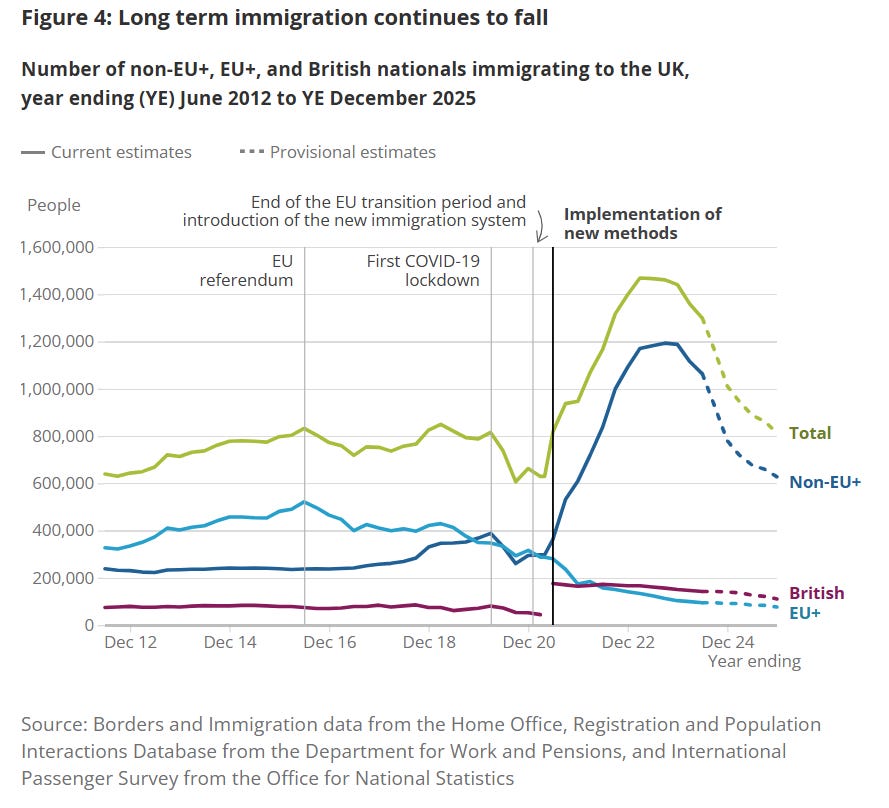
It is strange for a country with big economic problems to reject one of the few policies that we know would raise growth and improve our fiscal position. There is no fixed number of jobs in an economy, so immigrants don’t compete with British workers in a zero-sum game. Immigrants spend their wages and so create demand for native workers. Immigration likely also raises average UK wages by making us more productive. The average migrant is a net benefit to the public finances.
Free movement cuts red tape. Labour’s current immigration system is a Rube Goldberg machine – attempting to deliver simple policy outcomes (lower net migration) via complex means. There are now high salary and skills thresholds, and shortage lists that will allow visas for lower-paid jobs, but only if employers in a sector agree to complicated and possibly unworkable plans to train British workers.
The government is currently in the business of workforce planning, which didn’t work when Harold Wilson’s government introduced it in 1965 and is unlikely to work now. Better to allow employers to pick the best workers for the job, while improving the UK’s poor skills training system and ensuring that the minimum wage and working conditions rules are enforced.
Ukraine joining the free movement zone is an opportunity, not a threat. Free movement flows have slowed within the EU over the last decade as incomes in newer member states have converged with those of Western European countries and unemployment in southern Europe has fallen.
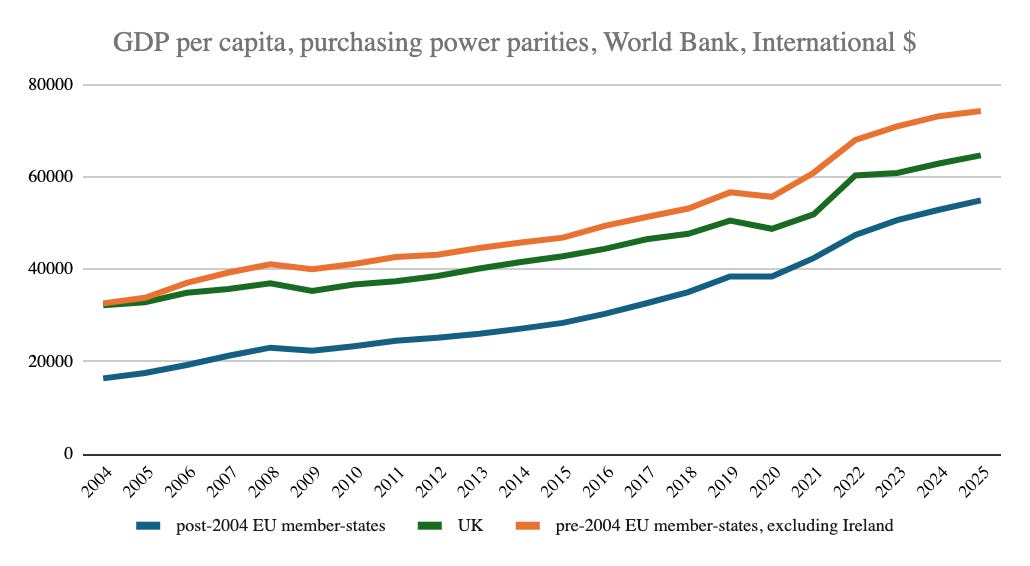
Sadly, it’s unlikely that Ursula von der Leyen’s promise of rapid Ukraine accession to the EU will happen. But when it does, it will offer a fillip to European labour markets as ageing really starts to bite in the 2030s, while the alternative – government incentives to raise birth rates – has little effect.
The final argument is that free movement constrains government overreach in Britain and elsewhere. Sweden is deporting British citizens for minor bureaucratic missteps such as failing to apply for settled status on time. EU citizens in Britain have been wrongly targeted by the Home Office and the Department for Work and Pensions. Under free movement rules, such treatment becomes illegal.
It’s no surprise that Brexit has failed to neutralise the immigration issue, as many Leave advocates predicted. We face the same trade-offs as in 2016 between growth, ageing and the cultural change that immigration brings. Politicians will always have to manage those competing imperatives, but freedom of movement offers a way to do so that’s far less damaging than the alternatives.
