


Today on Arguably, as the UK prepares for its hottest June day on record, Sam Alvis of IPPR explains why there is a green case for air conditioning.
(Aleksandar Tasevski/Shutterstock)
It’s hot, inescapably so. You’ve closed the blinds, you’ve got a tower fan running – only opening the windows once the sun has set – and it’s still 26 degrees inside. Do you risk a commute on even hotter public transport for the hope of a cooler office or stick it out at home? What are the alternatives?
Contrary to some claims, the UK doesn’t have a de facto ban on air conditioning, but it certainly doesn’t embrace it (just 5 per cent of households have air conditioning, compared to 37 per cent worldwide). Air con has a bad reputation – often cast by environmentalists as a waste of energy or a luxury for a privileged few. But if that position was ever tenable, it certainly isn’t now. There are three reasons why it’s time for progressives to embrace air con: it shows we’re serious about the danger our climate already poses to people; addressing extreme weather now is vital to mitigation in the future; and it can aid the clean-energy revolution.
Climate impacts such as extreme heat aren’t a future problem. Until 2003, UK temperatures had never reached 38 degrees. Since then we’ve broken this record three times, with the first 40-degree summer in 2022. As the UK continues to warm faster than the global average, these exceptions will become the norm. El Niño – the Pacific weather pattern that triggers higher temperatures – will likely mean another record-breaking summer in 2027.
People die in extreme heat, with 3,271 excess deaths in 2022, and it makes everything we want to achieve harder. At 26 degrees, hospitals cancel surgeries, violent crime increases and children’s exam performance falls. Our economy deteriorates: trains and flights are cancelled, worker productivity falls by 2 per cent for every degree over 20, and even our sport gets worse with more fouls and refereeing mistakes in football.
We need to protect people, public services and the economy. Passive cooling systems are vital: external shading, green space and open water all help. It’s right that the Future Homes and Building Standards starts with these for new developments, but guidance shouldn’t stop there. Passive measures have limits – they don’t change the fabric of existing buildings, which can be costly to retrofit, and, like most improvements in England, face planning barriers. They also do little for those in high-density or high-rise housing.
For many, especially in vulnerable spaces such as schools, hospitals and care homes, air con is the only option. Anyone telling you otherwise hasn’t paid enough attention to the warming we already face. Even with passive systems, keeping internal temperatures below 26 degrees is a challenge. All the guidance for newborns, for instance, is to keep the child’s room below 20 degrees. But in a mid-floor flat with south-facing windows, as I can testify, that’s an impossibility.
Trade unions, meanwhile, are rightly calling for the UK to match the likes of Spain and Germany by imposing a maximum working temperature of 27 degrees. But it’s only fair to businesses facing that regulation to have more options to actually meet it.
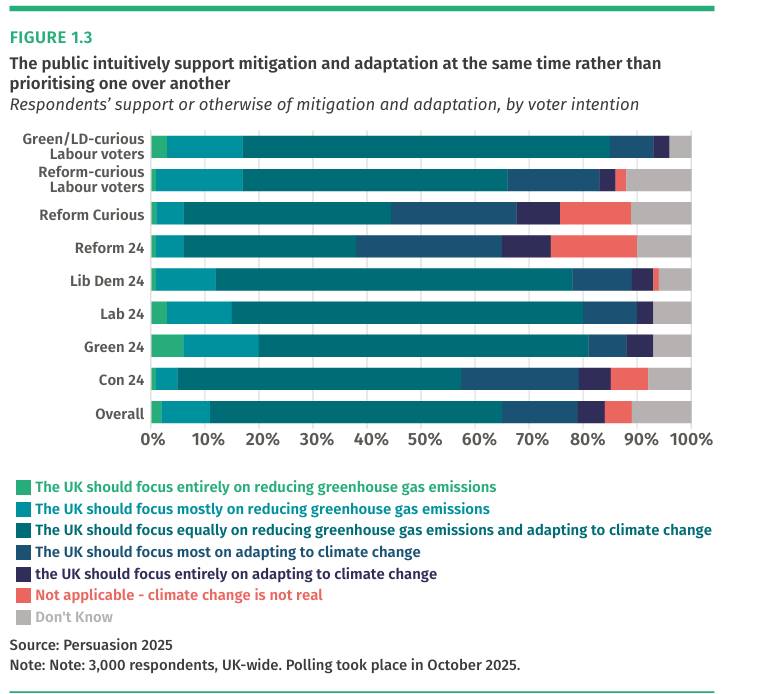
Protecting people from extreme heat is essential, but it is also vital to any hopes of mitigating emissions and keeping temperature rises at manageable levels. As Sof Jenkinson and I wrote earlier this year, the populist right is ruthless at exploiting natural disasters to undermine collective action. We saw this in Los Angeles after the 2025 wildfires and in Valencia after flooding the previous year. Without measures such as air con, we allow Reform the space to accuse a green elite of failing to protect people during a heatwave. The public wants adaptation and mitigation together – politicians should offer it.
Fortunately, the UK government already has a clear narrative available. Labour has aggressively rolled out solar panels for hundreds of schools, hospitals and public buildings to help cut energy bills. Solar is a natural partner for air con because it matches energy demand with peak supply – it’s hottest when the sun is strongest (even if solar, too, is less efficient over 26 degrees). Rather than creating excess strain on the grid, it can moderate it. Government should be installing air con alongside solar, demonstrating to the public that we can protect them now and in the future, even if that means the scheme’s £200m budget doesn’t go as far. The same is true of decarbonising heating – the government has finally made finance available for air-to-air heat pumps, with up to £2,500 grant funding through the boiler upgrade scheme.
Air conditioning doesn’t have to break the bank. The Climate Change Committee estimates that adaptation to reduce heat risk will have a lifetime cost of £2,500 per year – equivalent to the current government grant – and that covers air con, shading, ventilation and insulation.
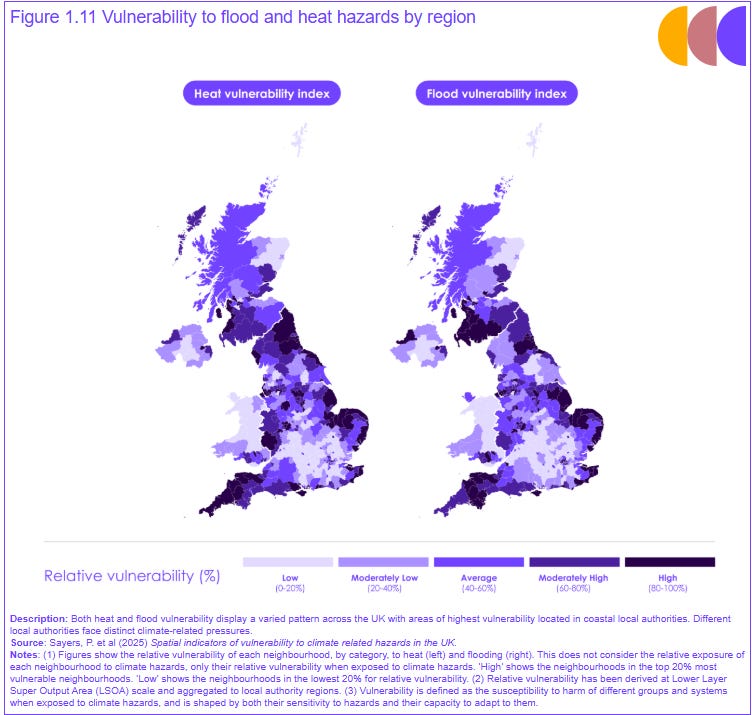
Electorally, extreme heat isn’t just a London problem; there are vulnerabilities across the UK with some of the highest risks in Reform-voting areas such as Clwyd, Clacton and Calderdale. Finding ways to get the most vulnerable air con now, and remove the barriers to others accessing it, would prove that Labour is serious about the climate we have and the one that we want.
For a progressive government, air con is a tangible example of how it can succeed where populist pretenders to the left and right fail. The left risks neglecting people’s lives and the economy now, while the right has no plan for future adaptation. To both we can signal that we want people to lead comfortable lives, and that we recognise they can’t survive on piety alone. It’s good to have nice things. Air con might be the only way for progressives to escape the heat.
