


Today on Arguably, Rob Ford, professor of political science at the University of Manchester and the author of books including Brexitland, explores how a new voting system would transform British politics.
(John Gomez/Shutterstock)
“I am committed to proportional representation,” Andy Burnham told the Observer while campaigning in the Makerfield by-election. “I think it would change the political culture.” With Burnham, a longstanding campaigner for electoral reform, now ensconced in No 10, is this the death knell for first-past-the-post?
Campaigns for electoral reform have been running for over 150 years (John Stuart Mill was an early supporter), and reformers have suffered many disappointments. Achieving reform requires a rare combination of circumstances, with popular pressure, political principle and electoral self-interest all pointing in the same direction.
Earlier efforts fell at one more or of these hurdles. The first New Labour government favoured reform in principle, but grew indifferent after concluding that a system which delivered landslides for Tony Blair wasn’t all bad. In 2011, the Lib Dems secured a referendum on introducing the Alternative Vote as part of the coalition agreement only to discover their reforming zeal wasn’t shared by the public. Will this time be different? And if reform were to happen, what would it mean for Westminster politics?
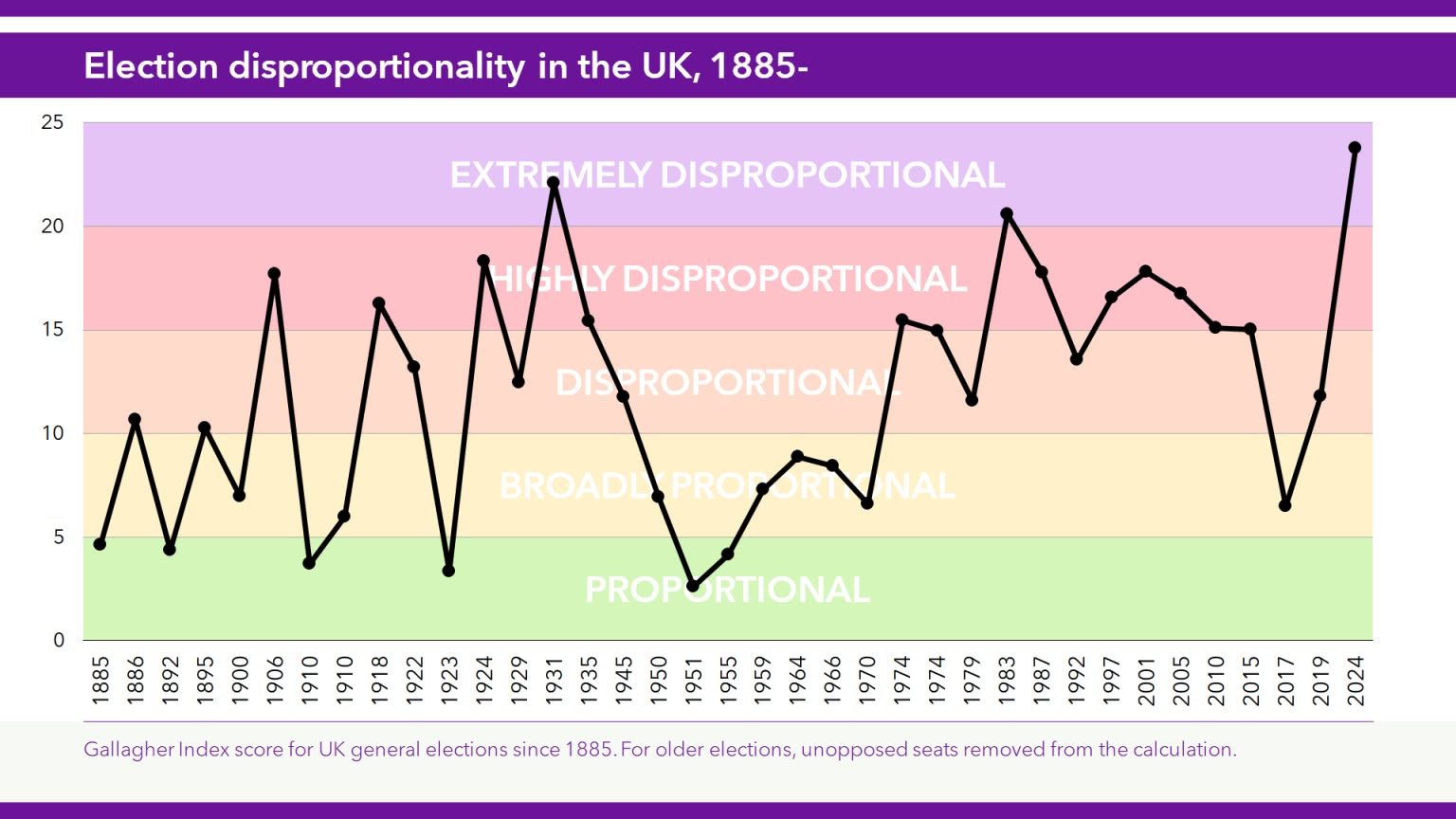
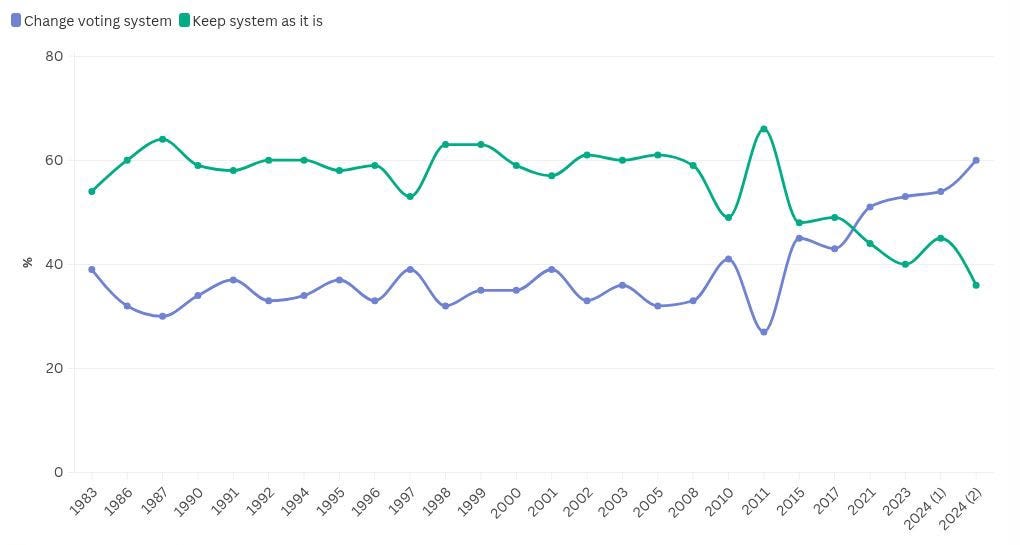
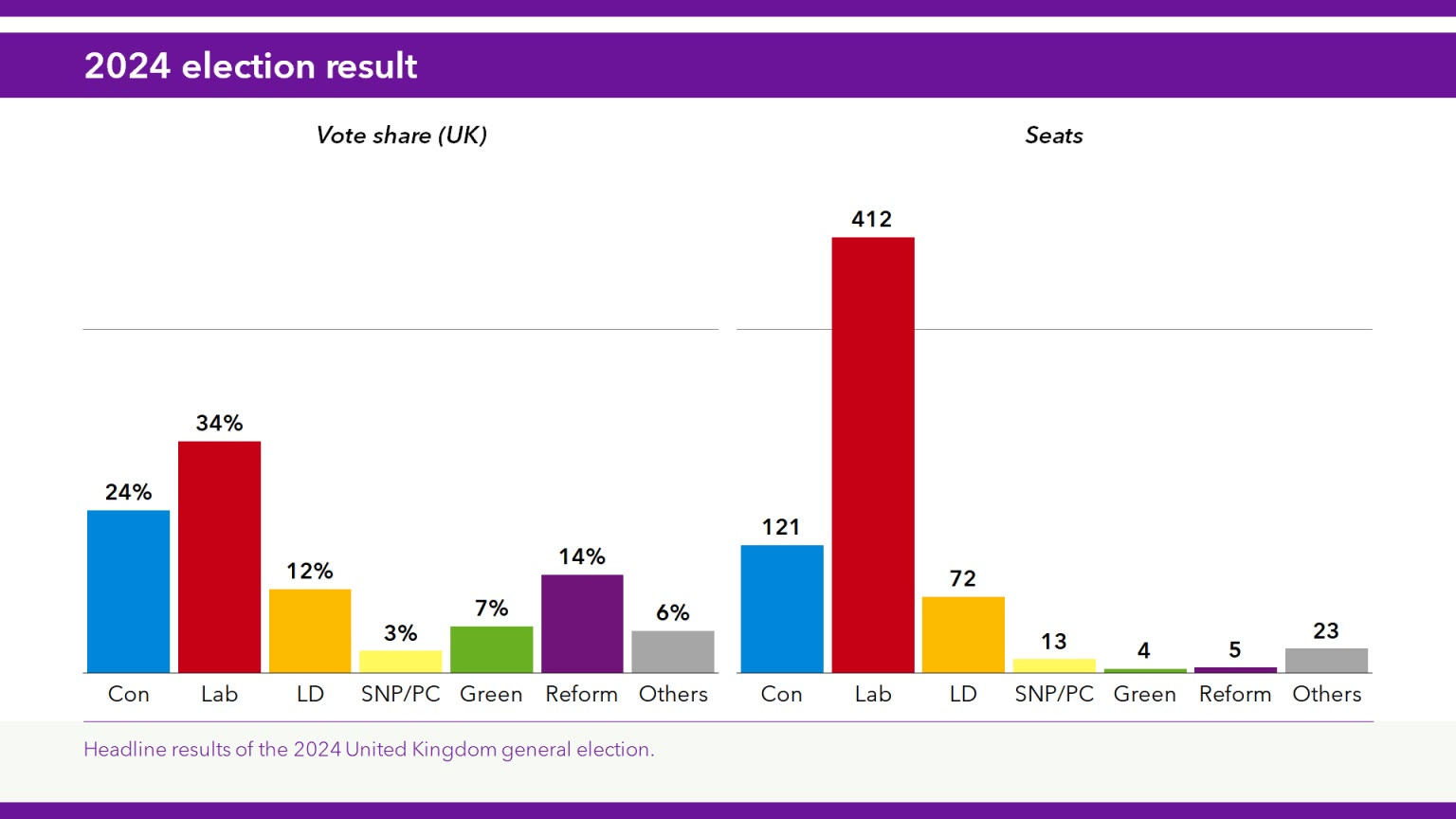
For perhaps the first time in postwar history, all the conditions for reform are now in place. The 2024 general election delivered the most disproportionate result in history, with Labour winning 63% of seats on just 34% of the vote, while Reform and the Greens won just a handful of seats despite winning a fifth of all ballots cast. This yawning gap between the will of voters and the composition of the Commons has helped shift public attitudes, with record shares backing electoral reform in the wake of the 2024 result.
(Make Votes Matter)
The principled arguments for reform have also gained ground. As chaotic and unrepresentative results have become more commonplace, the case for a more inclusive and consistently representative electoral system has grown. Smaller parties, for whom principle generally coincides with electoral self-interest, have long made such arguments. But they are now also making headway too in the largest parties, particularly Labour, where a broad coalition of support for a more proportional system has emerged in recent years, including a majority of members, many of the largest affiliated trade unions, and many backbench MPs.
Electoral self-interest, the last piece of the puzzle, has now also fallen into place. New Labour’s enthusiasm for Westminster reform waned as the party’s supremacy in the Commons waxed. But now, uniquely, we have a party which dominates the current Commons yet fears a future under first-past-the-post. Labour won a 2024 landslide by exploiting the electoral system to build a Commons ‘jenga tower’ – formidable yet unstable. Its post-election polling slump laid bare the shaky foundations of the Starmer landslide, and crushing defeats in local elections and by-elections have underlined how unpopularity in the current fragmented context could pose an existential threat. The same survival instincts that drove Labour to change leaders have encouraged the party towards electoral reform.
Principle, pragmatism and public support have got reformers to the starting line. But the hardest steps are still to come. Reformers often back ‘proportional representation’ without realising that it is an end, not a means. Proportional representation – seats awarded in rough proportion to votes – is the outcome reformers want a system to deliver, but many different systems can deliver this, and electoral reform activists who unite in opposition to first-past-the-post often divide over which is the best alternative. The most popular options include Single Transferable Vote (STV), used already in Scottish local elections and all elections in Northern Ireland; regional list proportional representation (list PR), used in the 2026 Welsh Senedd elections; and Additional Member Systems (AMS) which combine constituency contests with top-up lists to make the overall result more proportional – the system used in all Scottish Parliament elections, all London Assembly elections and pre-2026 Senedd elections.
Public support for electoral reform is at a record high
(British Social Attitudes)
All of these options produce more consistent and proportional outcomes than the current system, but each has drawbacks. List PR severs the ‘constituency link’ binding together single MPs and single locations – something both voters and legislators value highly. STV requires much larger multi-member constituencies, and the complex ranking, elimination and vote transfer process can be hard for voters and parties alike to understand. AMS aims to get the best of both worlds – retaining a constituency link while making results more proportional – but it can end up delivering dysfunctional and disproportional results, as happened in Scotland this May, when the SNP swept the board in constituency contests and there were not enough regional list seats to balance things out.
While each alternative system has flaws, all address the most glaring current problems with first-past the post. An incoming Labour leadership committed to reform could help break the impasse by pushing a specific plan and encouraging others to fall in behind it. Burnham’s commitment to reform without a referendum – “When I came into politics, my dad said, ‘Never commit to a referendum on anything.’ I look back and think how wise he was” – means the most likely path to reform is now clear. Labour sets out a reform proposal in its next manifesto, then enacts that reform in the next parliament, either on its own or with support from other parties. The next first-past-the-post election may end up being the last.
If electoral reform does happen, it will have a major political impact, regardless of which system is introduced. A more proportional system will deliver a more politically diverse Commons – that, after all, is the main point. Parliament will be less dominated by the two largest parties, and managing relations between potential coalition partners will become far more important.
(Electoral Reform Society)
A new electoral system will also change how voters and parties approach elections. Smaller parties previously dismissed as a ‘wasted vote’ will get a fresh look, while the pressure to vote tactically will be greatly reduced. As every vote contributes to the outcome, the distinction between ‘safe’ and ‘marginal’ seats will fade away – voters in formerly safe seats will get a meaningful choice, and parties will need to court them.
A new electoral system will also change the Commons as a representational institution. Reform would entail the most dramatic reorganisation of constituencies in living memory, a complex process with unpredictable effects. A change of system will change the places represented as well as the people elected to represent them.
Would all this add up to a “changed political culture”, as Burnham hopes? Perhaps. Parties would have to listen to a wider range of voters at election time and will hear a wider range of voices in the Commons chamber. The need to build coalitions will encourage broader engagement but could also complicate and slow down policymaking. Coalition bargaining may make legislating more inclusive yet also makes it harder for voters to know who to blame when things go wrong. With more parties able to win representation, legislators themselves will have more choice – which could make for more rebellions, splits and defections.
But the experience of the one developed democracy to make the switch away from first-past-the-post, New Zealand, suggests political cultures are resilient in the face of reform. The ‘big two’ parties who dominated kiwi politics before the change – Labour and the National Party – have continued to do so in the three decades since, but now usually govern at the head of multi-party coalitions rather than single–party majorities. Smaller, newer parties with distinct perspectives – liberal, nationalist, green – have played a larger role in politics yet the old dividing lines remain intact, and the traditional governing parties have weathered the transition. The New Zealand experience suggests electoral reform can be effective in delivering renewal without revolution.
There is no guarantee such experiences will travel – Britain is a bigger and more divided nation – but they will raise hopes that reform can improve the health of British democracy. Westminster has stuck with one electoral system for centuries. The time to roll the dice may have arrived at last.

While I agree entirely with electoral reform... there is reform and there is reform... I would stick with constituency based voting, but with STV (single transferrable vote) or instant run-off; the Australian model with which I grew up... and still a Westminster model). It is doubtful whether Reform under this model would have one more seats (most likely not) as the 50% + 1 is achieved by distributing 2nd and if necessary 3rd prefences. When it comes to reform of the HoL (House of Lords), the hereditary swill has already gone. This can retain the HoL nomenclature (saves on changing stationery) but become a fully elected Senate; modelled on that of Australia, which of course is a Westminster model. This can be ticket based with so many elected Senators (Lords if you prefer) per county or region (with periodic half senate rather than full senate election). It would work well. While wer are still here, why not go the whole hog and make voting compulsory as it is in Australia with over a 95% turnout. Hospital stays and other circumstances being reasonable reasons for not voting.
On PR, I agree that STV is the best system, and would add that multi-member constituencies would allow voters also to choose between candidates from the same party. https://www.camdennewjournal.co.uk/article/the-answer-is-stv-in-multi-member-constituencies I understand this is recommended by the Electoral Reform Society.
It's not just votes for small parties that are generally wasted under FPTP: any vote for a non -winning candidate is wasted.
I also agree - apparently - with Andy Burnham's father that referendums are a bad idea. Despite a line of argument running from A V Dicey (in the context of Home Rule for Ireland) to a House of Lords Constitution Committee report in 2010, there is no logic in saying that major constitutional change requires a referendum. Although the British constitution is not codified, it is in fact largely written, from the 1689 Bill of Rights through to devolution to Scotland, Wales and Northern Ireland, and the Human Rights Act. We are a parliamentary democracy, and all the written elements of our constitution are in Acts of Parliament, none of which involved a referendum.
The 'people's veto' on a constitutional change could be exercised by electing a subsequent Parliament that reversed the change or substituted a different one. Not ideal, but that's how parliamentary democracies work. So a clear commitment to PR, and to a particular form of it, would preferably be in the government's pre-election manifesto, as part of consensus-building for a change.