


Today on Arguably, James O’Malley, the author of the Odds and Ends of History and the co-host of YIMBY Pod, returns to explain why the left should learn to love driverless cars.
Within the next year, the roads of the United Kingdom could start to look very different. The autonomous vehicle (AV) revolution is very nearly here.
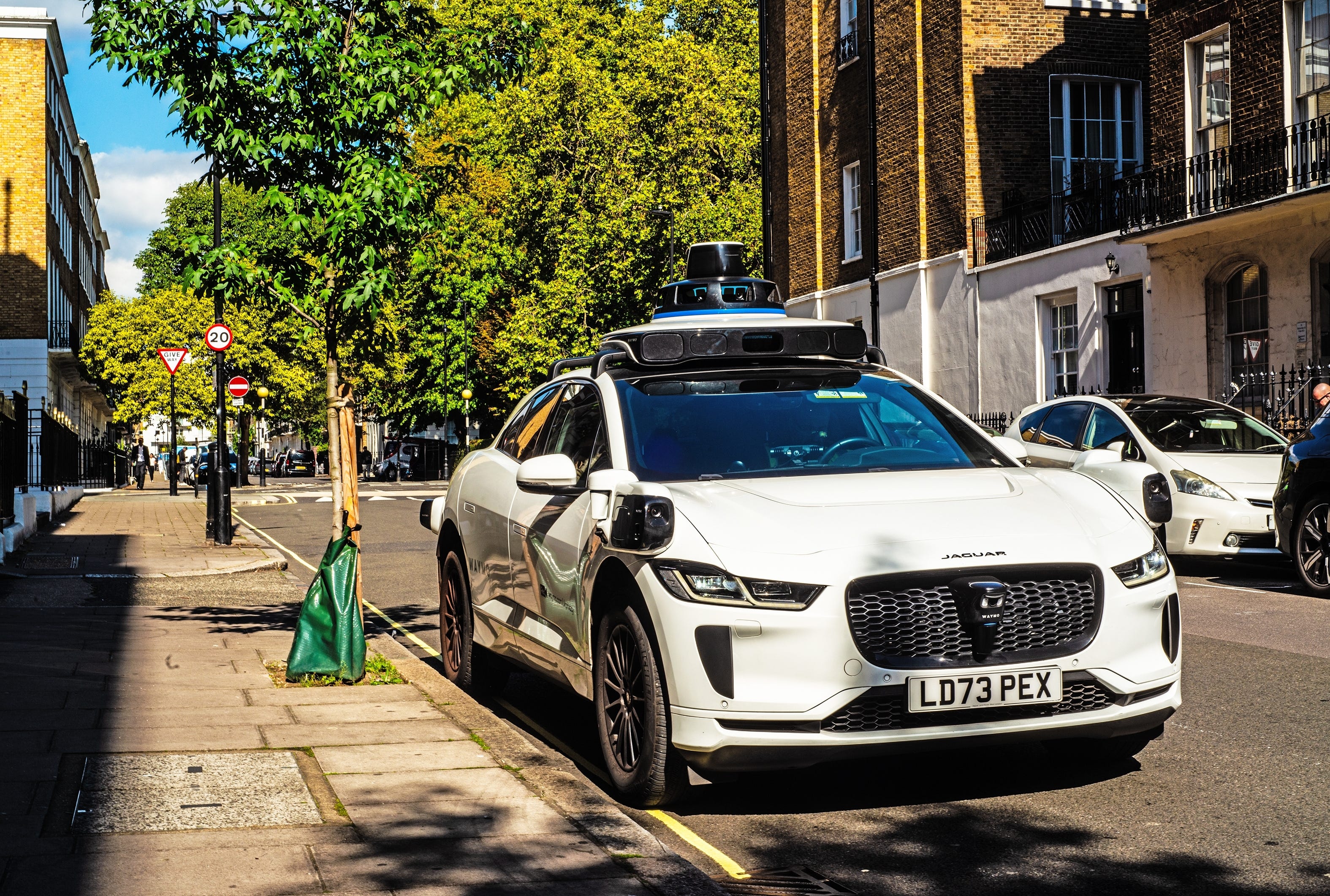
Today, three companies – Waymo, Wayve and Baidu – are testing robotaxis on the streets of London, and there are already thousands of privately owned Teslas across the country that contain the technology required for autonomy, which merely require the regulatory green light to operate in ‘full self-driving’ (FSD) mode. However, even before services have really begun, the technology is already facing a backlash from progressives.
Last month, on the same day that Wayve began taking robotaxi passengers, albeit in vehicles staffed by a safety driver, the GMB union called for the AV rollout to be slowed to better plan for the impact on taxi and private hire drivers. This follows reports from early July that the team around Andy Burnham are more sceptical of autonomous vehicles than the Starmer team were, for similar reasons.
Now I’m happy to acknowledge that in any technological transition there will always be disruption, and that this is something policymakers should mitigate. If autonomous vehicles are as transformative as they are promised to be, there will of course be a significant impact on jobs. But I don’t think this is a good reason to slow down Britain’s autonomous vehicle rollout.
One reason is, of course, purely economic. Autonomous vehicle services are already running in the United States and China, and many of our middle-power peers are moving at pace towards their own autonomous rollouts too (Waymo is also expecting to launch in Tokyo later this year). So we should want to keep pace – and benefit from removing the dead time millions of people waste every day, stuck behind a steering wheel. And Britain in particular is well positioned to prosper. Wayve is based in London, just north of King’s Cross – and one day the company could have its autonomous driving software embedded within hundreds of millions of cars worldwide.
But all of this aside, the stronger argument for embracing autonomous vehicles is the purely progressive one: that autonomous vehicles are a building block towards us building a better world for everyone.
Safety first
The first, and arguably most important, point to make is on safety. At this point, it is unarguable that AVs are better drivers than fallible humans.
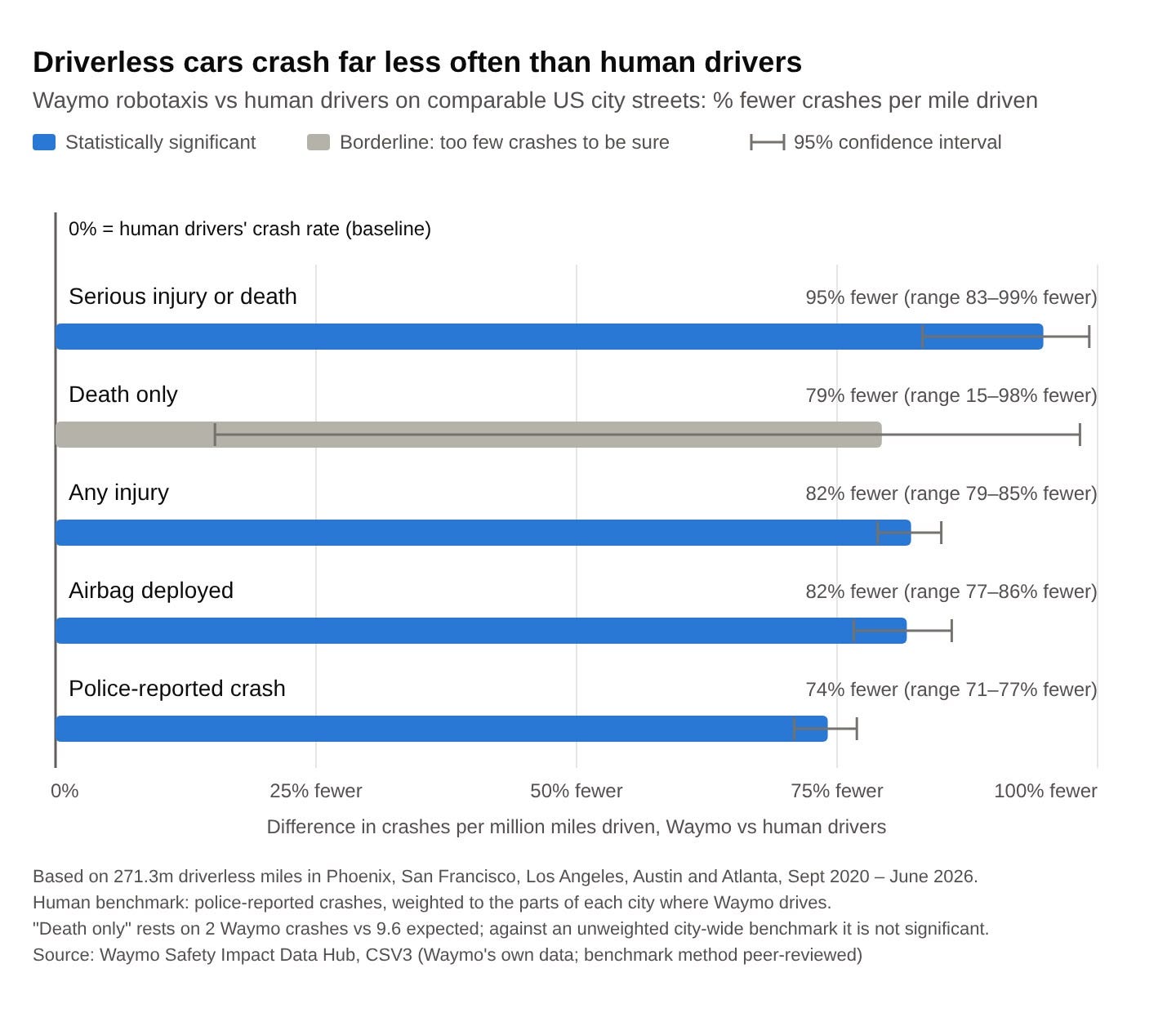
We know this from real world usage. According to Waymo’s own data, which analyses 271.3 million autonomous miles driven in US cities, and compares the figures to manual driving, serious injuries from crashes are 95% lower, crashes with pedestrians fall 93%, and crashes with cyclists fall 86%. Independent studies also found the same, such as work by the Insurance Institute for Highway Safety, which found that Waymo vehicles have “lower crash involvement rates than human drivers”.
And though it is too early to say for sure, every indication is that AVs are also now safely navigating Europe’s twistier, medieval streets. Earlier this year, Dutch regulators approved Tesla’s supervised FSD mode1, which enabled the technology in nine European countries – and millions of miles, driven by thousands of drivers later, there have been only a handful of collisions, none of them serious.
I think this is a strong reason to speed up autonomy adoption in and of itself. According to the Department for Transport, in 2025 there were 1,538 deaths and almost 30,000 serious injuries from road traffic accidents in Great Britain, and yet the technology already exists today that could save lives and prevent serious injuries. Every day we are not deploying this technology is another day in which people are dying unnecessarily.
Social justice
However, safety is not the only prize from autonomy. The invention of this technology is a huge opportunity for social justice in terms of mobility. Too much of our society is designed around car ownership, which puts everyone without a driving licence and access to a vehicle at a disadvantage, and this disproportionately impacts the young, poor, elderly and disabled. Autonomous vehicles are an opportunity to narrow this inequality.
How? The most important implication of autonomy is that it can dramatically reduce the cost of mobility. The most expensive part of running a vehicle service, whether private taxis or public buses, is paying for the human driving it. If we can remove them, suddenly it transforms the economics of transport, and enables services to serve more places, more regularly.
In cities, this will mean added convenience. In places like London, robotaxis can plug the gaps that public transport still does not reach, such as in the vast swathes of outer London where car ownership is still high. And in the countryside, autonomy could be a lifeline.
Imagine a bus service in a rural village, for instance. If residents are lucky, they may be served by a bus a handful of times per day, which isn’t actually all that useful for anything beyond the council ticking a box to say that a given area is served by public transport. But if running buses becomes dramatically cheaper, then it might become viable to run a bus multiple times per hour, and overnight.
So it’s here that there is an opportunity for a real transformation of how we live. Transport networks are only as useful as their weakest link – if we don’t believe buses will be available when we need them, then car ownership still makes sense. Even if we’re unlikely to ever make that 4am journey, the fact that it is possible makes car-free living feel viable because we know we’ll always be able to get around if we need to.
Liveable cities
This is the key capability that autonomy enables. As things stand, we have built a society predicated on car ownership. I live in the suburban sprawl, just outside London, and see this in my life: narrow streets that were laid out before the invention of the automobile are today choked by cars parked along every kerb. And even though I have a reasonably decent bus service in my area, at least by non-London standards, I still feel the need to own a car to get to where I need to go.
But soon it won’t have to be this way. Critics of robotaxis argue the technology will only lead to an increase in congestion, but I think this is a false assumption and that the technology actually gives us more regulatory tools to create more liveable cities, as managing the number of vehicles in cities becomes more of a technical fleet-management decision than an exercise in directly upsetting thousands of motorists.
For example, in an autonomous world, we won’t require as many parking spaces – because vehicles will simply pick up and drop off, and will be more widely shared, meaning physically fewer individual cars in the world. If autonomous vehicles need to be stored, they can park further out of town. This frees up space for denser, more walkable cities, not to mention unlocking countless prime locations for the development of new, urban housing. And by collapsing the cost and difficulty of ‘last-mile travel’, autonomy could vastly expand the catchment area for railway stations – making it more plausible to live car-free, and making it easier for people to use public transport for longer journeys too.
This is why, ultimately, autonomy could become a crucial means towards progressive ends. The technology now exists, and is going to be adopted across the world. And we have the power to use it for progress – we just have to choose to do so.
FSD is not intended to be as sophisticated as the likes of Waymo, as it still requires a driver to be ready to be behind the wheel, ready to take over – but is directionally moving towards the same place. In Austin, Texas, Tesla recently launched ‘Cybercab’, a fully autonomous robotaxi built on the same software, which does not even have a steering wheel.
