


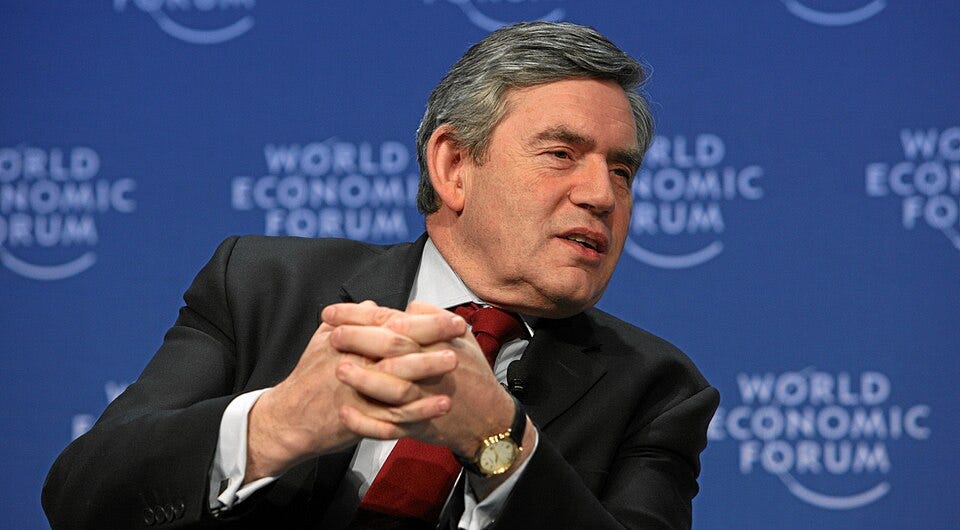
Gordon Brown, who declined to call an election after becoming prime minister in 2007 (Wikimedia Commons)
On 17 July, through a coronation rather than a contest, Andy Burnham will become prime minister. Attention has already turned to a different question: should he call an early election?
Reform and the Conservatives, despite their humblings in Makerfield, have both demanded one. More significantly, so have an array of Labour figures: grandee Alan Johnson has said it would “help restore trust in politics”, his former cabinet colleague John Hutton has noted the “very strong case” and Home Office minister Mike Tapp has even backed new legislation to make elections mandatory for new prime ministers. Newcastle backbencher Mary Glindon, meanwhile, has warned that Labour will simply be “hypocrites” should they fail to go to the country.
And, most importantly, far from crying “not another one”, a new YouGov poll shows that the public back an election, with 48 per cent in favour and 35 per cent against.
Rather than dismissing such calls, Burnham should heed them – not least as he demanded an early election when the Conservatives changed leader in 2022. There is, of course, no constitutional requirement for a snap contest. While Theresa May, Boris Johnson and Anthony Eden all went to the country, there was no obligation for them to do so. We elect MPs, not prime ministers, after all.
But the precedent that Burnham should recall is that of Gordon Brown, in whose cabinet he served. The former prime minister also became leader without a contest – as Blairite rivals gave way – depriving him of a formal mandate from Labour for his strategy. An early election, which he publicly toyed with after a poll bounce, could have won him the legitimacy he lacked. But, spooked by the Tories’ inheritance tax cut pledge, he retreated, a moment from which his premiership never recovered. He was dubbed “Bottler Brown” and forever bore the label of an “unelected prime minister”. Having initially led by nine points, Labour was trailing David Cameron’s Tories by five points just a year later.
Brown had, at least, fought the 2005 election as a double act with Tony Blair who had pre-announced his departure. Voters knew that Brown – who was then highly popular – was the heir apparent. Yet even he, after a decade as a commanding chancellor, was wrongfooted in office. That danger could be even greater for Burnham who was not an MP until two days ago, let alone part of the government. One of his greatest strengths as an incoming PM – his outsider status – could become a weakness in tougher political times.
Then there is Burnham’s need for a mandate. Without one, he will struggle to deliver on his promise to “change Labour”, hemmed in by red lines on tax, the fiscal rules, Europe and the triple lock. Jim O’Neill, one of Burnham’s acting advisers, has urged him to scrap the latter, but divergence from the manifesto is fraught with risk – just ask Rachel Reeves. Yet without fundamental change, what is the point of Burnham’s premiership? Winning a mandate from voters is his best hope of avoiding political purgatory.
There are also more positive reasons why Burnham should go to the country. His landslide victory in Makerfield proved he can beat Reform. He managed to unite the progressive bloc while also attracting soft Tories and soft Reform supporters – building what the Labour MP and former cabinet minister Liam Byrne has called a “heroic coalition”. His best opportunity to fight an election will be during his honeymoon period when prime ministers are invariably at their most popular.
Some may contend that it would be foolish for Burnham to risk losing seats – one of the factors that deterred Brown in 2007. But the experience of the last two years demonstrates that a landslide majority does not guarantee stability, authority or good government. And what use is one without a mandate to fully deploy it?
As a new leader, Burnham can frame himself as the real “change candidate”, marginalising the far more unpopular Nigel Farage. His leadership makes mass tactical voting – and preparedness to vote Labour – far more likely. He can only lead as a popular insurgent, divorced from the politics of the last decade. Wait too long, and that argument goes.
Should Burnham fail to call an election, his popularity will fade (his net favourability rating has already fallen from a peak of +9 to -11). Incumbency erodes appeal – Brown, Johnson and Rishi Sunak were all once the most popular politicians in the country. And governing could make Burnham decidedly unpopular. While Reform may weaken, the Tories could benefit as public scepticism of tax and spend grows. Burnham’s voter coalition – and his big tent within the Labour Party – could fracture as he is forced to confront some hideous policy trade-offs. The fiscal situation – with undeliverable spending cuts pencilled in – could overwhelm his government as it did Starmer’s. A febrile electorate, impatient with politics, will not be forgiving.
And that is why Burnham, who seized the crown with such ruthlessness, should embrace an election with the same spirit. “If it were done when ‘tis done, then ‘twere well it were done quickly”.

I certainly don't think he's required to call an election, but I can see the case for regaining some sort of momentum for a government that's become horribly bogged down. Though he'd need a clear message of a handful of really big things he wants to achieve and I don't know if he has those.