


This is the 2026 Jonathan Sacks Memorial Lecture, “Kings, Priests and Prophets: Power and its Missing Guardrails”, delivered by David Miliband at the London School of Economics this evening.
(US Institute of Peace/Wikimedia Commons)
It is a real privilege to be with you tonight. It is especially meaningful to be at the LSE, and not just because my parents met and fell in love here.
In 1933, LSE’s director, the great liberal reformer William Beveridge, saw what was happening in Germany and created the Academic Assistance Council, which helped hundreds of German scholars flee fascism and find “individual and intellectual freedom” in the labs and lecture halls of the UK.
Later that year, the organisation helped to bring Albert Einstein – who as it happens was the founder of the International Rescue Committee – to the Royal Albert Hall, where he argued that both science and civilisation depend entirely on those freedoms. Our duty, he argued, was to resist the powers that threaten to suppress them.
In 1930s Europe, that effort was unsuccessful. My parents were refugees to the UK, as was Jonathan Sacks’ father. They shared with Jonathan, and with Einstein, a learned passion to fight the abuse of power. My topic tonight honours that shared history.
Jonathan was a leader, a teacher, and a friend. I first got to know him and Elaine in the mid-1990s. At the time, I was Head of Policy for Tony Blair. Tony couldn’t get enough of Jonathan’s insights, and certainly not enough from their occasional meetings, so I was deputed to visit the Chief Rabbi on a monthly basis to get further food for thought.
Our meetings would take place at 9am at Hamilton Terrace. Elaine and I would chat for a few minutes, then suddenly we would hear remarkably loud and unusually fast banging on the stairs. Jonathan would speed round the corner and greet me with a booming: “David! … How are you?”
Over the next hour, we would talk about education policy, community, family… contracts and covenants, hopes and realities. I remember vividly Jonathan’s curiosity, patience and kindness. He was a patriot and an internationalist. He was rooted and cosmopolitan. He had an unwavering belief that communities could be, should be, pluralist in perspective yet united in commitment. To him, this was not a contradiction, but instead the foundation of a healthy society.
I also recall something else: Jonathan’s insistence that it is not hope that leads to action, as was often said, but instead action that leads to hope. I will come back to this.
Today, in times marked by political rupture, economic danger, societal doubt, international flux, we miss Jonathan and his voice sorely. But he still offers us wisdom and guidance, because he left so much inspiration and instruction in his books, speeches and sermons.
Perhaps this is the reason I was struck by Gila Sacks’ commitment, at the launch of the Rabbi Sacks Legacy, that its animating ideal should be to continue Jonathan’s work rather than hallow his memory. In saying this, Gila carried a torch for Jonathan’s commitment to debate, to humanity, to actions that learned the lessons of history and shaped the future for the better.
That is the commitment I want to summon tonight, by focusing on a subject Jonathan returned to again and again: the question of power and its guardrails, its necessity and its dangers, its use and its abuse.
I have given many speeches about the international dimension of this challenge. Tonight I will focus on the home front. At home and abroad we have, in my view, a dual task in the face of new and powerful forces of impunity: to defend and to create.
We must defend our inheritance of democratic institutions and the rule of law. But defence on its own is not enough. It is too passive, too satisfied… too defensive. We need to renew our inheritance for an age when improvisation, agility, innovation are the coin of the realm, and a necessity. These qualities cannot be the province only of those who would destroy the liberal democratic experiment; they need to be reclaimed by those of us who believe in it.
Running through my remarks is the pithy but vital insight by the author and journalist Fareed Zakaria. He wrote earlier this year: “The West is not a bloodline. It is a bargain. Power constrained, rights protected, coercion accountable.”
Jonathan’s story, my story, the LSE’s mission, Britain’s situation, all demand that we renew and re-invigorate this bargain that has defined the idea of the political ‘West’. I think this is today’s generational challenge. Those of us who have lived with the benefits of the bargain in the post-Second World War period, so much so that it is often taken for granted, need to defend it and advance it.
Kings, Priests and Prophets
Jonathan Sacks (Wikimedia Commons)
This is the Sacks Lecture so it is right to start with Jonathan Sacks. He was fascinated by politics. But there was a catch. Jonathan wrote the following: “…politics is about power, and at the heart of the Abrahamic vision is a critique of power”.
Jonathan repeatedly invoked Lord Acton’s warning that power tends to corrupt and absolute power corrupts absolutely. His concern was rooted in scripture, not political science.
In The Great Partnership, Jonathan wrote: “Nothing amuses and angers God more in the Bible than people setting themselves up as demigods, as many ancient rulers did and as tyrants have continued to do ever since”.
Jonathan explored what the Hebrew Bible says about the balance of power between the leaders of Judaism, what the Sages would call the “three crowns”: Kingship, priesthood and prophecy. Hence the title of this lecture.
As many of you will know, Kings had formal power. Priests had institutional authority. And prophets had moral authority. For Jonathan it was no accident that there were three voices of leadership in Judaism. They served different functions in relation to God: Creation, Revelation and Redemption. Each group had their own ways of thinking and speaking.
Kings held secular, coercive, executive power. They spoke the language of wisdom. They were necessary to get anything done. But according to Jonathan, the Bible is clear that while this form of power was necessary, it was a necessary evil, because the temptations of power made Kingship dangerous. After all, even King Solomon succumbed to temptation, acquiring great numbers of horses, taking many wives and hoarding gold.
Jonathan wrote: “Wisdom without Torah is not enough to save a leader from the corruptions of power”. He explains that it was the job of priests to teach Torah, the word of God for all time. Priests therefore held power in the religious domain, with formal “systemic” power as custodians of sacred order. Their role was to discriminate, distinguish, divide. They were teachers and judges who upheld rules and norms.
Prophets, by contrast, had informal power, mandated by God to be critical of corruptions of power and to speak truth to power. They spoke on behalf of the people, the poor, the downtrodden. Their prophecy responded to contemporary issues, and illuminated the here and now. Prophets had visions for their time, not all time.
What Jonathan saw was that these three forms of leadership were needed to balance each other. The tendency to impunity was thereby held in check.
Without pressure from priest and prophet, the King had too much power, and was likely to abuse power. Equally, a priest without a prophet becomes a technocrat, lacking moral urgency. And prophecy without priesthood becomes performative: words not deeds, or in modern incarnation, tweets as a substitute for action.
For Jonathan, the injunction was clear. Beware the siren call of rule of one. And build the institutions of collective agency.
The Great Reversal
The questions this raises are not far below the surface in the UK. But they are well above it where I live, in the US. The 250-year-old battle cry “No Kings” has taken on contemporary relevance.
It is an irony that in his formidable speech to the US Congress earlier this year, King Charles, the hereditary Monarch of the former colonial power, the descendant of George III against whom the colonists had 27 grievances, reminded elected representatives of the most powerful Republic the world has known not just about shared history but also about the need for checks and balances on the use of executive power.
You might call that chutzpah. But in fact it was insight. And he was cheered for it.
The King’s address was timely and edgy because democracy and constitutional rule of law, the most advanced and elaborate checks on the abuse of power, are now contested terrain.
The Varieties of Democracy project at the University of Gothenburg is the world’s largest and most detailed data set on democracy. Its 2026 Report states baldly: “For the average global citizen, democracy is now back to 1978 levels. In effect, almost all democratic gains of the ‘third wave of democratisation,’ starting with Portugal’s Carnation Revolution of 1974, have been erased.”
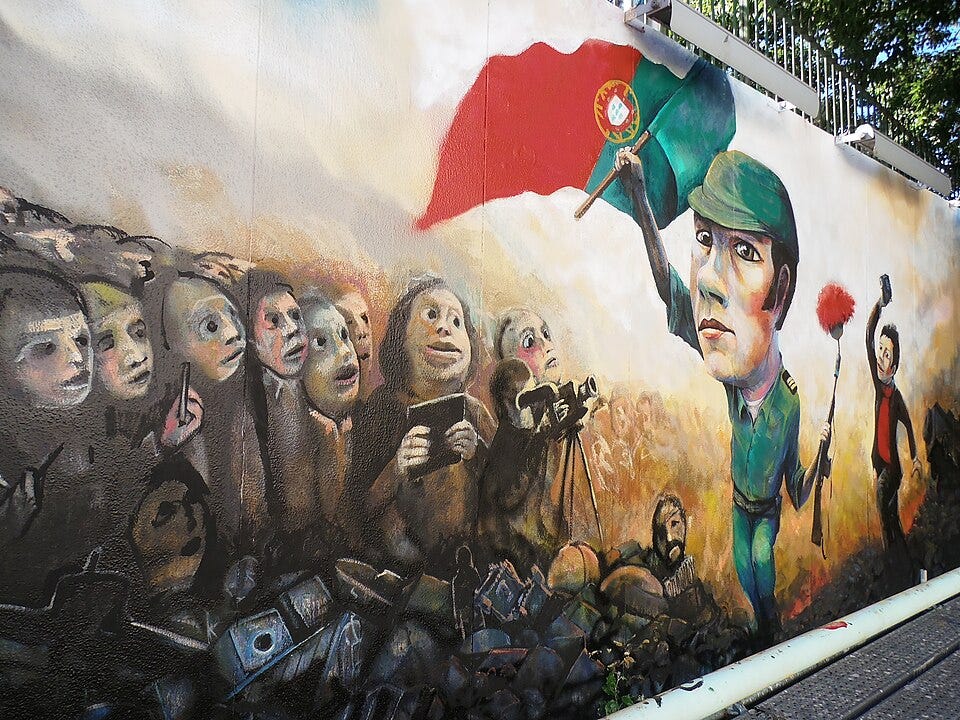
A mural commemorating Portugal’s 1974 Carnation Revolution (Jeanne Menjoulet/Wikimedia Commons)
Incredibly, less than 40 years after the collapse of communism, there are now more autocracies than democracies in the world. A record 41 per cent of the global population now live in autocratic countries; only 7 per cent in “liberal democracies”. Those living in the 44 countries heading towards autocracy suffered a serious decline in freedom of expression last year. In over half of those nations, people were punished for or restricted from engaging in political, religious or activist groups. Their election processes became less transparent, and less fair. In two thirds, torture rose.
These are dramatic figures by any standards. After a wave of democratic advances since the 1990s, we are now experiencing a “great reversal” on a global scale. What Professor Larry Diamond diagnosed ten years ago as “democratic recession” is now a full-blown democratic depression.
I know that in the UK, we have so far been protected from the worst of these trends, but we should not kid ourselves that we are immune. In the last decade, independent judges have been denounced as enemies of the people. Parliament was illegally prorogued until the Supreme Court stepped in.
Also, the UK is among the democracies with very high levels of democratic dissatisfaction. Ipsos reports that only 26 per cent of the public are satisfied with how democracy is working. Three in four are worried about the state of democracy, and only one in five say that the national government is doing a good job of protecting it.
My focus tonight is why this is happening, and what can be done about it.
But I want to insert a coda here, about the international dimension. I do not have time to dwell on it, but it is relevant. As I see in my day job every day, the worst kind of international records are being broken. Sixty wars underway, 120 million refugees and displaced people, 300 million people hungry, 100,000 civilians killed in conflict last year, health facilities attacked over 10 times a day in conflict zones around the world.
The very rules of war, designed to constrain the abuse of power, are increasingly viewed as optional, not just by non-state actors who never signed up to the Geneva Conventions, but by states who did.
The issue is not whether this is happening, but whether it is a good thing. I think it is not.
The post-Second World War efforts to establish rules for international order were based on the fact that the rule of “might is right” had led to global disaster twice in half a century. The new rules intended that the sovereignty and integrity of states were foundational. Also that the most basic rights of civilians caught up in conflict to life and aid were absolute. This had never been set out in such a way before. As President Truman said at the founding conference of the UN in San Francisco in 1945, the historic function of the conference was to show that “right makes might”.
Now things are heading in the opposite direction. And the relevance to my topic tonight is that retreat from the rule of law abroad reinforces democratic recession at home, and is accelerated by it. Look at the scholarship of the period and you will see this is precisely what the pioneers of the post-Second World War order feared.
Why, and What Now?
Two questions arise from this analysis.
The first is how have we gone from a situation where liberal democracy was, in the words of the brilliant political scientist Ivan Krastev, “presumptively canonical” at the end of the Cold War, to one today where there is more autocracy than democracy in the world?
One answer is that the rules and norms of liberal democracy have failed. That they have at best become ossified, inefficient, inimical to the speed necessary to get anything done, and at worst they are agencies of deviant, minority power.
This is the argument of President Putin, who called liberalism “obsolete” in an infamous Financial Times interview in 2018, and is echoed by so-called populists in democratic countries today.
It is true that the modern state is often bureaucratic and behind the times. The modern state can get in the way of itself. It can over-regulate. This argument defined the 1980s, after President Reagan said that the eight most terrifying words in the English language were “I’m from the government and here to help”. There are legitimate arguments about government process and judicial review.
But these points cannot, in my view, explain the reversal of the democratic order in the 2010s and 2020s.
Instead, I believe we need to look to four major factors that have combined together to widen the gap between people’s rights and their power, the gap that political philosopher Judith Shklar identified as the source of powerlessness for the many, and impunity for the few.
The first is the rise of global inter-connectedness and therefore global risk. Many problems today cannot be solved on a national level because they are of international scale. Migration, which has roiled so many countries, fits into this category. So does climate; pandemics; nuclear proliferation.
Yet far from being too strong and over-bearing, international institutions – including the UN – are too weak to address them. This failure creates anger in countries like our own. Equally, the pre-eminence of western democratic nations in international institutions, and their failure to reform them, has alienated rising countries of the so-called Global South. So there is frustration all round.
Second, the relative economic decline of the West and the rise of the rest. The share of global income of the G7 group of leading democracies has dropped from nearly 60 per cent in the early 1990s to just over a quarter today. China has produced and negotiated its way to being the leading trade partner to 120 countries in the world. The success of an economically dynamic model of autocracy threatens to reverse the lesson of the Cold War, that democracy is a better system not just on moral grounds but also for reasons of efficiency.
Third, and related, is the rise of new and massive inequalities of income and especially wealth. These have corroded confidence in the democratic model. And these inequalities have corrupted political systems around the world. A third of American wealth is now in the hands of the top 1 per cent, and 55-60 per cent in the hands of the top 5 per cent. Democracy seems rigged and ineffective to its own citizens.
Finally, the technological revolution has accelerated all these trends, and all the indications are that the rise of AI is going to drive them further, not least by creating a 21st-century information ecosystem out of sync with 19th-century democratic institutions. Technology now moves faster than regulation, and the gap is only widening. And impunity is not only practised by governments; it is also a feature of powerful private interests.
Each of these waves of change would on their own be challenging. Together they reinforce each other and create a massive delivery deficit. Political fragmentation makes it harder to tackle global risks, and global risks make it harder for nations to collaborate. Money, including foreign money, escapes regulation and infects politics. Rogue states, and rogue actors, hold asymmetric sway.
It’s wrong, evidentially not just morally, to say that in these circumstances only a dictator can get things done. But the lure of strongman solutions arises from frustration and grievance. And that is what we are seeing, such that the period we have lived through in the West since the Second World War now looks like a historical outlier. If there is a natural tendency, it is seemingly towards impunity not towards accountability. And it is reasserting itself.
Countervailing Power
So this leaves a second question. What can we do about these trends? How can we reverse this great reversal?
I want to turn to a man who looked at an enormous imbalance of power, and developed a theory of how to address it.
In 1953, JK Galbraith – the Canadian-born American academic, diplomat, sage – saw the American economy falling victim to exploitative large corporations, with ever-growing power. He argued that this power, if it was allowed to increase unchecked, would be a threat to consumers and workers. And he offered a solution: “the best and established answer to economic power’, Galbraith argued, “is the building of countervailing power”.
Countervailing power meant creating and developing institutions that would hold monopolies and oligopolies to account, that would build new public capabilities, and offer new forms of participation, in their place. This would help to create new public responsibilities and agency, emboldening and enabling individuals with a shared power that was previously unfelt.
Countervailing power worked on two levels. It meant imposing guardrails to limit the abuse of power. But it also meant generating new forms of power. So, while trade unions needed to be boosted to check employer abuse, they could also act as schools of citizenship, builders of solidarity, providers of welfare, political educators.
Countervailing power was a “self-generating force”. According to Galbraith, it was a feature not a bug of any effective system of administration.
Today, I think we should take inspiration from Galbraith, and build countervailing power to renew our democracy. It should be generative of new sources of power not just defensive of old ones; it should be informal as well as formal; mass as well as elite.
I will discuss countervailing power in five areas.
The first has been thrust onto the front pages in this country in the last couple of weeks. It concerns the need to take on the concentration of the UK’s economic and political power in Westminster. The constraints on local government make the UK an outlier. I believe it is one of the major reasons we are also an outlier in levels of democratic discontent.
Since the 1990s I have seen this over-concentration as a weakness of the British model. As Local Government Minister I championed “double devolution” and “city regions” to tackle the problem. Yes, we have the Scottish Parliament, the Welsh Assembly, and the English mayoralties, but devolution is, to paraphrase Andy Haldane, former chief economist at the Bank of England, “half a loaf, half baked”.
Power over spending, taxation and financing is still so centralised in this country. As Haldane has pointed out, this is ironic, because the UK’s infrastructure in the 19th century was originally financed at city level using long term municipal bonds.
The commitment last week by Andy Burnham that he intends to give meaningful power to those who know and serve their communities, to invest in those communities, suggests we are on the verge of big change, and it is long overdue. Devolving down to encourage levelling up will create countervailing power in Britain in a healthy way.
The second area concerns the independent institutions that prop up our democracy. Living in America, it becomes especially clear why we must defend an independent judiciary, fight for a non-political civil service, bolt down the independence of the Boundary Commission and the Electoral Commission, and preserve our democracy from foreign influence.
Not because these institutions always get it right, but because they are sworn to defend the public interest. These impartial institutions are needed to keep elections and civil processes fair by keeping money and inappropriate influence out of politics.
The same goes for universities, non-governmental institutions, law firms: in the march of impunity all find themselves under attack. Yet as Einstein’s speech suggested 90 years ago, these are pillars of all our liberties. They are countervailing power in action.
The same argument applies to the need to defend independent public media like the BBC. I promise you that living in the US is the best antidote to BBC-bashing. Public service broadcasting makes mistakes, but the benchmark it sets for scrutiny and accountability is second to none.

BBC Broadcasting House (Amy Karle/Wikimedia Commons)
This leads to the third area. We must address the concentration of power that is growing in our new information eco-system. We must do so by upholding the foundation of debate and deliberation: shared facts around which people can hold different opinions. This, I believe, is the number one democratic issue of the next decade.
Historically, democracies depended on local newspapers, investigative journalism, professional editorial standards, for these shared facts. But the economic model for that work has collapsed. In its place, engagement-maximising commercial digital platforms subvert deliberative democratic practice. What counts is what sells, and what sells has been well-documented, including recently by Yuval Noah Harari. As he puts it, “…the easiest way to make people engaged is to press the hate button or the greed button or the fear button”. As he says, we are being “hacked”.
The recent riots in Southampton and Belfast show what happens when there are no safeguards on the spread of opinion masquerading as fact, and when the algorithm rewards and accelerates the spread of hate.
There are many insidious and dangerous aspects to this. One that stands out has been highlighted by the House of Commons Foreign Affairs Select Committee, which studied extensive foreign manipulation and interference campaigns – run via social media – designed to undermine our democracy. They highlight the role of Russia, China and Iran.
The Committee proposes a suite of counter-measures:
Greater transparency about the function of social media algorithms.
Better education for everyone, from children to adults, to help us understand how the media we consume everyday actually works.
Beefed-up national efforts to counter foreign misinformation campaigns.
Greater European coordination on all of these efforts, in line with the European Democracy Shield initiative of the EU.
And requirements on social media campaigns to disclose user locations.
These are all good examples of countervailing power – and we need to put them into action if we are to understand and improve our current information ecosystem.
We need to “stop the bots” not just “stop the boats”.
My friend and former colleague Geoff Mulgan has also made a case for a “right to truth” as an antidote to the pernicious phenomenon of “truth decay”. Mulgan’s solutions, like independent Electoral Integrity Commissions, to assess claims and counter claims, offer another potential route to protecting our right to shared facts.
In the spirit of Galbraith, we must also enable new actors rather than simply keeping those we have in place. This means actively encouraging co-operative or community platforms that work with anti-algorithm media, which give people more choice about the way they consume media.
The fourth area concerns democratic deliberation. I chair the Advisory Board of the Atlas of Impunity, which tracks impunity and accountability in 170 countries across the world. The report we have just published describes the need for norms and rules, information and consequences to keep power in check. But it also highlights the importance of deliberation in the fight for accountability.
As with new forms of media, new forms of deliberation and decision making are now proliferating. They use new technological tools for positive effect, and we should learn from them. They include:
- Citizens’ assemblies in Ireland and France that have brought people from all walks of life together to discuss major policy issues. These conversations have led to real legislative change - from abortion to climate policy.
- Deliberative polling in America shows that when people of vastly different political tribes are given shared information - shared facts - they can often find shared ground.
- Participatory budgeting now spreading to Paris from Sao Paolo means residents of a neighbourhood can decide – with the click of a button – whether funding goes to a road repair or a community garden.
In the UK, the newly-launched National Strategy Project is promising to use these techniques to forge consensus on big choices. These systems promise to put people back at the heart of policymaking. And they can counter that sense of individual powerlessness and structural ineffectuality that has led to democratic malaise. The lesson from abroad is that government needs to commit to action following deliberation to make it real.
The final area concerns our electoral system. At the 2024 election, only 15 per cent of MPs won 50 per cent of the vote. Meanwhile, the top seven countries in Cambridge University’s Satisfaction with Democracy Index all have some form of proportional representation. There is an issue here.
I supported the Alternative Vote system when it was debated in parliament in 2011 because it offers a way to better engage the public in politics without fueling the fragmentation of society. The AV system ensures every one of the elected 650 MPs wins at least 50 per cent of the vote in their constituency.
AV allows voters a first vote with the heart, and then second and third votes with the head. And it means that when people vote, they feel their individual and intellectual choices count. That remains why I support electoral reform today.
Conclusion
Of course, none of these points are a silver bullet. But they speak to the need to make our democracy one where power is spread, and the abuse of power countered.
The kind of democratic backsliding I have described today, and which I see as a threat, has been described by the Carnegie Endowment for International Peace as “grievance-fuelled illiberalism”. Around the world it is slowly but surely eating away at the governmental and non-governmental institutions designed to keep the powerful in check.
To fight back, we need to go back to where we began: to Jonathan Sacks.
Where JK Galbraith explained how societies can and do generate alternative centres of organised power, Jonathan Sacks explains the moral and civic foundations on which countervailing power is built: trust, covenant and shared responsibility.
In The Politics of Hope, Jonathan wrote that “civil society is where we learn the habits of cooperation”. This is what countervailing power can offer, and it is a spirit as well as a system that is needed more than ever.
You can see it at work around the world if you look. In Bangladesh and South Korea, contrary to global trends, people saved their democracy last year. At all levels of society countervailing power fought back. And Prime Minister Orbán of Hungary, who led the drive to pioneer “illiberal democracy” in Europe, was comprehensively defeated in the recent election, despite a massively unbalanced playing field, by a united civil society coalition.
It was Jonathan who famously wrote in his book The Home We Build Together that society is a home where we contribute, not just a hotel where we consume, and that homes require more than laws and rules to keep them standing. A home needs maintenance, participation, contribution and shared responsibility.
The home of British liberal democracy has taken centuries to build. My argument tonight is that we cannot cease to maintain and develop it, because if we do, then its foundations will crumble; and that would be a disaster.
In the spirit of Jonathan, this is a project that will demand from all of us that “each be leaders”.
By holding power to account. By building systems that enable collaboration. By fighting for representation that channels the best of us, rather than perpetuating the worst of itself. By encouraging leadership to innovate as well as to defend. By taking action, which is the renewable energy of hope.
Of course, Jonathan would have made this case much better than I. He was both priest and prophet, with formal and informal power. I believe that today, in this age of Kings, he would be urging us to use both.
