



Hannah Camilleri writes about culture and performance in Westminster at Soft Power.
The Chancellor recently announced that he was inviting all Treasury staff to pitch ideas for next week’s Budget. Admittedly, I’m not a civil servant or special adviser, but if I may be so bold: Chancellor, I have an idea – I’d like you to sell me a bridge.
As a reluctant teenager on an open-top bus tour around Manhattan, I remember an endearingly proud tour guide telling us that, because he had bought one whole share in the Empire State Building, it meant he owned a brick in it. The story has stuck with me over a decade later, and although the factual claim of ownership is ridiculous, the emotional ownership that the tour guide felt was entirely real.
There is a lesson to be learned here. The development of British infrastructure is plagued by the fact that we have no shortage of opponents to building but remarkably few organised, vocal – let alone enthusiastic – participants. There are two main opportunities for the public to engage with infrastructure projects: when they are being told how they will pay for them via taxes and when they can speak, or forever hold their peace, via statutory consultations.
Our infrastructure system is structurally excellent at producing objectors (Nimbys), consultees, ‘stakeholders’ and concerned taxpayers but very bad at producing backers. The opportunity to be a participant in public infrastructure is almost nonexistent in the UK – the distinction between a ‘backer’ and a consulted ‘stakeholder’ matters. Just compare the statements ‘my taxes paid for this’ to ‘I helped build this.’ Financially and conceptually these statements are not worlds apart – but they are emotionally diametrically opposed. One signifies extraction and the other agency.
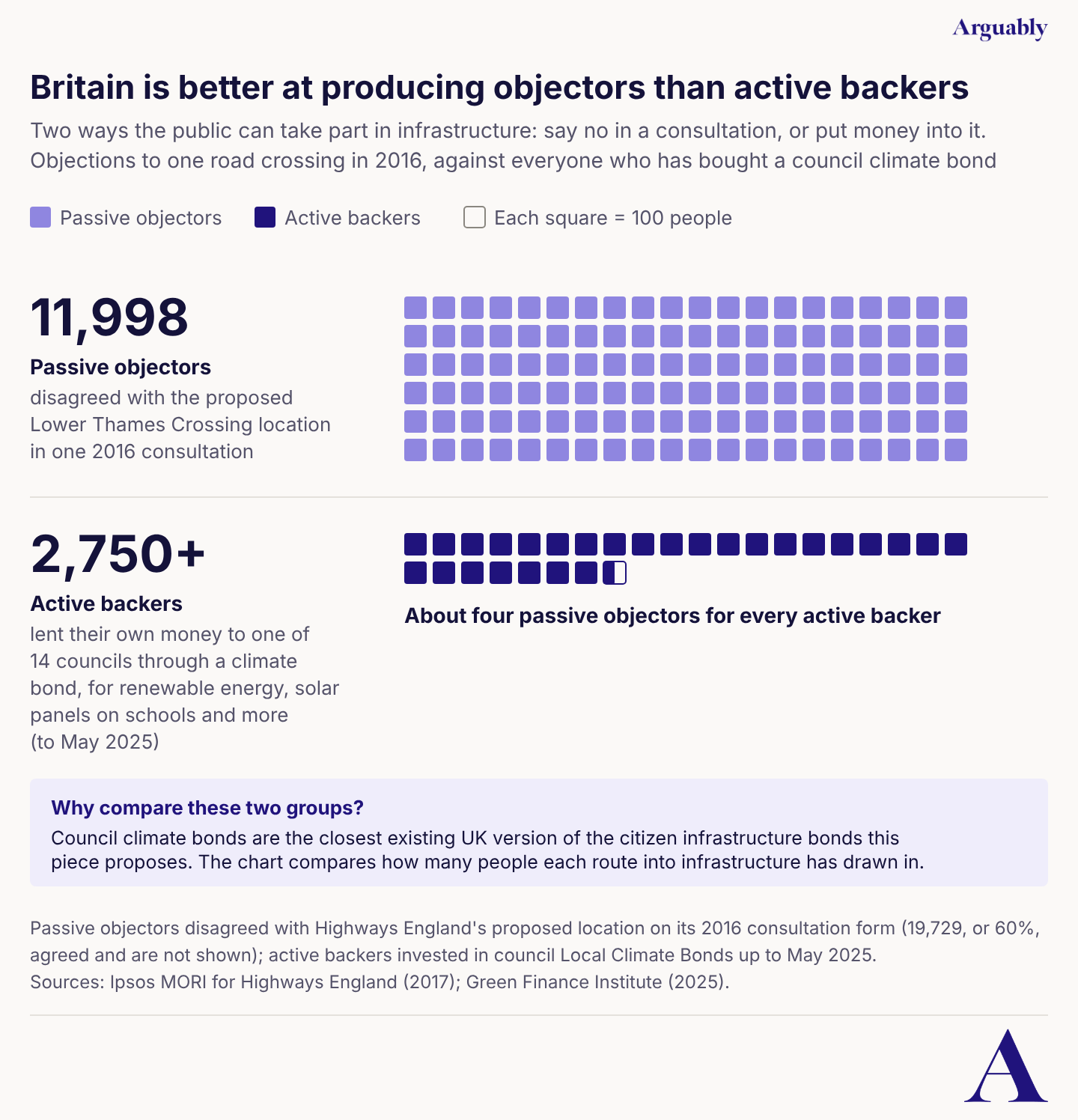
Historically, to be a patron of something meant to attach yourself to an idea, a project greater than oneself. Our modern formula, casting citizens as payers and not participants, does not create backers of infrastructure projects but citizens who merely pick up the invoice. Look at HS2, the Lower Thames Crossing or Heathrow’s third runway: rather than purchasing projects emblematic of our national ambition we feel as if we are having something taken away from us.
In the long run, this emotional distinction between taxpayer and participant matters because infrastructure has a classic political asymmetry. Opponents to development can easily articulate the immediacy of what they are losing: a gap in a city’s skyline, a green space, ‘peace and quiet’, less busy roads, the brownfield land which attracts antisocial behaviour but for some reason is essential to the community – the list goes on. The losses are concentrated and immediate; the benefits diffuse and long-term. The politics of planning, development and building presents a collective action problem.
If our new Prime Minister is serious about bringing power closer to people, surely we should be treated as patrons of our own country? A government that is truly pro-growth and pro-building, therefore, must create a constituency for construction.
In fairness, we have already discovered the concept of municipal bonds; they were first introduced two centuries ago in New York City in 1812, and a few years later state bonds paid for the Erie Canal. Recent advocacy for municipal bonds hasn’t bothered to attach the same romance and aspiration that built great projects such as our railways.
As ThinkLabour’s James Howat has noted, municipal borrowing was once the norm, a crucial pillar of Joseph Chamberlain’s “gas and water socialism” in Birmingham. The bonds proposed would grant mayors access to markets so they could get on with building rather than enduring the ritual of going cap in hand to the Treasury for grants. I agree that mayors need the resources and agency to be builders rather than just campaigners. But ThinkLabour’s proposed buyers for these bonds are largely institutional investors, and why should we stop there?
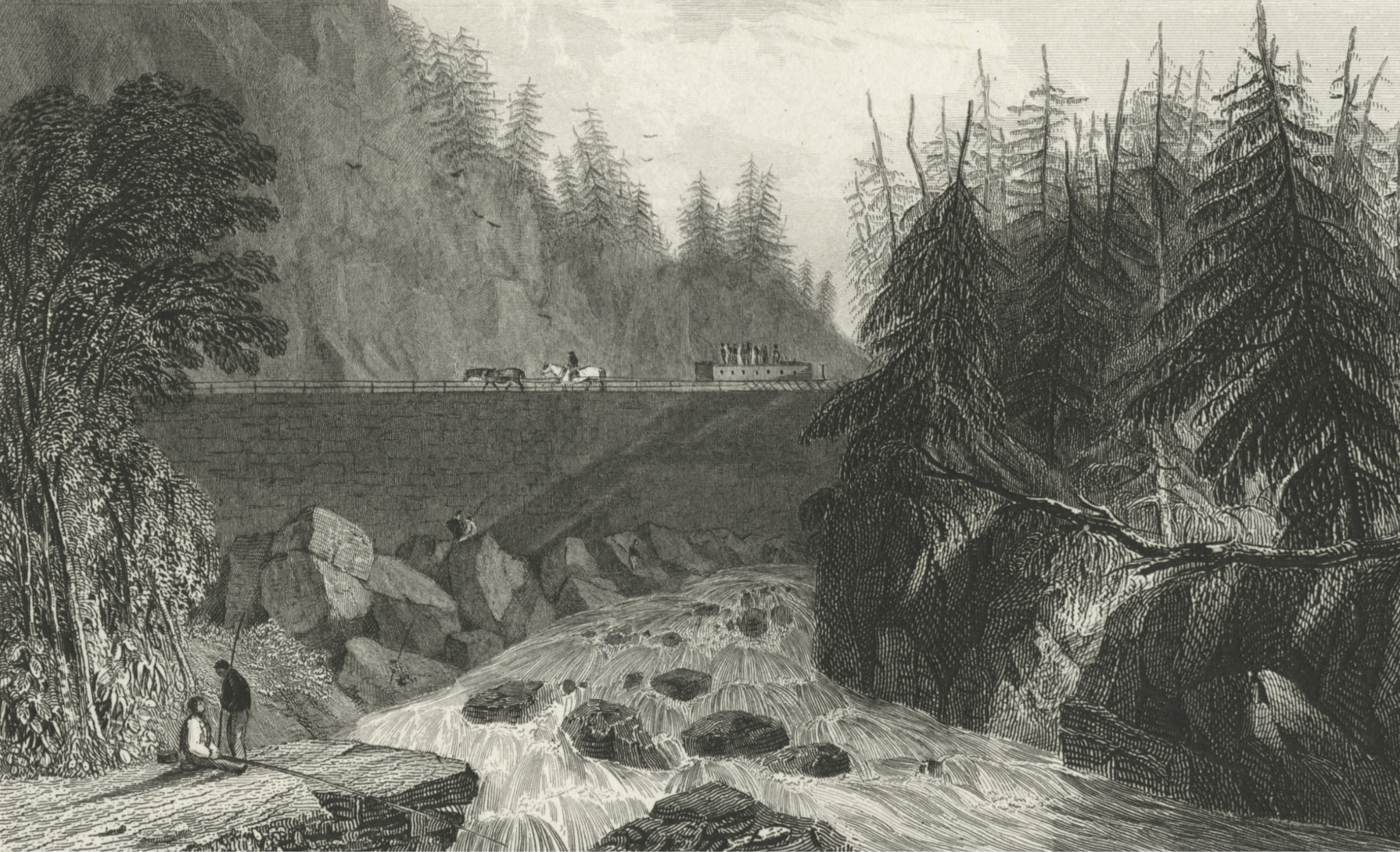
Councils already offer Community Municipal Investments for as little as £5; Sheffield has recently raised £1m from these efforts and offers a good example of how municipal bonds could be sold to citizens. But what if, for specific national infrastructure projects, a tranche of borrowing was reserved for ordinary citizens from, say, £50. Not because I believe my £50 is going to save HS2, but because I want the project to succeed, I believe in it, and when prattling on to my grandchildren in 50 years’ time I’d like to tell them I played a part.
The economic innovation our country requires is not just financial but emotional. I know this move won’t solve all of Britain’s economic woes. If our government borrows £100 from me to finally build another bridge across the Thames, and promises me interest, it is still government borrowing.
The current fiscal rules constrain my proposal while serving a purpose. Borrowing is still borrowing, but I am not proposing that HS2 should be built by passing a tithe box round the UK; you can keep 95% of the financial structure behind large infrastructure projects the same if you like.
But what about reserving a small tranche? The purpose of my £100 isn’t just that the Treasury needs it; it’s that I want to give it, I believe in the ambition the project represents. By investing in the project, I am changing my relationship with it. Play this strategy out across the country, and suddenly you get a pro-HS2 constituency that goes beyond train nerds, think-tankers, special advisers and the occasional journalist.
The Treasury is very good at measuring the financial value of things and rather shocking at measuring public attachment. The point of creating a tranche for citizens is to build political capital, not just financial.

We understand the notion of collective excitement well enough when it comes to other aspects of our national life. The human condition demands we seek opportunities to say “I was there before it existed”. Yet our current development models strip away the very processes through which we usually form these attachments.
We experience collective life, and especially political life, through stories, symbols and rituals as well as economic outcomes. Britons have not stopped being ambitious; it’s just that the only political language available to us makes ambition sound administrative. Truly beautiful things have become PDFs. Politics is not just policy; it is also a form of interactive theatre.
In An Honest Day, Mark McVitie and Chris Curtis MP argued that our economic woes were due to the state losing the ability to “build, decide, enforce and shape productive markets in the public interest”. They propose a shift from a “distributive state” to a “capable state” that delivers democratic choice. But they don’t just talk about the government – they also talk about a new contract between our state and us. In one half of the equation, a citizen would work, contribute and have agency. In the other half, the state would be both capable and provide protection.
The two meet when a new bridge is proposed – and I am not just told how much of my taxes are going towards it, but also offered the chance to invest £100 to help build it. I choose to back it, I receive the plans, I follow its construction, and I get to be one of the first to walk over it. The state has built something grand and I, just a citizen, have helped to build it in a way that transcends the role of passive taxpayer.
“Politics is not just policy; it is also a form of interactive theatre.”
Policy wonks have rediscovered municipal finance but not municipal romance – the giants of municipal reform such as Chamberlain in Birmingham, New York’s Robert Moses and Glasgow’s Robert Stewart did not speak of their cities as simply places to be managed. In the same vein, Zohran Mamdani has spoken of how “most of all, [the city’s greatness] will be felt by each New Yorker when the city they love finally loves them back”. Councillors, mayors, urban planners, policy wonks, architects, engineers – come on, romance us a little, find the political equivalent of taking the public out to dinner and buying flowers.
Rather than instructing us by asking whether or not we object to something, our governments should be inviting us to help build something. We would hardly be venturing into the unknown; this approach has already been tried out in Tanga, Tanzania, and Indore, India, to great effect. Tanga’s water authority raised an estimated $21m through East Africa’s first sub-national green bond with the majority of the funding coming from from local institutional investors; Indore went even further, gathering 7,600 retail investors in support of a bond issued to fund a solar farm.
My Manhattan tour guide did not invest in the Empire State Building to diversify his financial portfolio. Whatever reasons he had for his initial purchase had, by the time I met him, evolved into part of his autobiography.
I hope to one day be able to drag my grandchildren across a bridge along the Thames and say: “Your grandma helped build this bridge; in fact, that girder is mine”. We have finally started asking, and answering, how our country can reignite its ambition, but the next question is how we give people a reason to say: “we built that”.
So, Chancellor, sell me a bridge.
