


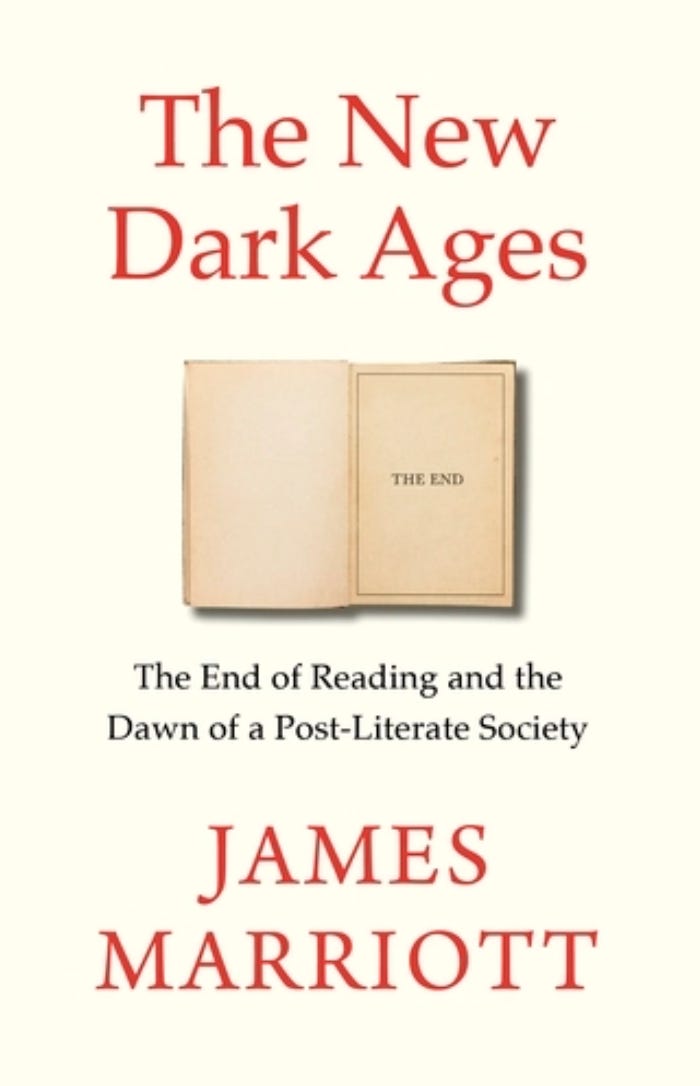
Today’s edition of Arguably features an in-depth interview with Times columnist James Marriott on his new book, The New Dark Ages: The End of Reading and the Dawn of a Post-Literate Society.
James and George Eaton discuss AI’s effect on universities, the legacy of TV on literacy, Andy Burnham’s English degree and whether the decline of reading threatens liberal democracy itself.
To read the full interview, become a paid subscriber or sign up for a seven-day free trial.
George Eaton: The decline of reading is now quite a well-established trend. But you were one of the first commentators to spot it and give it the prominence it deserved. What were the early warning signs you picked up?
James Marriott: Probably the first was my own habitual pessimism. This is something I’ve always been talking to my friends about, and I think that pessimism wasn’t unjustified because one of the things I try and emphasise in the book is that this is a long story now and it dates back to the 1950s and the rise of television.
I did a piece about the challenges facing the humanities and this theme came up that people were struggling to get their kids to read books. I spoke to a lecturer who said that she had once assigned books such as Middlemarch and Ulysses to her students and those were basically falling off the syllabus because the capacity to read them wasn’t there. You always have to be careful as a columnist to avoid merely projecting your own prejudices onto the world, but that was a moment when I thought this is really something.
GE: You describe at length the moment in 2007 when Steve Jobs, an “appropriately messianic figure,” unveiled the iPhone. Is that where you would place most of the blame?
JM: No, I don’t think so, it’s probably equally proportioned. As I say in the book, it seems that all the most important statistics for the beginning of the decline of reading come from the 1950s. And television transforms leisure time in a way that we completely fail to appreciate because we’re so used to it. It’s hard to think ourselves back into that time when you’d just go to your front room and the most entertaining objects in the front room were probably your spouse and whatever the most interesting book you read was and probably also the radio.
So the iPhone is finishing what television started and it contains multiple revolutions within itself because it’s such an extraordinary piece of technology. The one that’s in the background of this book, and the reason this is such a ubiquitous topic of conversation, is the rise of short-form video, the rise of TikTok, the colonisation of every single social media platform with video. The idea that we’re moving from a text-based internet to a video and image-based internet has finally erupted and it’s really striking for people that their everyday lives look much, much less textual than they would have done even five or ten years ago.
GE: You quote the Google whistleblower Tristan Harris as saying that “you can try having self-control, but there are a thousand engineers on the other side of the screen working against you”. How much has using a ‘dumb phone’ helped in your case? And do you essentially think we need a people’s revolt against smartphones?